


The 2026 General Meeting of Shareholders (AGM) season takes place in a more special context when many important legal changes related to public company governance, information disclosure and operating mechanism of the AGM simultaneously take effect, forcing businesses to make appropriate adjustments.

The obligation to report on the use of mobilized capital has been significantly expanded.
Capital use report: Tightening the disclosure requirement
A notable new point comes from Decree No. 245/2025/NDCP amending and supplementing Decree No. 155/2020/ND-CP guiding the Law on Securities. Accordingly, the obligation to report on the use of mobilized capital has been significantly expanded. Clause 1a, Article 9 of Decree 155/2020/ND-CP (amended) requires the issuer to monitor and announce the use of capital raised from the offering, even in case the mobilized capital is not associated with a specific project.
Notably, this report must be audited by an approved auditing organization at the AGM. This regulation has changed the nature of the capital expenditure report from an informational obligation to an independent endorsement obligation. The accountability of the Board of Directors therefore does not only stop at reporting but also must ensure the accuracy and verifiability of the published financial data.
In practice, preparing reports close to the time of the general meeting can put businesses at risk in terms of audit progress and information disclosure. Therefore, the 2026 General Meeting of Shareholders season requires businesses to integrate this obligation into the annual financial management plan instead of processing it as a post-production procedure.
Changes to the calculation of the voting rate
The amended Law on Enterprises in 2025 has made significant changes in Article 148 related to the conditions for passing the resolution of the General Meeting of Shareholders. According to the new regulations, the voting rate is determined on the total number of votes of shareholders attending and exercising their voting rights at the meeting, instead of the total number of shareholders attending the meeting as before.
In terms of legislation, this adjustment is to ensure that the principle of voting rights must be associated with actual voting behavior. In the previous period, the fact that shareholders attended but did not vote or abstained from voting was still counted in the denominator, which invisibly affected the threshold for passing the resolution, making it difficult for the decision-making process of enterprises.
However, this change also requires businesses to review their charters, meeting regulations and vote counting processes. If the internal documents still maintain the old calculation method, the resolution of the General Meeting of Shareholders may face the risk of being sued for validity, especially in situations where there is a shareholder dispute.
Right to convene the AGM: Increase governance control
The amended Law on Enterprises 2025 also adds a mechanism related to the right to convene a General Meeting of Shareholders, especially for joint-stock companies without a Supervisory Board. According to Clause 4a, Article 140 of the Law on Enterprises (amended), a shareholder or a group of eligible shareholders may exercise the right to convene a meeting in case the Board of Directors fails to perform its statutory obligations.
This regulation is important in ensuring that the supreme power of the General Meeting of Shareholders is not stalled by delays or conflicts of interest within the governance. At the same time, the mechanism for reimbursement of reasonable expenses to shareholders who convene meetings also expresses the legislative view that this act is aimed at protecting the common interests of the company.
In the context of the 2026 General Meeting of Shareholders, enterprises need to establish a clear process for receiving and handling meetings to limit disputes arising, especially in companies with a distributed shareholder structure.
Bilingual information disclosure: Mandatory from 2026
Circular No. 68/2024/TT-BTC amending Circular 96/2020/TT-BTC has set out a roadmap for information disclosure in English for listed organizations and public companies. Accordingly, from January 1, 2026, listed organizations and large-scale public companies must disclose extraordinary information, announce on request and other information simultaneously in English.
The practical impact of this regulation is most evident in the 2026 General Meeting of Shareholders when all meeting documents, from meeting invitations, submissions, resolutions to post-meeting information, need to be prepared bilingually. The new obligation not only increases the workload, but also imposes a requirement to control the consistency of content between the two language versions in order to avoid the risk of different interpretations in front of investors.
From a management perspective, bilingual disclosure also reflects the integration trend of the Vietnamese stock market when businesses have to approach information transparency standards closer to international practices.
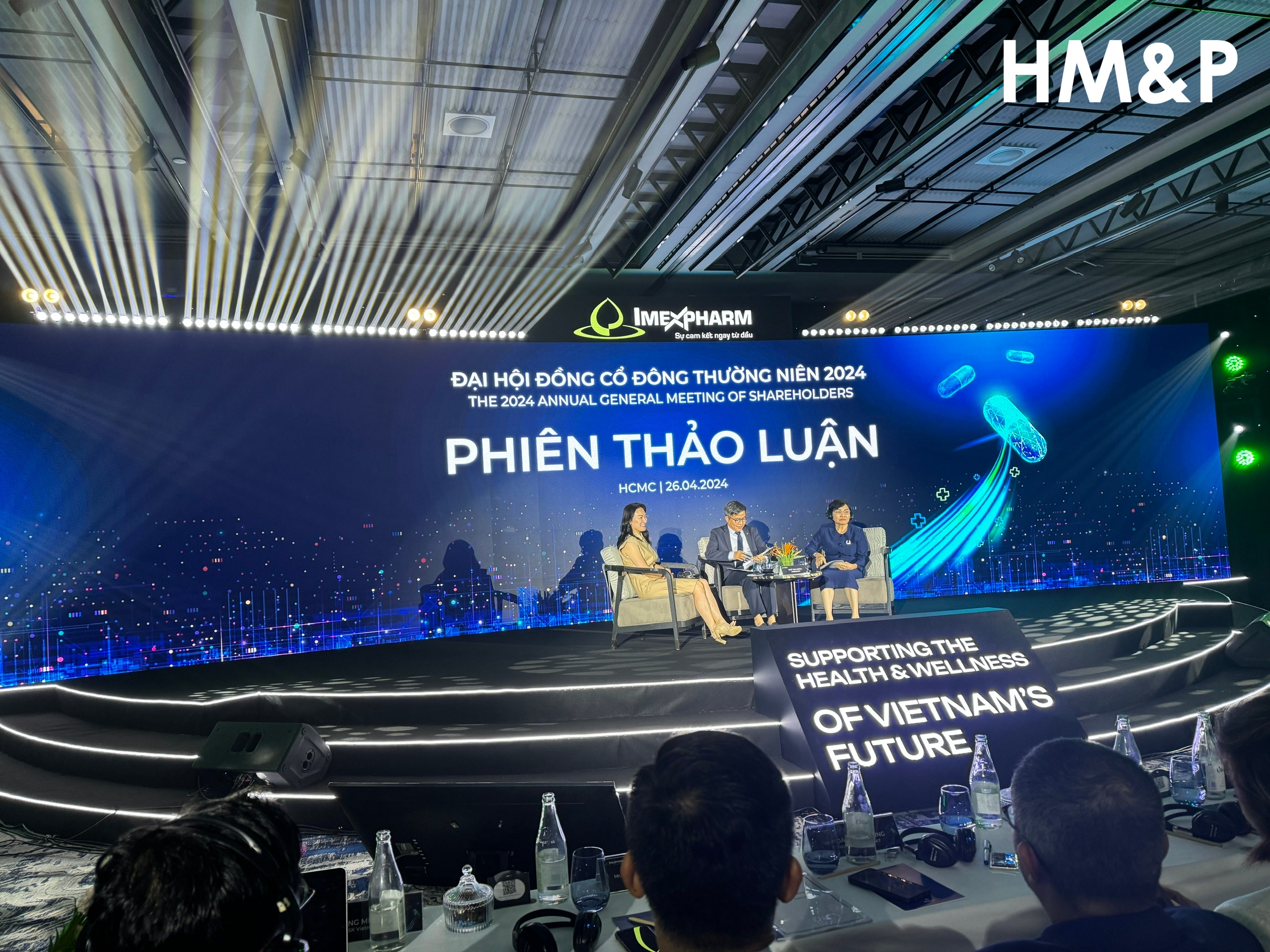
HM&P lawyers attended 2024 AGM of Imexpharm
Governance standards: Raising compliance requirements
Decree 245/2025/ND-CP also amends a series of regulations on the governance of public companies, including requirements for independent board members, the number of non-executive members, the reporting obligation of independent members, and the mechanism to control transactions with related persons.
These changes show a marked shift from a control-based governance model to an accountability-based governance model. The role of the Board of Directors no longer stops at the function of managing the strategy but must demonstrate the ability to independently supervise and protect the interests of shareholders.
Therefore, the 2026 AGM may become the time for enterprises to review the structure of the Board of Directors or amend the internal governance regulations to meet new legal requirements.
Charter Review: A key preparatory step
An issue that is often overlooked is the updating of the company's charter after the law changes. In fact, the charter is not automatically adjusted according to the new regulations, and in case there is a difference between the charter and the law, the enterprise may fall into the situation of applying regulations/processes that are no longer appropriate.
Therefore, the 2026 General Meeting of Shareholders season is the right time for enterprises to submit to shareholders for approval the amendment of the charter to synchronize with the new provisions of the amended Law on Enterprises 2025 and Decree 245/2025/ND-CP. Proactively updating the charter not only helps to reduce legal risks but also creates a stable foundation for long-term governance activities.
Overall, the legal changes from 2026 are aimed at improving transparency, increasing accountability and ensuring substantive shareholder participation in corporate governance activities. In this context, businesses preparing for the general meeting with a minimum compliance mindset may face many arising risks. On the contrary, businesses that proactively review processes, update charters and standardize documents according to new regulations will not only ensure the validity of the resolution but also strengthen investor confidence, which is increasingly decisive in the modern business environment.
Lawyer Nguyen Van Phuc -Lawyer Nguyen Nhat Duong
HM&P Law Firm
Read more: Mùa ĐHCĐ 2026: Doanh nghiệp cần chú ý gì?


