


Bank guarantees are often considered by businesses as the last layer of protection when the partner fails to fulfill their obligations. But having a letter of guarantee in hand does not mean that money is guaranteed. In many disputes, the deciding issue is not only whether the guaranteed party is in breach of contract, but whether the guarantee commitment is actually valid and whether the payment request meets the conditions of that commitment exactly.

The risk of a bank guarantee therefore does not arise only when the bank refuses to pay.
Judgment No. 184/2020/KDTM-PT dated 17/9/2020 of the Hanoi People's Court[1] (Judgment 184) shows that risks can appear right from the issuance stage: letters of guarantee and renewal documents are reviewed for jurisdiction, process and authenticity. A guarantee that seems to exist may not create payment obligations as the beneficiary expects.
The risk of a bank guarantee therefore does not arise only when the bank refuses to pay. It may have formed from the time the parties accepted a letter of guarantee with unknown conditions, did not verify the issuance, caused the guarantee term to deviate from the guaranteed obligation, or changed the underlying contract without simultaneously reviewing the guarantee commitment.
1. One transaction, three legal relations
Bank guarantee is a form of credit extension whereby a credit institution or foreign bank branch commits to the obligor to perform financial obligations on behalf of the obligor when this party fails to perform or insufficiently performs the committed obligations; the obligor must accept the compulsory debt and repay it to the guarantor as agreed.[2]
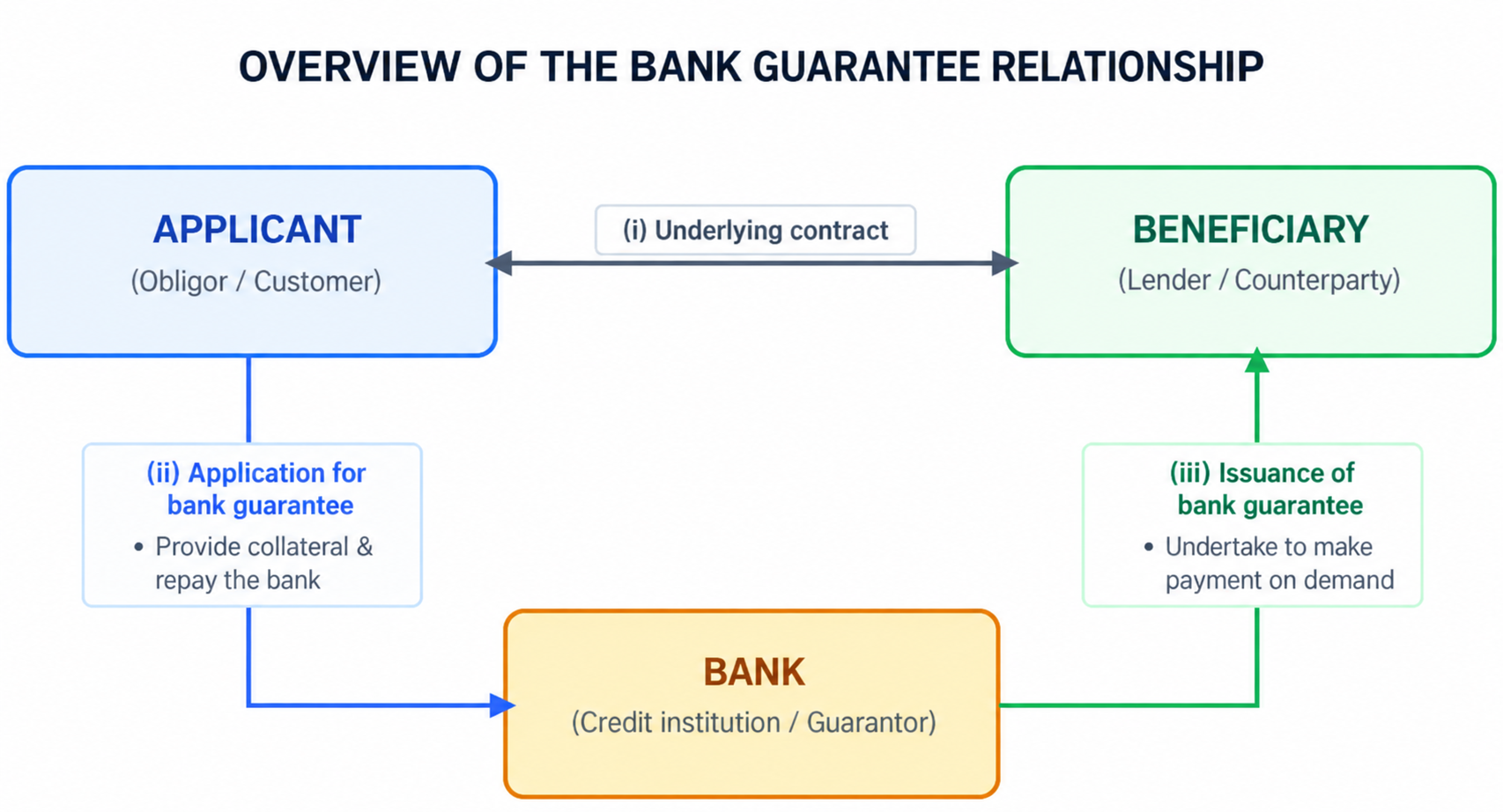
A bank guarantee transaction usually consists of three related but heterogeneous relationships: (i) the underlying contract between the guaranteed party and the guaranteed party; (ii) the guarantee agreement between the bank and the guaranteed party; and (iii) the guarantee commitment, usually expressed in a letter of guarantee, between the bank and the guaranteeee. It is this separation of these three relationships that helps explain why the dispute in the underlying contract does not automatically determine the bank's payment obligations.
2. Breach of contract is not enough for the bank to pay
It should not be implicitly equated with a bank guarantee with an unconditional payment commitment. Under what conditions the bank must pay depends first of all on the content of the guarantee commitment itself: conditions, documents, scope and duration of the payment request. Thus, the extent to which the bank's payment obligation depends on the underlying contractual relationship is in fact determined significantly by how the payment conditions in the guarantee commitment are designed.
A request for payment may not be accepted if it does not meet the conditions of the undertaking, is submitted after the validity period, exceeds the scope of the guarantee, or the dossier has authenticity issues. Therefore, it is necessary to distinguish three situations that are often entered into one: documents that do not match the requirements of the letter of guarantee; forged documents; and disputes over whether the guaranteed party has breached the underlying contract.[3]
Inappropriate documents are a problem of meeting the conditions of the commitment: lack of documents, wrong forms, wrong signatories or not presented on time.
Fake documents raise the issue of authenticity. This is a more serious problem and should not be equated with the bank only suspecting the transaction or with a commercial dispute between the parties.
The fact that the guaranteed party claims that it does not violate the underlying contract is another dispute. If the letter of guarantee does not set the settlement of the dispute as a condition of payment, the dispute of the underlying contract should not be taken for granted as an alternative basis for examining the claim under the guarantee commitment.
This distinction has practical significance: having a commercial basis to request payment does not necessarily mean having the right to ask the bank to pay according to the letter of guarantee. Enterprises can still fail if they do not meet the correct mechanism for calling for guarantees; on the contrary, banks should not turn the examination of documents into the adjudication of all disputes of the underlying contract.
The risk is particularly high when the letter of guarantee uses general conditions such as "when the guaranteed party breaches the contract" but does not specify the type of breach, supporting documents, the form of the request, or the time of presentation. A seemingly flexible clause can become a point of contention when each party has a different understanding of the terms of payment.
In addition, the bank is only liable to the extent of the amount and obligation guaranteed. Penalties, interest, or damages can only be claimed within the scope of the truly comprehensive guarantee undertaking. Similarly, the underlying obligation that exists does not automatically extend the validity of the guarantee letter.
The major risk often lies in the "deviation" between the underlying contract and the letter of guarantee: the contract is extended but the guarantee is not extended; the contract value changes but the guarantee limit remains the same; or the subject, obligations and documents of the transaction have changed but the guarantee commitment has not changed accordingly.
Therefore, a tight letter of guarantee at the time of issuance is not enough; the compatibility between the guarantee and the underlying contract must be maintained throughout the transaction lifecycle.
3. When the transaction changes but the guarantee does not change according to
3.1. Risks of jurisdiction, issuance and authenticity
A more serious risk than the inappropriate application for guarantee is that the document takes the form of a letter of guarantee but the issuance or renewal has problems of authority, process or authenticity. The question must then be asked before the payment obligation: has a valid bank commitment really been established?
Judgment No. 184 cited above is a notable example. In this case, the beneficiary requested the bank to fulfill its obligations under the letter of guarantee and the renewal documents. The bank argued that the signatory exceeded the scope of its jurisdiction; the case file also shows issues related to transaction documents, recording on the system, and guarantee fees. The court considers these factors and determines that the letters of guarantee do not give rise to the bank's payment obligations.
The lesson from the case should not be interpreted in the direction that the beneficiary must self-examine the entire internal process of the bank – something that a third party is often incapable of doing. The risk lies in the asymmetry of information: the beneficiary must rely on the bank's commitment but it is unlikely to fully examine the internal process that created it. A more practical solution is to verify the authenticity and validity of the letter of guarantee through the bank's official channel before performing the important obligation based on the guarantee.
For high-value transactions, verification should be done in a traceable manner, with a minimum of reference number, issuer, value, duration and validity. This is not a way to eliminate all internal risks of the bank, but it helps the beneficiary to create evidence that the commitment has been verified before relying on the guarantee.

The guarantee should not be managed as a one-time receipt document and then kept on file
3.2. Risks when changing or transferring beneficiary rights
An easy point to overlook is that the underlying contract can be changed but the bank's independent commitment does not automatically change accordingly. According to Judgment No. 03/2025/KDTM-PT dated 28/03/2025 of the Kien Giang Provincial Court[4], the initial beneficiary right (receiving the guarantee) is transferred from SSG to REEME and the bank issuing the amendment letter, showing that identifying the right to request payment can become the central issue of the dispute.
In practice, it is necessary to distinguish between the transfer of the underlying contract, the transfer of rights arising from the underlying contract, the change of the beneficiary in the letter of guarantee and the transfer of the right to request payment under the guarantee commitment itself. These acts are related but not necessarily homogeneous. Therefore, any changes in the beneficiary, value, term or conditions of payment should be reconciled with the guarantee commitment and, when necessary, noted by the bank in an appropriate amended document.
4. Guarantee management as a fixed-term financial right
The guarantee should not be managed as a one-time receipt document and then kept on file, but as a conditional and time-limited financial right. When receiving a letter of guarantee, the beneficiary needs to check four core issues: authenticity and authority of issuance; the scope and amount of the guarantee; conditions, documents, and methods of requesting payment; validity period.
Each significant change of the underlying contract – in terms of term, value, subject matter or obligation – should therefore simultaneously trigger a review of the letter of guarantee and, if necessary, complete the amendment before the business can continue to rely on the guarantee.
Similarly, the preparation of the bail call must begin early enough before the expiration date. A commercially based request may still be inability to be fulfilled simply because the application is not signed, submitted, or completed in the committed time and form.
The value of a guarantee does not lie in the fact that the business has a document called a "letter of guarantee" in its hands, but in its ability to convert that commitment into payment when a risk occurs. The gap between the two is sometimes just an invalid signature, a missing document, a vague payment term, or an omitted expiration date. Therefore, guarantee management must start from the time of contract negotiation, continue throughout the transaction lifecycle, and should not wait until the business needs to call for a guarantee.
[1] https://thuvienphapluat.vn/banan/ban-an/ban-an-1842020kdtmpt-ngay-17092020-ve-tranh-chap-hop-dong-bao-lanh-149595, accessed on 01/10/2026.
[2] According to Article 4.2 of the Law on Credit Institutions 2024 and Article 3.1 of the Consolidated Document No. 102/2026/VBHN-TT-NHNN.
[3] Article 22.1, Article 27.7 of the Consolidated Document No. 102/2026/VBHN-TT-NHNN.
[4] https://congbobanan.toaan.gov.vn/2ta1818640t1cvn/chi-tiet-ban-an, accessed on 01/10/2026.


