


As personal data protection becomes more and more part of corporate governance, the question for many businesses is no longer simply whether or not a Data Protection Officer (DPO) is needed. The more difficult question is: What will the DPO actually do and what model can help businesses manage data effectively instead of just meeting a compliance requirement on paper?
An effective DPO must understand where the data is going, who is accessing it, what the data is being used for, who it is shared with, and at what point risks may arise.
This is also the reason why outsourced DPO services are increasingly interested. Instead of immediately building a dedicated department with significant personnel costs, businesses can use external professional resources to monitor compliance, advise on data processing activities, and act as a focal point in arising issues related to personal data.
However, outsourcing DPO is not simply about "hiring one person in your name". The value of this model depends significantly on the capacity of the service provider and, more importantly, how the DPO is integrated into the actual operation of the business.
It is also the point that HM&P chooses to bring value to customers as well as differentiate its services.
DPO is not a title to "qualify"
An effective DPO must understand where the data is going, who is accessing it, what the data is being used for, who it is shared with, and at what point risks may arise.
From this perspective, HM&P does not design DPO as a single service. DPO is placed in the overall data compliance system of the enterprise, in addition to developing internal policies, assessing the impact of processing personal data, assessing the impact of data transfer abroad, reviewing data processing agreements, training and dispute resolution. The DPO service also has the support of the technical team in reviewing and evaluating the existing technical security measures of the enterprise.
From legal compliance to practical operability
A well-drafted data protection policy does not necessarily create a good data protection system. The gap between "having a policy" and "implementing the policy" is one of the biggest challenges of data compliance. A business may have a complete set of documents but personnel do not know how to handle it when a customer requests to withdraw consent; the marketing department still uses the data for a new purpose without assessing the processing facility; or the technology provider has access to the data but the responsibilities between the parties are not clearly defined.
Therefore, HM&P identifies an important principle in its data protection service: compliance must be tied to the actual operation of the business.
Instead of applying the same model to all clients, consulting and training activities are designed based on real processes. At the same time, HM&P builds DPO services in the direction of customization, practical implementation and statutory compliance.
This is especially important because no two businesses have the same "data map". A manufacturing enterprise, a technology company, a securities company or an investment service provider may be subject to legal requirements for the protection of personal data, but the type of data, the scale of processing, the purpose of use and the level of risk are completely different.
HM&P's experience is also shaped by providing data protection services to a variety of business groups, including U.S. semiconductor manufacturers, Australian technology companies, Japanese investment advisory firms, food manufacturers, and aviation businesses. In some cases, the scope of work includes not only DPOs but also internal policies, impact assessment records, and training.
It's this multidisciplinary experience that keeps DPOs from looking at data issues under a single template.
A DPO but not just one person behind it
This is perhaps one of the most notable differences of the HM&P model.
If a business hires an in-house DPO or hires an independent expert, the competency of the DPO function largely depends on the individual's knowledge and experience. Meanwhile, today's data problems are rarely confined to just one area of expertise.
A data incident can simultaneously raise questions about personal data protection, cybersecurity, contracts, labor, civil liability, and even disputes. A cross-border data transfer can simultaneously involve corporate structures, vendor contracts, cloud platforms, and compliance obligations in multiple countries.
Therefore, HM&P's DPO does not act as an independent individual in terms of professional resources. The DPO staff is supported by HM&P's team of lawyers, through which arising issues can be approached from a variety of legal angles. This is one of the four advantages that HM&P identifies for its DPO service.
More importantly, the current model also has a connection with IT, cybersecurity, and data teams to review and evaluate the technical security measures being applied by the business. This helps to bridge a common gap in data consulting: the gap between legal requirements and how the technology system actually operates.
Businesses therefore do not just hire the capacity of a DPO. Behind the DPO is a system of expertise that is likely to be mobilized when the problem becomes complex.
Not only looking at Vietnamese law
An FDI enterprise operating in Vietnam rarely only processes data within Vietnam.
HR systems can be located in Singapore; CRM can use the vendor's platform in the United States; financial data can be shared with the parent company; or the business's customers come from a variety of markets.
The DPO in these cases must understand the requirements of Vietnamese law but at the same time need to be able to place those requirements within a broader data governance system.
HM&P's DPO model is therefore built on the basis of reference to international standards and models, including the GDPR of the European Union and the PDPA of Singapore. The goal is not to apply foreign legal machinery to Vietnam, but to use relatively mature standards in data governance to support businesses to build a system that is compatible with cross-border activities.
This foundation is underpinned by HM&P's participation in international data and privacy expertise programmes. HM&P has attended Personal Data Protection Week 2025 and Singapore Data Festival 2026, participated in PDPC Singapore's training programmes, IAPP's professional activities, and expanded connections with international data technology partners. This is especially meaningful for FDI or Vietnamese enterprises that are expanding their operations into international markets.
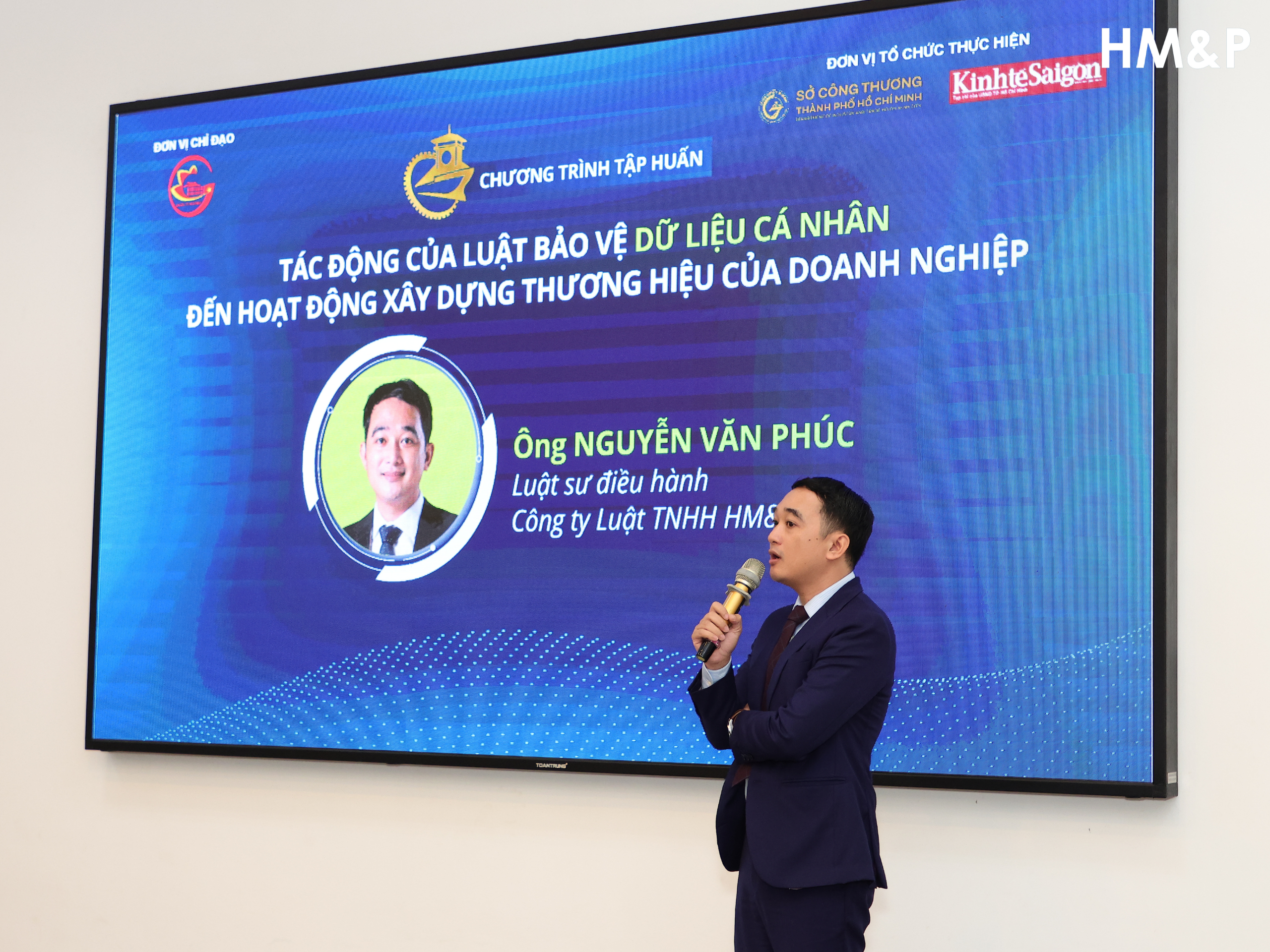
Managing Partner Nguyen Van Phuc provides in-depth insights on personal data during the corporate training session.
DPO must not only handle incidents, but must help businesses prevent incidents
If the DPO only appears when there is a complaint or data incident, the DPO function appears too late. An effective data management system must be able to identify risks before they turn into breaches. Therefore, the scope of HM&P's DPO includes coordinating with businesses to periodically review, assess compliance status, and propose improvement plans; support in developing policies and processes; advising on administrative procedures; handling arising issues; acting as a focal point with regulators and data subjects; and implementing internal training programs. This is also why training is considered an important part of the model. Data protection cannot be just the job of the DPO, legal department, or IT. The person who directly creates the risk is sometimes a marketing staff who uploads a customer list, the HR department sends the wrong record, or an employee who uses an AI tool without evaluating the data uploaded to the system.
A good DPO therefore does not replace everything for the business. A DPO must help businesses form their own compliance capacity.
Optimize costs but professional capacity is still guaranteed to be standard
The obvious advantage of outsourcing DPO is cost. Businesses do not necessarily need to hire a full-time dedicated person, but can choose the scope of services that suit their size and needs. HM&P identifies this as one of the advantages of the model: optimizing resources and controlling compliance costs.
But cost savings shouldn't be the only reason to choose an outsourced DPO. The greater value lies in the ability to simultaneously access multiple layers of competencies that an individual employee is unlikely to possess: legal expertise in data, compliance experience, operational understanding, technical support capabilities, and the ability to handle cross-disciplinary legal issues.
That's why HM&P is aiming for a longer-term goal: building internal compliance capacity so that the system can operate efficiently, reliably and sustainably.
The final difference lies in the way the DPO is looked at.
HM&P chooses to build its services on a combination of Vietnamese law, international governance standards, practical implementation experience, legal resources and technology support. More importantly, DPO is housed in a broader compliance ecosystem, from policies, contracts, impact assessments, training to incident and dispute handling.
After all, businesses don't need a DPO just to prove that they have a DPO. What businesses need is a mechanism to help data be processed correctly, risks are identified early, and responsibilities are clearly allocated throughout the operational process.
At that time, outsourcing DPO is no longer an alternative to hiring an additional person. It becomes a new governance model option for the new compliance requirements in Vietnam. And that is the value that HM&P aims for when providing this service.


