


HM&P's Managing Partner Nguyen Van Phuc and Legal Associate Nguyen Nhat Duong share HM&P's insight in The Saigon Times (No. 43-2023) on 26 October 2023. Below is the English version:
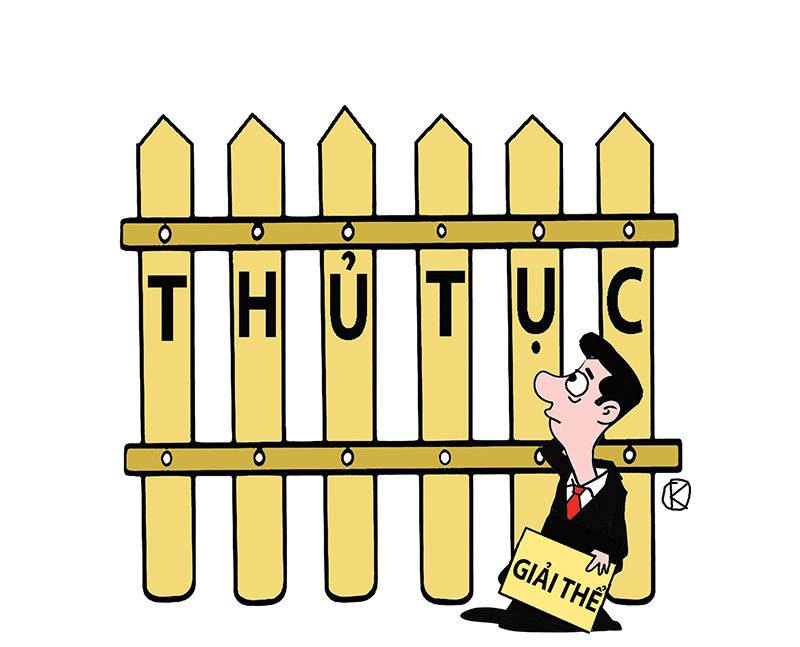
Company dissolution is a procedure that a company must follow when it wants to withdraw from a market. The current Law on Enterprises of Vietnam provides a number of cases in which enterprises must carry out procedures to register for dissolution. However, many regulations on dissolution of enterprises are still problematic, causing obstacles or even difficult to apply in practice. In this article, the author mentions the requirement to convene a meeting to decide on the dissolution of the company, which is one of the regulations considered as a barrier for companies in the process of implementing dissolution procedures.
Dissolution if the company no longer has the required minimum number of members
The Law on Enterprises 2020 stipulates that a company shall be dissolved if it does not carry out procedures to change the type of company when it no longer has the required minimum number of members for a period of six consecutive months.
This is a case that actually occurs quite often, for example, the case referred to in Judgement No. 09/2023/KDTM/-PT dated 23 February 2023 ("Judgement") on the settlement of a dispute over a capital contribution purchase agreement between the plaintiff, Ms. Lam Van A (“Ms. A”), and the defendants, Mr. Tran Phuc H (“Mr. H”) and Ms. Le Ngoc Duyen A1 (Mr. H’s wife)[1]. According to the contents of the decision, on August 10, 2016, L Gaming Company Limited ("Company L") was established with a charter capital of VND10 billion, including two members, Mrs. A (who committed to contribute VND07 billion, representing 70% of the charter capital of Company L) and Messrs. H (who committed to contribute VND03 billion, representing 30% of the charter capital of Company L). On August 30, 2016, Company L held a meeting of the Members' Council and then issued the Minutes of the Meeting of the Members' Council No. 08/2016/BB with all signatures of the members of Company L, including the content that Ms. A did not contribute capital to Company L.
On June 4, 2018, Mr. H and Ms. A entered into the Capital Contribution Purchase Agreement, accordingly, Mr. H transferred his entire contributed capital in Company L to Ms. A with a value of 02 billion VND. On that day, Company L issued a Members' Council Meeting Minutes with all the signatures of the members of Company L, further stating that Ms. A had not yet contributed any capital to Company L.
Pursuant In accordance with the law, Company L was issued an enterprise registration certificate on August 10, 2016, but as of June 4, 2018, Ms. A had not yet made the capital contribution, so Ms. A is automatically not a member of Company L from the time the capital contribution period expires (the capital contribution period is ninety days from the date of issuance of the enterprise registration certificate). At the same time, Company L must complete the procedures to reduce the charter capital and change the type of company from a multi-member limited liability company to a single-member limited liability company.
Sources: https://thesaigontimes.vn/
In fact, as of June 4, 2018 (more than six months after the end of the capital contribution period), Company L has not completed the above procedures. Therefore, in this case, Company L must proceed with dissolution according to Article 208 of the Company Law 2020. According to this provision, since the dissolution of the company stems from not having the required minimum number of members as prescribed in six consecutive months, the prerequisite procedure that must be carried out is to pass a resolution or decision to dissolve the company ("dissolution decision"). There are two issues arising from this dissolution resolution that need to be mentioned, as follows:
First, on the authority to adopt the dissolution resolution
According to the current regulations, the dissolution decision must be approved by the council of members for multi-member limited liability companies, by the general meeting of shareholders for joint stock companies, and by the owner for single-member limited liability companies[2].
For the mentioned case, the Company Law stipulates that if Ms. A has not contributed enough capital as promised, after the capital contribution period expires, she shall no longer be a member of Company L. Therefore, it can be reasonably understood that Company L then had only one member, Mr. H, becoming a single-member limited liability company, and Mr. H is the owner of Company L, regardless of whether Company L had not carried out procedures for converting the type of companies. The procedure for converting the type of company is merely an administrative procedure to help the management agency update changes in the company, and in this case does not affect the nature of Company L. In principle, the dissolution decision must be issued by Mr. H, the owner of Company L.
Second, about the signatures of some individuals on the dissolution resolution
Article 208 of the Law on Enterprises 2020 requires that the dissolution resolution must be signed by the owner of the company, the chairman of the members' council or the chairman of the board of directors. In the above case, this requirement can be met. Since Mr. H is now considered to be the owner of Company L, Mr. H's approval of the decision to liquidate Company L is obviously included in his signature on the liquidation decision. However, if we assume that Company L is a joint stock company with 03 shareholders registered to buy shares, including Mr. H, Ms. A and Mr. M, and Ms. A did not pay for the registered shares, but Company L has not carried out the procedure to change the type of company from a joint stock company to a multi-member limited liability company, Company L must carry out dissolution procedures. Similar to the argument in the section "Authority to adopt the dissolution resolution", under this circumstance, Company L's board of members must adopt the dissolution resolution. However, Company L has not yet carried out the procedures to change the type of company. Therefore, it is unclear whether Mr. H or Mr. M is the chairman of the company's board of members. In this case, would it be appropriate to require the signature of the chairman of the members' council?
Inconsistencies in the rules for convening the General Meeting of Shareholders

In addition to the above-mentioned case of dissolution, the Law on Enterprises also provides that the company shall be dissolved in case of revocation of the Enterprise Registration Certificate. Pursuant to the provisions of Clause 2 Article 209 of the Law on Enterprises 2020, within 10 days from the date of receipt of the decision to revoke the Enterprise Registration Certificate, the company shall convene a meeting to decide on dissolution. In the case of a joint stock company, the power to decide on the dissolution of the company is vested in the general meeting of shareholders. However, the time required for a joint-stock company to convene a general meeting of shareholders under the regulations is much longer than the above requirement.
In particular, in order to convene a general meeting of shareholders, the convener of a joint stock company must send an invitation to the general meeting of shareholders to all shareholders included in the list of shareholders entitled to attend the general meeting of shareholders at least 21 days before the date of the opening of the general meeting of shareholders (unless the company's articles of association provide for a longer period). Therefore, when considering the procedure for convening a general meeting, it is clear that the period for organizing a general meeting of shareholders of a joint stock company exceeds the period provided for in Article 209 of the Law on Enterprises 2020.
In Article 71 of Decree 01/2021/ND-CP, there are more specific instructions for the case of dissolution of the company due to the revocation of the Enterprise Registration Certificate. The instructions do not mention the convening of a meeting to decide on the dissolution of the company. However, as a matter of principle, priority is given to the application of legal documents with higher legal validity; therefore, in this case, the requirement to convene a meeting to dissolve the company within 10 days from the date of receipt of the decision to revoke the Enterprise Registration Certificate, as mentioned in the Law on Enterprises, still applies. In other words, Article 209 of the Law on Enterprises 2020 seems to contradict the provisions of this Law itself on convening a general meeting of shareholders in joint stock companies and cannot be applied in practice.
In addition to the difficulties and obstacles related to the procedures to be carried out, the legal provisions themselves are somewhat unclear and cause many difficulties for enterprises to understand and apply. With statistics showing that about 46,086 enterprises are awaiting dissolution procedures, an increase of 26.9% over the same period in 2022 (calculated in the first nine months of 2023[3]), it is obvious that not only market entry, but also market exit is an administrative procedure that needs to be accelerated. In order to achieve this, the review and improvement of legal regulations in a clearer direction is something that the relevant authorities must pay attention to and adjust accordingly.
Read the article at: Giải thể doanh nghiệp – vướng mắc từ chính quy định pháp luật
[1] https://congbobanan.toaan.gov.vn/2ta1138301t1cvn/chi-tiet-ban-an, accessed October 02, 2023.
[2] Point a Clause 1 Article 70 of the Decree 01/2021/ND-CP.


