


On June 4, 2024, the General Department of Taxation also promulgated official telegram No. 01/CD-TCT to check the tax declaration and payment for individuals who livestream sell goods. In this article, our Managing Partner, Nguyen Van Phuc will give some opinions on the tax management of livestream sales activities to match the reality. This article was published in The Saigon Times No. 27 - 2024, dated on July 04, 2024.
Nowadays, with the explosion of e-commerce, buying and selling goods has become more active than ever. Buying and selling goods on e-commerce platforms takes a variety of forms, and consumers are no longer unfamiliar with the form of organizing online sales by broadcasting real-time videos on social networking platforms (also known as livestream). Recently, there has been a lot of information about the livestream sales industry, which has achieved billions to hundreds of billions of Vietnamese dong in revenue, causing a stir in public opinion. This topic also raises many issues related to tax management of livestream sales income.

The nature of livestream sales activities
Livestream is a useful tool for individuals and businesses to sell faster. Currently, individuals and companies can organize livestreams to sell goods to consumers, or they can work with influencers (KOLs) or key consumers (KOCs) to conduct livestream sales sessions. This activity is becoming increasingly popular on e-commerce platforms as well as social networking sites, and creates many difficulties in terms of government management, especially in terms of tax management.
The image of KOLs and KOCs selling via livestream is no longer strange. However, these individuals are often not direct sellers on social networks or e-commerce platforms. Their role is to interact with followers on livestreams to promote "closing deals" for brands. These individuals are typically not the ones who purchase goods to sell, nor are they the entities that directly deliver products to consumers. In fact, the income of KOLs and KOCs is paid by being "booked" and commissions are based on the value of successful orders. It can be seen that this is an activity with the purpose of introducing products and brokering sales, not directly selling goods to buyers.
In an era where e-commerce is booming, livestreaming is increasingly scaling up, both in terms of the number of participants and the revenue generated for brands. Recently, there have been livestream sessions that have generated tens to hundreds of billions of Vietnamese dong in revenue. Although it has not been determined whether these revenue figures are real or fake (as they may include fake orders or cancellations and refunds), this phenomenon has raised questions about tax management. In official telegram No. 01/CD-TCT, the General Department of Taxation has instructed local authorities to check and control the tax declaration, payment and use of e-invoices by organizations, household businesses, individuals engaged in e-commerce, trading on e-commerce trading floors, affiliate marketing and livestream sales. This shows that livestream sales activities are growing rapidly and tax management related to these activities is a "hot" issue.
Income of livestreamers from tax law perspective
The income of livestream sellers, KOLs, and KOCs may be subject to different tax rates and types. For individuals who have not registered as a business household, this income may be considered as taxable income from salaries and wages, and the tax rate applied to this type of income is based on the 7-step progressive tax scale according to the Law on Personal Income Tax. For individuals registered as business households, if they receive income, such income is considered income from business activities. The income of individuals with registered business households may benefit from lower tax rates compared to the tax rates applicable to the income of individuals without business registration. According to Appendix I of Circular 40/2021/TT-BTC, which provides guidance on value-added tax (VAT), personal income tax and tax management for business households and individual enterprises, the tax rate for the distribution of goods may be either 1.5% or 7% for the activities of KOLs and KOCs.
At present, tax management for individuals engaged in livestream sales faces many difficulties. There are many reasons for this, but according to the author, the difficulty in tax management for individuals engaged in livestream sales is due to the following 03 main reasons:
First of all, most of the subjects participating in livestream sales, or KOLs, KOCs, are individuals. These subjects have not paid proper attention to tax issues or have not mastered tax regulations, as these issues are quite complex. Therefore, these subjects often find themselves in situations where they violate tax management regulations, resulting in tax arrears and other tax sanctions[1].
Secondly, personal income from livestreaming sessions has become a new and prominent issue in recent years. As a result, the Tax Administration Law does not contain specific provisions on providing information on livestream participants of e-commerce platforms. As we all know, e-commerce platforms are a hub and gateway connecting brands, KOLs, KOCs and consumers. As such, these entities have the most comprehensive understanding of information about brands, products, and the KOLs and KOCs involved in livestream sales. Therefore, e-commerce platforms can participate in collecting and providing information to tax authorities about individuals selling their products via livestream or KOLs and KOCs involved. However, current laws only require e-commerce platforms to provide information about sellers through the platform's online ordering function[2].
Thirdly, there are many difficulties in tax management for livestream activities, personal buying and selling of goods on social networking platforms. This is because the law does not have specific regulations on tax management for these individuals. In addition, some social networking platforms have not established a commercial presence in Vietnam, which makes it difficult to provide information. Tax authorities can access information on social networking platforms and request livestreamers to provide bank statements, as well as information on the use of shipping services, to require individuals who livestream to pay[3]. However, this solution is difficult to apply on a large scale, even if tax authorities require bank statements, it is still difficult to determine which banking transactions are business activities and which are not (other civil transactions).
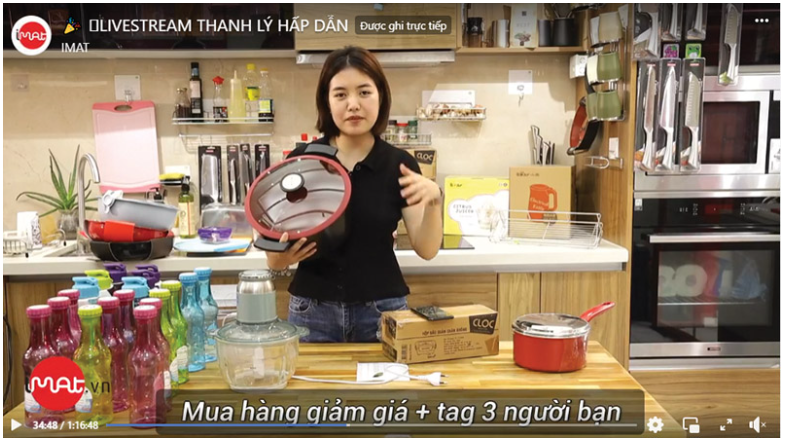
(Source: The Saigon Times)
Tax management for livestream activities - which solution is suitable?
To make tax management of livestream activities effective, according to the author, the main solution is to strengthen the management role and coordination of e-commerce platforms and related units.
Firstly, e-commerce platforms can declare and pay taxes on behalf of livestream individuals. At present, the Ministry of Finance is proposing to amend legal regulations, which will require e-commerce platforms to declare and pay taxes on behalf of individuals who conduct business on the platform (including livestream activities). As a result, e-commerce platforms will act as the focal point for declaring and paying taxes for thousands of individuals. In our view, this proposal is reasonable because the tax filing and payment rules are very complex issues for an individual to understand and implement. In addition, individuals selling live streams often sign contracts with many different brands, making it difficult for these individuals to file and pay taxes. E-commerce platforms with human and financial resources can help tax authorities as well as individuals with livestream activities to manage, declare and pay taxes.
Secondly, it is possible to take advantage of the central role of e-commerce platforms, and supplement the regulations to provide information about livestreamers of these platforms. E-commerce platforms, as focal points and intermediaries between parties in e-commerce activities, may have information about the parties' activities during the livestream. Therefore, it is possible to amend e-commerce regulations to allow e-commerce platforms to require brands to register information about KOLs and KOCs participating in livestream sessions on the accounts of these brands. At the same time, it is necessary to add regulations that e-commerce platforms must provide information about live streamers, participating KOLs and KOCs to the tax authorities. From there, tax authorities can understand the status of these individuals' livestreaming activities on e-commerce platforms.
Thirdly, tax authorities need to effectively coordinate with social media platform providers, information technology companies, transmission companies, network infrastructure providers, etc., to exchange, collect and have information on individuals who sell through livestream on social media in order to carry out tax inspection and collection. This is a measure that tax authorities can temporarily apply to manage individuals who sell through livestream on social networking platform.
In conclusion, livestream sales activities are increasing both in terms of participants and revenue generated. This raises many concerns in the personal income tax management of individuals who livestream sales, as well as KOLs and KOCs who participate in livestreams. To solve this problem, it is necessary to promote the role of intermediaries for livestream activities, such as e-commerce platforms, social networks, telecommunication service providers, etc. Therefore, the addition of legal regulations that allow e-commerce platforms to declare and pay taxes on behalf of livestream individuals, will give the right to e-commerce platforms to collect and provide personal information (of livestream individuals) for government management agency, and coordinate with social network platform providers and information technology companies, transmission, network infrastructure provision. This is a necessary step in the near future.
Read more at: Quản lý thuế trong hoạt động livestream sao cho phù hợp?
[1] https://dantri.com.vn/lao-dong-viec-lam/vo-mong-nghe-tiep-thi-lien-ket-khi-phat-hien-no-thue-gan-1-ty-dong-20240510135402612.htm
[2] Clause 8, Article 27, Decree 126/2020/ND-CP, amended and supplemented by Clause 7, Article 1, Decree 91/2022/ND-CP


