


A drug is a preparation that is used for the prevention, diagnosis, treatment, alleviation of diseases in humans and regulation of human physiological functions[1]. Because the use of drugs has a direct impact on human health and life, the introduction and provision of drug information to consumers is strictly regulated and governed by many different legal documents. Drug enterprises and consumers must be aware that not all types of drugs are allowed to be advertised, drug advertising content must ensure some mandatory content according to regulations. Therefore, this article will provide drug enterprises with comprehensive legal provisions related to drug advertising to ensure that advertising is carried out in accordance with the laws.

1. General considerations for drug advertising
1.1 About restrictions on drug advertising
According to the law, pharmacy enterprises have the right to inform and advertise drugs[2] to consumers. However, drug enterprises should note that they are not allowed to advertise in the following cases[3]:
- Advertising drugs before obtaining approval on the advertising content from competent authorities or against the approved content ;
- Using a certificate not recognized by the Ministry of Health; using material benefits, the reputation of an organization or individual, symbols, images, positions, prestige, mails, letters of thanks to advertise drugs;
- Using clinical trial or preclinical trial results, or test results, bioequivalence study results not recognized by the Ministry of Health to advertise drugs.
Accordingly, knowing the regulations that are not allowed to be advertised in this case will help enterprises to avoid administrative fines that each violation can be fined from 60,000,000 VND to 80,000,000 VND, respectively[4].
1.2 About the conditions for advertising drugs
i. Conditions on advertised drugs
According to the provisions of Clause 2 Article 79 of the Law on Pharmacy 2016, advertised drugs must meet all of the following conditions[5]: a) It is on the list of over-the-counter (OTC) drugs; b) It is not restricted in use or subject to medical supervision as recommended by a competent authority; c) Its certificate of free sale is unexpired in Vietnam.
From the content of the above regulations, it can be seen that OTC drugs are not allowed to be advertised, this has also been stipulated in the Law on Advertising[6] because if they are not used according to the prescription instructions, they can be dangerous to our life and health. In addition, it should be noted that OTC drugs, which are recommended by the competent state authorities to limit the use or use under medical, are still prohibited from advertising[7].
Obviously, drugs are prohibited from advertising shall be in cases that have a major impact on the health of the patient, so it must be monitored, indicated and prescribed by a doctor, as well as having a valid circulation period to ensure that drugs are circulated on the market in accordance with the provisions of law and used safely, quality efficiency. Therefore, if violations of regulations on advertised drug conditions, enterprises may be subject to a maximum administrative penalty of up to 140,000,000 VND[8].
ii. Conditions for licenses related to advertising of medicinal products
As mentioned above, advertised drugs must have Certificate of free sales issued according to the Law on Pharmacy, so that State authorities have facilities to determine drugs in circulation to ensure the provisions of law and safety of use. Therefore, in case that enterprises advertise drugs that have not been issued such certificate, or the certificate is expired, it may be subject to an administrative penalty of up to 80,000,000 VND[9]. It should be noted that drug advertising content must also ensure compliance with the above issued certificate, otherwise, a penalty of 40,000,000 VND to 60,000,000 VND will be imposed on the violating enterprise[10].
After that, enterprises wishing to advertise drugs must apply for a Certificate of drug advertising content because drugs are classified as special goods and products under the Law on Advertising[11], so the advertising of these products is done only after being confirmed by the competent State authorities[12].
Certificate of drug advertising content will be issued in case the drug advertising content applies for the first certificate; or content of drug advertising that has been granted certificate but has changed drug registration applicant, drug names, ingredients, concentrations or contents, dosage forms, indications, contraindications, dosages, use of drugs on special objects, information related to drug warnings and safety[13]. Thus, related to this certificate, enterprises must understand the regulations and strictly comply with approved advertising content to avoid the risks of administrative penalties, for example, a penalty of 40,000,000 VND to 50,000,000 VND for acts of advertising drugs without having the content approved by competent State authority prior to implementation prescribed advertising[14]; or a penalty ranging of 60,000,000 VND to 80,000,000 VND for advertising drugs contrary to the advertisement content certified by a competent State authority; advertising drugs within the period of processing of applications in accordance with regulations; advertising drugs using registered information brochures that have been expired[15].

2. Considerations regarding the content of drug advertisement
2.1. Drug advertising content regulations
Currently, the content of drug advertising is strictly regulated and controlled by the guidance document of State authorities to ensure that drug information advertised to consumers must be clear and transparent to as not to cause any confusion to users. Accordingly, Decree 54/2017/ND-CP has stipulated specific requirements for drug advertising content and content and images not used in advertising in Articles 125 and 126 as follows:
|
General requirements for drug advertising content |
|
|
Content requirements |
The contents must include:
|
|
Presentation format requirements |
|
|
Other relevant requirements |
|
|
Specific requirements for each form of advertising |
|
|
Drug advertisements in audio and video |
|
|
Advertisements in online newspapers, websites, electronic devices, advertising screens and other advertising media |
|
|
Drug advertisement through outdoor advertising media |
Only appear on the same 01 side of the advertising media and must include the information in items No. (1), (2), (9), (10) and (11) above. If the advertising content includes information related to the uses, effects and indications of drugs, it is mandatory to include all information as prescribed in the “Content requirements” section above. |
|
Information and images are not used in drug advertising content |
|
|
|
Compared with other conventional products or products subject to registration with the Ministry of Health such as functional foods and cosmetics, it is crystal clear that the advertising content of drugs is especially strictly regulated by the State. For consumers, it should be understood that due to the characteristics of drugs, advertising will be very strictly controlled, knowing the requirements related to drug advertising content is also a way to distinguish the current proliferation advertisements “real” or “fake” by complying with the above mandatory regulations.
2.2. Registration of drug advertising content
As analyzed, in order to advertise drugs, enterprises shall first carry out procedures to obtain approval of advertising content from the competent State management authority. If drugs meet the advertising conditions and content, according to the guidance in Article 127 of Decree 54/2017/ND-CP, enterprises shall submit application for a Certificate of drug advertising content to the Ministry of Health, specifically the Drug Administration of Vietnam. The consideration and issuance of this certificate, as prescribed in Article 79 of the Law on Pharmacy 2016, shall be carried out within 15 days from the date on which the satisfactory application for approval of drug advertisement contents is received by the Ministry of Health. If the application is rejected or the advertisement contents need to be revised, the Ministry of Health shall provide an explanation in writing.
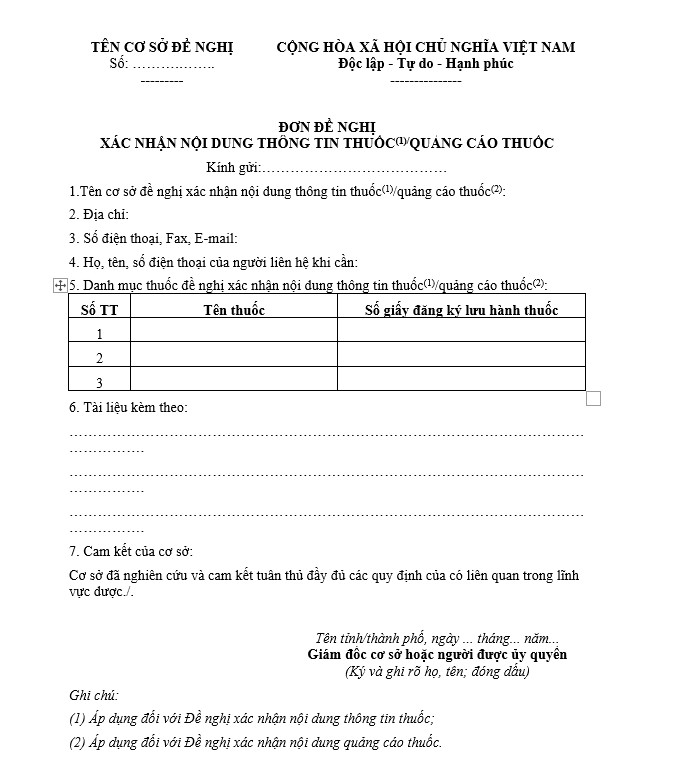
Another point to note that, at present, the regulations concerning the reissuance of the drug advertisement content certificate have been abolished.
Instead, according to the Article 129a of Decree 54/2017/ND-CP, as amended and supplemented by Decree 155/2018/ND-CP, if the information on such certificate is incorrectly recorded due to the fault of the competent authority, the enterprises shall send a written notice to that authority, clearly stating the incorrect contents to be corrected. Upon the receipt of the written notice, the authority shall return to the enterprise the Receipt of written notice of drug information, advertising to be corrected. Thus, the enterprises shall then be allowed to conduct drug advertising according to the corrected content and responsible for the corrected contents.
In addition, in case the certificate of drugs advertising content has changed but does not fall into the cases that need to be register new certificate mentioned in Section 1.2.ii of this Article, according to Clause 2 Article 129a of Decree 154/2017/ND-CP, enterprises shall send a written notice to the competent authority of the adjusted content. After that, enterprises are automatically adjusted and responsible for the content of adjusted drug information and advertising without registering a new certificate.
In principle, the regulations on drug advertising and the procedures for advertising registration have been clearly stipulated in terms of content, application, and order of implementation. Enterprises should note that they must ensure that drugs are eligible for advertising and that the advertising content is regulated as analyzed above. Simultaneously, after the advertising content has been approved, enterprises must abide by it, because the content approval is only a procedure for initial control, and for products that directly affect the safety and health of consumers such as drugs, the control over the proper implementation of the law is very strictly regulated. If enterprises improperly advertise approved content and violate the provisions of the law, they will still bear the risk of their violations.
[1] Clause 2 Article 2 of the Law on Pharmacy 2016.
[2] Point c, Clause 1, Article 42 of the Law on Pharmacy 2016.
[3] Clause 10 Article 6 of the Law on Pharmacy 2016.
[4] Points b, c and dd Clause 4 Article 50, Clause 2 Article 5 of Decree 38/2021/ND-CP dated 29 March 2021 prescribing penalties for administrative violations involving cultural and advertising ("Decree 38/2021/ND-CP").
[5] Clause 27 Article 2 of the Law on Pharmacy 2016 stipulates: “OTC drug (over the counter drug) means a drug that may be dispensed, retailed, and used without a prescription on the list of OTC drugs promulgated by the Minister of Health.”
[6] Clause 5 Article 7 of the Law on Advertising 2012.
[7] Clause 5 Article 7 of the Law on Advertising 2012.
[8] Point d Clause 1 Article 33, Clause 2 Article 5 of Decree 38/2021/ND-CP.
[9] Point e Clause 4 Article 50, Clause 2 Article 5 of Decree 38/2021/ND-CP.
[10] Clause 3 Article 50, Clause 2 Article 5 of Decree 38/2021/ND-CP.
[11] Point a, Clause 4, Article 20 of the Law on Advertising 2012.
[12] Clause 1 Article 12 of Decree 181/2013/ND-CP dated 14 November 2013 details the implementation of a number of articles of the Law on Advertising ("Decree 181/2013/ND-CP").
[13] Clause 1 Article 120 of Decree 54/2017/ND-CP dated 08 May 2017 details a number of articles and measures to implement the Law on Pharmaceutical ("Decree 54/2017/ND-CP").
[14] Clause 1 Article 49, Clause 2 Article 5 of Decree 38/2021/ND-CP.
[15] Point dd Clause 4 Article 50, Clause 2 Article 5 of Decree 38/2021/ND-CP.


