


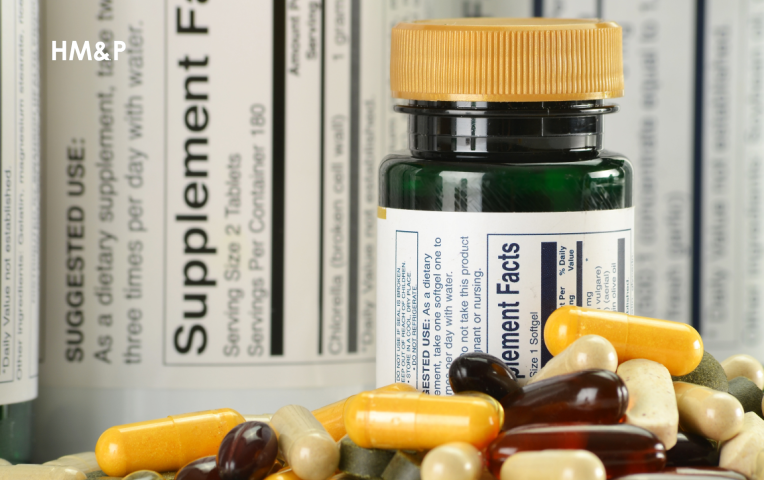
Functional foods are special commodities and products under the management of the Ministry of Health, which means that advertising for this type of goods is subject to stricter regulation and supervision by the Government authorities. Currently, with the proliferation of functional foods advertising, consumers are finding it increasingly difficult to distinguish between “real” and “fake” claims in each advertisement. This situation may also have an impact on legitimate businesses. In our role as legal advisors, HM&P would like to provide essential considerations for enterprises involved in the trade of functional foods with essential considerations for their advertising activities.
1. Legal regulations on functional foods advertising
According to Clause 23, Article 2 of the Law on Food Safety 2010, it is defined as follows:: “Functional food is a food that is used to support a function of the human body, relax the body, strengthen the immunity against diseases, including food supplements, health protection food, and medically nutritious food”. Based on Point a, Clause 3 Article 1 of Circular 09/2015/TT-BYT[1], functional food is a type of commodity, food additive, and special product that falls under the management of the Ministry of Health.
Furthermore, according to Article 7 of the Law on Advertising 2012, functional foods are not included in the list of goods that are probihited from being advertised. As a result, advertising for functional foods is permitted as long as it complies with the relevant legal requirements.
Specifically, two decrees currently rregulate the advertising of functional foods, namely Decree 181/2013/ND-CP[2] and Decree 15/2018/ND-CP[3].
Decree 181/2013/ND-CP regulates the advertising activities of food and food additives (including functional foods, as mentioned above) regarding the content of functional food advertisements and the verification process of such content. Subsequently, Circular 09/2015/TT-BYT provides specific requirements for the verification of the content of functional food advertisements. However, this content was later abolished by Circular 25/2018/TT-BYT[4].
Prior to the effective date of Circular 25/2018/TT-BYT, Decree 15/2018/ND-CP, which details the implementation of a number of articles of the Law on Food Safety, provided more specific regulations on food advertising . In particular, foods such as health protection foods, medical nutrition foods, and foods for special dietary purposes are subject to mandatory registration on their advertising content prior to advertising[5].
In essence, advertising activities for functional foods are still governed by Decree 181/2013/ND-CP. However, the procedures for registering advertising content must comply with Decree 15/2018/ND-CP.
2. Special considerations for functional food advertising:
a) Advertising content Considerations
As aforementioned, when advertising functional foods, in addition to complying with the provisiontions of Article 27 of Decree 15/2018/ND-CP, enterprises must also comply with the provisions of Article 5 of Decree 181/2013/ND-CP, as illustrated in the table below:
|
No. |
Criteria |
Decree 15/2018/ND-CP |
Decree 181/2013/ND-CP |
|
1 |
Product Type
|
Health protection foods, medical nutrition foods, and foods for special dietary purposes. |
Functional foods include: food supplements, health protection foods, medical nutrition foods, and foods for special dietary purposes[6]. |
|
2 |
Reference basis for compliance |
Effects and functions of the products are specified in the product declaration. |
Certificates of conformity or certificates of compliance with food safety regulations |
|
3 |
Mandatory requirements |
It is required to have the text “Thực phẩm này không phải là thuốc và không có tác dụng thay thế thuốc chữa bệnh” (equivalent to “This food is not a medicine and does not replace medicines for treatment”), which must be clearly written and in a contrasting color to the background (applicable to health protection foods only).
|
The name of the functional food; the name and address of the organization or individual responsible for placing the product on the market; the main effects and possible side effects (if any); and the text: “Sản phẩm này không phải là thuốc và không có tác dụng thay thế thuốc chữa bệnh” (equivalent to “This product is not a medicine and is not a substitute for a medicineon”). |
|
4 |
Restrictions |
It is prohibited to use images, equipment, uniforms, names, documents of health care facilities, doctors, pharmacists, health care personnel, patient testimonials, articles of doctors, pharmacists, health care personnel to advertise functional foods. |
Functional foods shall not be advertised in a manner that could mislead the consumer into believing that the product is a medicine.
|
|
5 |
Other specific requirements |
For health protection foods, when advertising in audio and video advertisements, the warning “Thực phẩm này không phải là thuốc và không có tác dụng thay thế thuốc chữa bệnh” (equivalent to “This food is not a medicine and does not replace medicines for treatment”) must be clearly stated if the advertisement lasts more than 15 seconds. For advertisements with a duration of less than 15 seconds, this warning does not need to be read aloud but must be visibly displayed in the advertisement. |
Functional food advertisements in audio and video advertisements must clearly state the name of the functional food, its main effects and potential side effects (if any), and include the warning “Sản phẩm này không phải là thuốc và không có tác dụng thay thế thuốc chữa bệnh” (equivalent to “This product is not a medicine and is not a substitute for a medicine”). |
Enterprises must pay special attention when advertising health protection foods. The advertisement must include the warning “Thực phẩm này không phải là thuốc và không có tác dụng thay thế thuốc chữa bệnh” (equivalent to “This food is not a medicine and does not replace medicines for treatment”) and the text should be clear and have a contrasting color with the background. Meanwhile, for other types of functional foods, the warning “Sản phẩm này không phải là thuốc và không có tác dụng thay thế thuốc chữa bệnh” (equivalent to “This product is not a medicine andis not a substitute for medicine”) must also be included, with the written or spoken words being clearly visible and audible under normal conditions[7]. The purpose of these warnings is to ensure that consumers receiving the advertisement clearly understand that the advertised product is not a medicine and to avoid any confusion among the audience.
Compliance with these regulations will help enterprises avoid the risk of administrative penalties. For exampleẽ, advertising health protection food without including the warning “Thực phẩm này không phải là thuốc và không có tác dụng thay thế thuốc chữa bệnh” (equivalent to “This food is not a medicine and does not replace medicines for treatment”) or failing to clearly or correctly present it in the advertisement, may result in a fine ranging from 10,000,000 VND to 20,000,000 VND[8]. Similarly, advertising other types of functional foods creates confusion about their effects as medicines may result in a fine ranging from 40,000,000 VND to 60,000,000 VND[9].
.png)
b) Advertisement content registration
Currently, as mentioned above, advertising for health protection foods, medical nutrition foods, and foods for special dietary purposes requires content registration prior to advertising.
Businesses should note that the registration authority may vary depending on the type of product being advertised.
Specifically, in accordance with the provitions of Point a, Clause 5, Article 27 of Decree 15/2018/ND-CP, organizations or individuals with products to be advertised must submit a registration application for content approval to the authority that grants the certificate of registered product declaration.
In accordance with Clause 5, Article 37 of Decree 15/2018/ND-CP, the Ministry of Health is responsible for receiving and managing the registration applications, granting the Certificate of registered product declaration and the Certificate of advertising content for health protection foods. Therefore, in the case of advertising health protection food, enterprises must submit their registration application for content approval to the Ministry of Health, specifically to the Department of Food Safety – Ministry of Health.
Meanwhile, according to Clause 8 of Article 40 in Decree 15/2018/ND-CP, the provincial People's Committees are responsible for receiving and managing registration applications, granting the Certificate of registered product declaration and the Certificate of advertising content for medical nutrition products and foods for special dietary purposes. In practice, this responsibility is often delegated by the provincial people's committee to specialized government administrative departments, such as Food Safety Department or the Health Department, depending on each locality. Therefore, when advertising medical nutrition foods and foods for special dietary purposes, enterprises must submit their registration applications for content approval to these specialized authorities.
Another important point is that if an enterprise submits a registration application to the competent authority and it requires amendments or supplements, such amendments or supplements can only be made once and within a maximum period of 90 working days from the date of receipt of the official request for amendment or supplement. If the enterprise fails to make the required amendments or supplements within this time frame, the application will no longer be valid[10].
Currently, Decree No. 15/2018/NĐ-CP stipulates that if an enterprise advertises special products and commodities, including functional foods, without obtaining prior approval of the content from the competent State authority, it may be subject to administrative fines ranging from 40,000,000 VND to 50,000,000 VND[11].
In essence, the procedures for registering the advertising content of functional foods have been fairly well-defined in term of the process and the dossier that enterprises need to pay special attention to in the advertising content, including mandatory requirements and restrictions on what can be presented in advertisements. Furthermore, after obtaining the approval of the advertising content, enterprises must comply with the approved content strictly because the approval of advertising content is only a preliminary control measure. If the enterprise incorrectly advertises the approved contents and violates the regulations, the enterprise will still bear the risks of its violation.
[1] Circular 09/2015/TT-BYT dated 25 May 2015 stipulating the approval for contents of advertisements for special products, commodities and services under the management of the Ministry of Health.
[2] Decree 181/2013/ND-CP dated 14 November 2013 detailing the implementation of a number of articles of the Law on Advertising (“Decree 181/2013/ND-CP”).
[3] Decree 15/2018/ND-CP dated 02 February 2018 detailing the implementation of a number of articles of the Law on Food Safety (“Decree 15/2018/ND-CP”).
[4] Circular 25/2018/TT-BYT dated 28 September 2018 abolishing a number of legal documents in the health sector promulgated and jointly promulgated by the Minister of Health (“Circular 25/2018/TT-BYT”).
[5] Clause 1, Article 26 of Decree 15/2018/ND-CP.
[6] Clause 1, Article 1, Article 6, Article 13 of Circular 43/2014/TT-BYT dated 24 November 2014 regulating the management of functional foods mentions functional foods, including foods for special dietary purposes (“Circular 43/2014/TT-BYT”).
[7] Clause 2, Article 7 of Circular 43/2014/TT-BYT.
[8] Clause 1, Article 52 and Clause 2, Article 5 of Decree 38/2021/ND-CP dated 29 March 2021 on penalties for administrative violations in the field of culture and advertising (“Decree 38/2021/ND-CP”), amended and supplemented by Point a, Clause 15, Article 4 of Decree 129/2021/ND-CP dated 30 December 2021 amending and supplementing a number of articles of the decrees regulating penalties for violations administration in the field of tourism; sport; copyright and related rights; culture and advertising.
[9] Point b, Clause 4, Article 52 and Clause 2, Article 5 of Decree 38/2021/ND-CP.
[10] Point b, Clause 5, Article 27 of Decree 15/2018/ND-CP.
[11] Clause 1, Article 49, Clause 2, Article 5 of Decree 38/2021/ND-CP.


