


Mergers and acquisitions are an important strategy to help listed companies expand their scale, optimize resources, and strengthen their competitive position in the market. However, this process has many potential legal, financial and operational risks if not strictly managed through the merger contract. In this article, we will clarify the important legal notes that listed enterprises need to consider when drafting and executing a merger contract so that this procedure can take place smoothly and with little risk in practice.

Source: https://rb.gy/3bs9zv
1. Determining the status of the parties to the transaction
One of the fundamental elements of a merger contract is to ensure that both parties have the legal status and authority necessary to carry out the transaction. In which, the important factors that the parties need to note are:
Legal Status Check: Enterprises need to verify their business licenses, company charters, and relevant legal documents at the Department of Planning and Investment (now the Department of Finance) or the competent authority. This helps to avoid disputes over legal status, especially when one party may be facing issues such as debt or shareholder disputes.
Representation authority: It should be ensured that the individuals who sign the contract have valid authority, authorized by the Board of Directors (BOD) or the General Meeting of Shareholders (AGM). An error in the authorization can cause the contract to be voided.
Practice shows that listed enterprises often use in-depth legal advisors to thoroughly review and appraise legal status, ensuring that there are no potential disputes over ownership or legal obligations that the parties must perform during the merger process.
2. Transparent merger and valuation mechanism
The merger mechanism is the core factor, determining how the two businesses will merge. In the contract between the parties, the merger mechanism is often clearly stipulated. One of the important factors is to make appropriate valuations of the actual value of the business so that additional shares can be valued.
Fair valuation: The valuation of stocks and assets should be based on independent audit reports and accepted valuation methods. This ensures fairness for shareholders of both parties and avoids disputes later on.
Swap rate transparency: The swap rate should be clearly disclosed and approved by the General Meeting of Shareholders.
Enterprises should hire an auditing company or financial consultant to carry out the valuation, and at the same time publish transparent information on the Stock Exchange (HOSE) and the Vietnam Securities Depository (SEC).
3. Prerequisites and approval of regulatory agencies
The merger contract is only effective when the prerequisites are met, including approval from the General Meeting of Shareholders, the Board of Directors, and state regulatory bodies such as the State Securities Commission (SSC) on the issuance of shares and the National Competition Commission to ensure that the transaction does not violate the Competition Law on Economic Concentration.
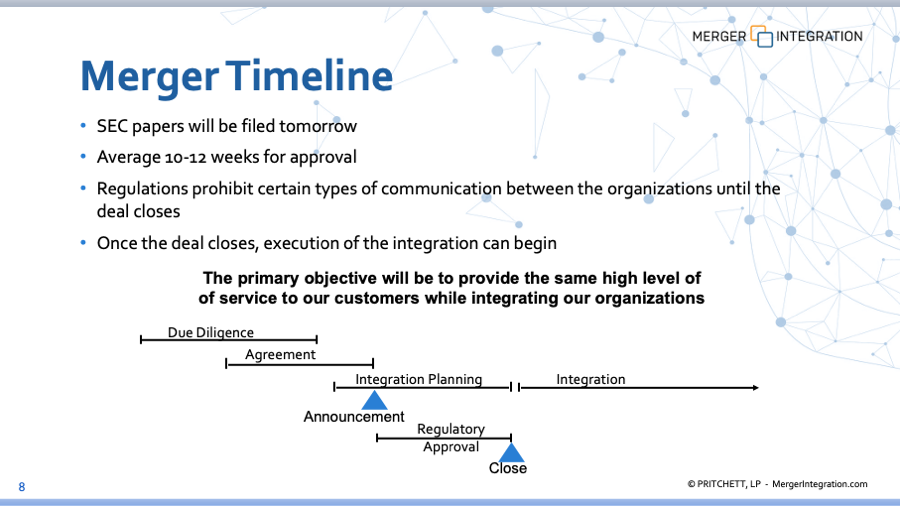
Source: PRITCHETT, LP
Approval from shareholders: The resolutions of the General Meeting of Shareholders must be duly approved, with the percentage of votes complying with the provisions of the Law on Enterprises of Vietnam in effect from time to time. This requires the enterprise to organize a transparent shareholders' meeting and provide full information about the merger plan.
Approval from the regulator: Listed enterprises must apply for a certificate of issuance of shares from the SSC and ensure compliance with regulations on economic concentration under the Competition Law 2018.
In order for the transaction to go smoothly and as desired by the parties, businesses need to make a detailed plan for the approval process, including the time to submit documents and process additional requests from regulators.
4. Transfer of assets, debts and employees
The merger process includes the transfer of all assets, interests, liabilities, and obligations from the merged company to the receiving company or the new company. In order for the transfer of these obligations to take place smoothly and limit the risks arising, the buyer needs to (i) Conduct a detailed and careful due diligence to accurately determine the value of the assets, liabilities, and potential legal obligations that may arise, such as undisclosed debts, disputes with employees. (ii) Transfer of labor contracts: the merging company or the new company must ensure the inheritance of the entire labor contract, employee benefits, and compensation (if any). Practice shows that businesses should make a detailed list of assets, liabilities, and labor contracts, and coordinate with the human resources and legal departments to handle issues related to transfer activities.
5. Other issues
Transaction information security
Information security is an important factor in the merger process, especially for listed companies with sensitive financial and strategic information. The parties may only disclose with written consent or as necessary for the purpose of the merger. Businesses need to ensure that information about strategy, finance, and business operations is not leaked, avoiding affecting stock prices or competitive interests. During the execution of the transaction, stakeholders, including employees, attorneys, and financial advisors, should sign an NDA to bind confidentiality responsibilities.
Restrictions on the issuance of new shares
In the period from the signing of the contract to the completion of the merger, both parties are restricted from issuing new shares, incurring additional debts, or entering into new contracts without the consent of the other party. These restrictions ensure that the value of both companies is not adversely altered during the merger, protecting the interests of shareholders. Therefore, any decision that affects the company's financial situation, operations, such as borrowing capital or signing value contracts, should be agreed to avoid affecting the merger transaction.
Conditions for termination or modification of the Contract
Usually in a merger transaction, the contract can be terminated if the prerequisites are not met, the law is violated, or the two parties mutually agree. Any amendments must be made in writing and with the consent of both parties. In order for the transaction to be successful, businesses need to prepare contingency plans, such as renegotiation or withdrawal, to handle force majeure situations that are beyond the control and prediction of the parties. Enterprises also note that any changes need to be clearly announced and approved by the Board of Directors or General Meeting of Shareholders to ensure legality.
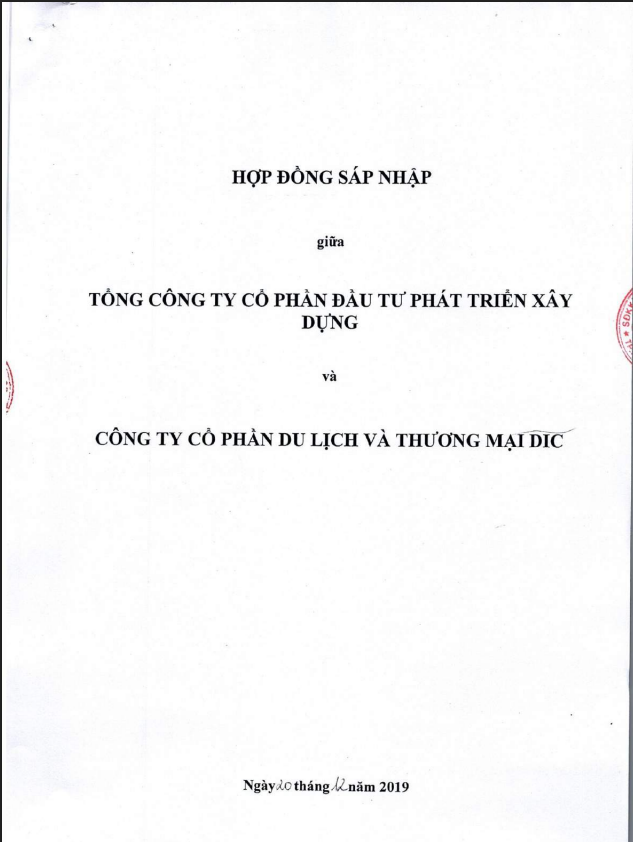
Image disclosed by the company
Manage trading documents and execute reports
The merger contract needs to require complete documentation such as a list of assets, liabilities, contracts, and audited financial statements. These documents are the basis for regulatory approval and integration after the merger. Financial statements and asset lists need to be independently audited to ensure accuracy and avoid the risk of errors or incomplete information. The transfer of all dossiers of the merged company must be transferred within the prescribed time to ensure the continuity of the operation of the enterprise after the completion of the merger.
A merger contract between listed enterprises is a complex document that requires thorough preparation and strict compliance with legal regulations. In Vietnam's unique legal and business context, coordinating with legal experts when preparing and executing the merger contract is key to the success of the deal in the merger transaction.


