


The Law on Recovery and Bankruptcy 2025 was passed at the 10th National Assembly session and will take effect from March 1, 2026[1], not only completing the legal framework in handling businesses in impasse and crisis, but will also feature new principles: prioritizing production recovery, business glasses of enterprises in order to create conditions for enterprises to "return" to the market when they are still able. This is the first time in legislative history that Vietnam has established the procedure for restoring business activities as an independent institution, which is relatively fully regulated, comprehensively and has a legal position equivalent to and in addition to bankruptcy procedures.

Deputy Chief Justice of the Supreme People's Court Nguyen Van Tien introduces the law. Source: Finance and Investment Newspaper
1. When will the business be restored?
The Recovery and Bankruptcy Law stipulates that one of the important principles is to prioritize the application of restoration procedures to enterprises and cooperatives (collectively referred to as enterprises).[2] In order for enterprises to apply recovery procedures, it is necessary to go through 2 stages: (i) the stage of requesting the opening of recovery procedures; and (ii) the stage of implementing the recovery plan. In particular, the stage of implementing the recovery plan will only be carried out after the Court has a decision to open the recovery procedure. Accordingly, the restoration procedure is opened when:
Firstly, the enterprise has a written request for the application of restoration procedures[3]
If the bankruptcy procedure is of the nature of "dealing with consequences" and terminating the operation of the enterprise, then the recovery procedure plays the role of prevention and early intervention, creating an opportunity for the enterprise to restructure its operations, restructure its finances and maintain its existence. The law grants the right to file a petition for reinstatement to entities including: (1) the legal representative; (2) internal management agencies corresponding to each type of enterprise; (3) the general meeting of members of the cooperative; as well as sole proprietorship owners and owners of single-member limited liability companies. Clear regulations help ensure legitimacy and unity of internal will when choosing the path of recovery.
Secondly, the petition is accepted by the Court[4]
The applicant must be responsible for the accuracy of the information, and at the same time provide complete core documents such as the business recovery plan, the list of creditors and debtors, accompanied by documents and evidence proving the financial status of the enterprise.[5] In addition, the obligation to pay the recovery fee and advance the recovery cost is a mandatory condition to ensure resources for the proceedings and recovery.[6] The Court conducts a screening and when the conditions are met, the Court announces the acceptance of the application and the formal reinstatement procedure is opened. After the Court accepts the petition, the enterprise or cooperative is not allowed to carry out a number of activities of the nature of asset dispersal[7] as well as must report to the asset management officer or asset management and liquidation enterprise for supervision before carrying out activities related to the business activities of the enterprise. cooperatives.[8] After the competent Court issues a restoration decision, the enterprise may apply the recovery plan.
Within 05 working days from the date of receipt of the plan for resumption of business operations, the Judge shall consider and decide to convene the creditors' meeting.[9] Creditors participating in the Conference will vote on the plan to restore business activities proposed by enterprises and cooperatives. The resolution of the creditors' meeting shall be adopted when the number of creditors representing 65% or more of the total debt of creditors participates in voting in favor and has mandatory effect for all creditors.[10]
Subsequently, within 07 days from the date on which the resolution of the Creditors' Meeting approves the plan for resumption of business operations, the Judge shall issue one of the decisions to recognize the resolution of the Creditors' Meeting. The resolution of the creditors' meeting approving the plan for resumption of business operations takes effect from the date the Judge issues the decision on recognition.[11] In addition, from the effective date of the resolution of the creditors' meeting, the prohibition and supervision measures applied to enterprises and cooperatives are automatically terminated.[12]
2. When is an enterprise allowed to go bankrupt?
The bankruptcy procedure of an enterprise is one of the legal procedures carried out to terminate business activities in an orderly manner. This procedure may be carried out under the ordinary procedure or the expedited procedure if it is considered that the nature and size of the small business or the nature of the case is not complicated.[13]
According to regulations, when the enterprise is insolvent[14] and the person with the right and obligation or the competent state agency files a petition for the application of bankruptcy procedures[15]. At this time, the Judge accepting the case has the right to make a decision on whether or not to open bankruptcy procedures[16]. This decision does not take effect immediately and may be changed after a request for reconsideration or a petition with a previous decision. This is the first step for the Court to examine and evaluate before officially making a decision to declare bankruptcy for the enterprise. From the time of opening procedures until there are grounds for the decision to declare bankruptcy, a series of other procedures are carried out such as supervising business activities, changing the legal representative if requested, determining interest on the debt of the enterprise, etc organizing creditors' conferences.
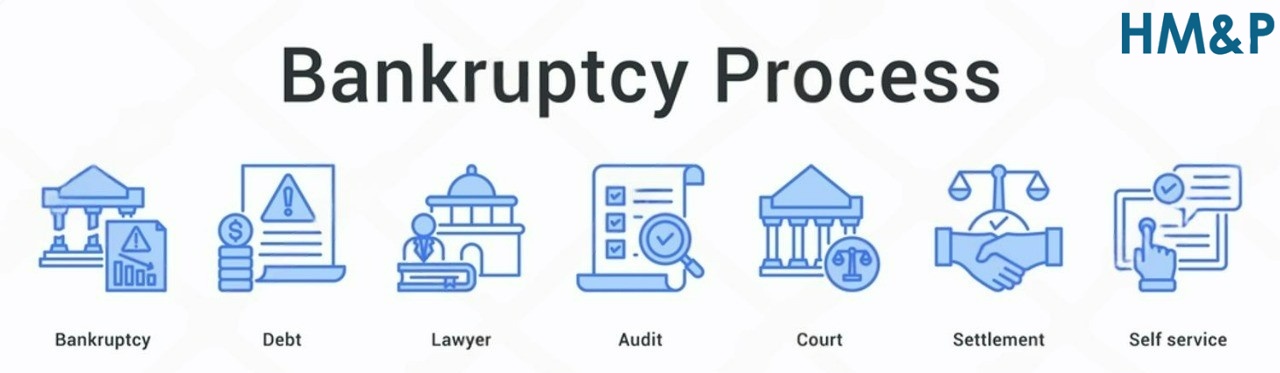
Through this procedure, the State not only protects the legitimate interests of enterprises but also contributes to limiting the negative consequences that cause disturbance and instability to the economy in general.
After the court's bankruptcy decision is issued, the enterprise will be subject to bankruptcy procedures to terminate its operations. At this time, the judge based on the following cases to determine whether the enterprise is forced to go bankrupt or not.
Firstly, there is a report on the results of the creditors' meeting in case the creditors' meeting fails to pass a resolution concluding the handling plan for the enterprise;
Secondly, there is a resolution of the creditors' meeting with the conclusion of the proposal to declare bankruptcy and the dispute between the parties has been settled by the Court;
Thirdly, there is a report of the Asset Management Officer on the inability to carry out the restoration or the overdue period of business recovery but still insolvent;
Finally, there was a decision not to recognize the resolution of the Creditors' Meeting with the content of approving the plan to restore business activities.
3. Advantages and challenges of the new legal framework
Positive points
Instead of focusing only on bankruptcy procedures when businesses fall into difficulties, the law has established a policy of prioritizing the restoration of the financial health of enterprises through appropriate support mechanisms. This approach creates conditions for businesses to have more opportunities to overcome the crisis period and be able to continue production and business activities. Through this procedure, the State not only protects the legitimate interests of enterprises but also contributes to limiting the negative consequences that cause disturbance and instability to the economy in general.
The new regulations also continue to prioritize debts owed to workers.[17] At the same time, the employee is also recognized as one of the subjects who have the right to file a petition for recovery and bankruptcy procedures without having to bear recovery costs, except for cases where the application is taken advantage of to infringe upon the legitimate rights and interests of the agency. organizations and individuals.
There are many challenges when the new regulation takes effect
It is possible that at the beginning of implementation, the new regulations will cause many difficulties for businesses because it takes time to test and complete the guiding documents from the competent authorities. Such as regulations on obligation clearing.[18] However, applying the clearing method based on the value of the valued asset may arise cases where the valuation level does not properly reflect the actual value of the asset. In this case, the property owner may benefit if the property is valued higher than its true value, and vice versa. Thereby directly affecting the determination of the scope and level of obligations of stakeholders. Therefore, the development of guiding documents will face significant challenges, requiring an objective valuation mechanism and qualifications of asset management officers and judges in accordance with the nature of the case. In addition, the recovery and bankruptcy procedures both have requirements to satisfy the "insolvency" factor, but different subjects filing applications will lead to two different handling directions, which are easy to cause conflicts of authority and prolong the settlement time.[19] This can happen in the case of abuse when the business owner simultaneously files for recovery to delay his payment obligations or creditors file for bankruptcy to pressure the business to repay.
Nguyen Viet Hung
HM&P Law Firm
Read more: Luật Phục hồi, phá sản 2025: Khi nào doanh nghiệp được phục hồi, khi nào cho phá sản?
[1] Except for the case specified in Clause 3, Article 38 of this Law, which takes effect from 01
July 2026.
[2] Clause 1, Article 3 of the Recovery and Bankruptcy Law.
[3] Clause 1, Article 24 of the Law on Recovery and Bankruptcy.
[4] Article 25 of the Recovery and Bankruptcy Law.
[5] Clause 1, Article 25 of the Law on Recovery and Bankruptcy.
[6] Clause 5, Article 25 of the Recovery and Bankruptcy Law.
[7] Article 31 of the Recovery and Bankruptcy Law.
[8] Article 32 of the Recovery and Bankruptcy Law.
[9] Clause 1, Article 33 of the Recovery and Bankruptcy Law.
[10] Clause 6, Article 33 of the Recovery and Bankruptcy Law.
[11] Point a, Clause 1, Article 34 of the Recovery and Bankruptcy Law.
[12] Clause 2, Article 34 of the Recovery and Bankruptcy Law.
[13] Section 2 Chapter IV of the Recovery and Bankruptcy Law.
[14] Clause 2, Article 5 of the Recovery and Bankruptcy Law.
[15] Article 38 of the Recovery and Bankruptcy Law.
[16] Article 41 of the Recovery and Bankruptcy Law.
[17] Article 46 of the Recovery and Bankruptcy Law.
[18] Clause 2, Article 53 of the Recovery and Bankruptcy Law.
[19] https://kinhtedothi.vn/hoan-thien-luat-pha-san-de-tang-hieu-qua-phuc-hoi-doanh-nghiep.914917.html, last accessed 2025/12/29.


