


WHAT IS ECONOMIC CONCENTRATION?
Under the competitive pressure in the current economic climate, enterprises are constantly seeking solutions to improve their business capabilities in order to gain development opportunities. The history of the establishment of various types of enterprises has shown that the shortest way for enterprises to improve their competitiveness is to combine capital and management capabilities in business operations. At present, the form of concentration of business resource is quite common with different degrees and has become an important part of the freedom to conduct business.
The 2018 Law on Competition does not define economic concentration (including foreign-to-foreign transactions carried out outside Vietnam), but only lists forms of economic concentration, including: (i) merger of enterprises; (ii) consolidation of enterprises; (iii) acquisition of an enterprise; (iv) joint venture between enterprises; and (v) other forms of economic concentration as stipulated by law[1].
POSITIVE EFFECTS OF ECONOMIC CONCENTRATION ON THE COMPETITIVE ENVIRONMENT

RESPONSIBLE PARTIES MUST SUBMIT A DOSSIER FOR THE NOTIFICATION OF AN ECONOMIC CONCENTRATION
Undertakings intending to take part in an economic concentration must jointly submit a set of economic concentration notification documents, in cases where undertakings are required to notify the economic concentration.
WHEN MUST TRANSACTIONS BE NOTIFIED?
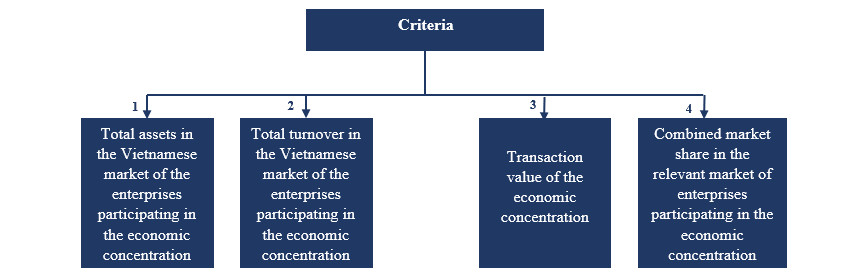
Not all economic concentration transactions are subject to obligation to notify. Only if it falls within the specified threshold of one of the four criteria below with the parties be required to make a notification.
|
Entities |
Total assets |
Total sales turnover/ purchase revenue |
Transaction value |
Combined market share |
|
Enterprise (except for the 3 entities below) |
VND 3 trillion (approximately USD 127 million) in the financial year preceding the planned year of economic concentration |
VND 3 trillion (approximately USD 127 million) in the financial year preceding the planned year of economic concentration |
VND 1 trillion (approximately USD 42 million) |
20% in a relevant market in the financial year preceding the year of economic concentration |
|
Insurance enterprises |
VND 15 trillion (approximately USD 633 million) in the financial year preceding the year of economic concentration |
VND 10 trillion (approximately USD 420 million) in the financial year preceding the planned year of economic concentration |
VND 3 trillion (approximately USD 127 million) |
|
|
Securities companies |
VND 15 trillion (approximately USD 633 million) in the financial year preceding the year economic concentration |
VND 3 trillion (approximately USD 127 million) in the financial year preceding the planned year of economic concentration |
VND 3 trillion (approximately USD 127 million) |
|
|
Credit institutions |
Reach at least 20% of the total assets of the system of credit institutions in the Vietnamese market in the financial year preceding the planned year of economic concentration |
Reach at least 20% of the total sales turnover of the system of credit institutions in the financial year preceding the planned year of economic concentration |
Reach at least 20% of the total charter capital of the system of credit institutions in the financial year preceding the planned year of economic concentration |
Notes 1: Before carrying out the act of economic concentration, undertakings must carefully assess, on the basis of the above criteria, whether they are required to notify the economic concentration and, if so make a notification.
PROCEDURES FOR NOTIFYING OF AN ECONOMIC CONCENTRATION
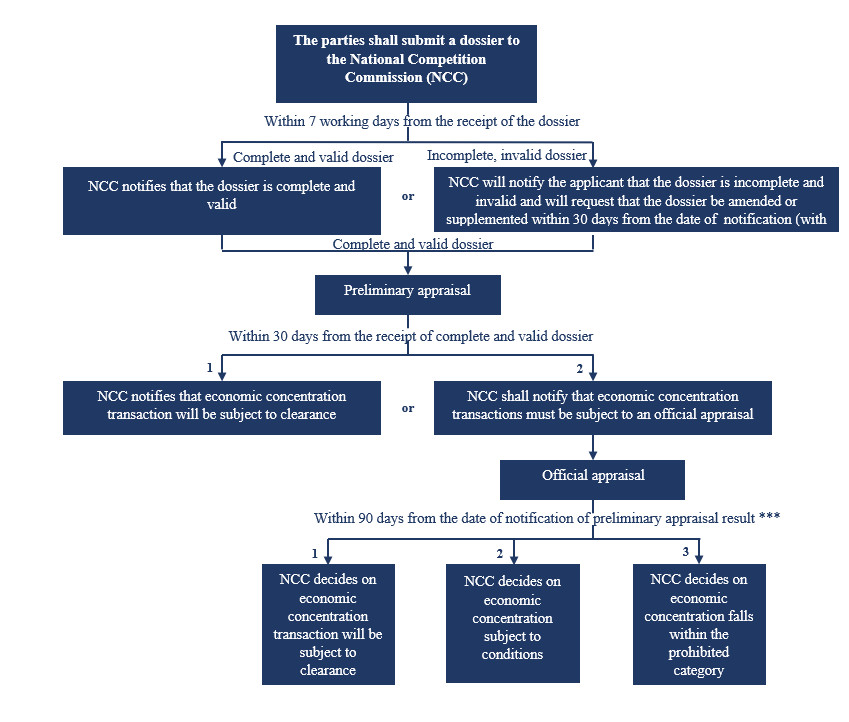
(*) If the enterprise does not submit additional documents within 30 days, the NCC shall return the dossier.
(**) If the NCC has not issued a notice on the results of the preliminary appraisal upon expiry 30 days from the receipt of the valid dossier, the economic concentration transactions may be carried out.
(***) In complicated cases, the deadline for the official appraisal of the economic concentration may be extended, but not more than 60 days, and the NCC shall inform the applicant in writing.
The NCC must send the decision on the economic concentration to the parties involved in the economic concentration procedure within 05 working days from the date of issuing of the decision.
PRELIMINARY APPRAISAL CRITERIA
Criteria that the NCC shall consider in preliminary appraisal process:
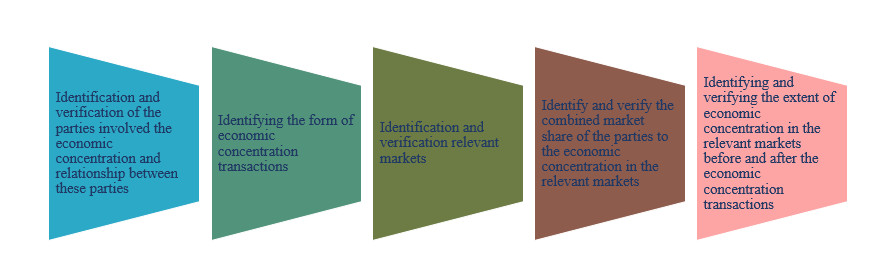
Economic concentration transactions are subject to unconditional clearance if they fall into one of the following situations:
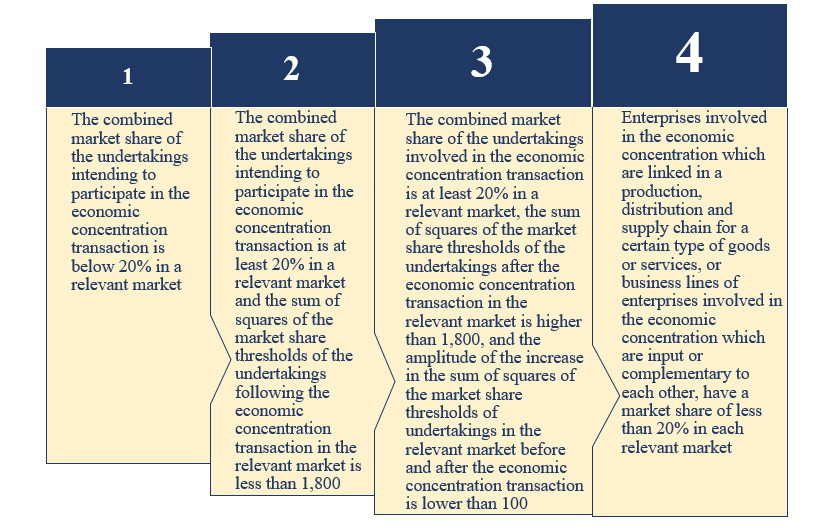
Economic concentration transaction must be subject to an official appraisal if it does not fall into the four cases above.
OFFICIAL APPRAISAL CRITERIA
Criteria that the NCC shall consider in official appraisal process:
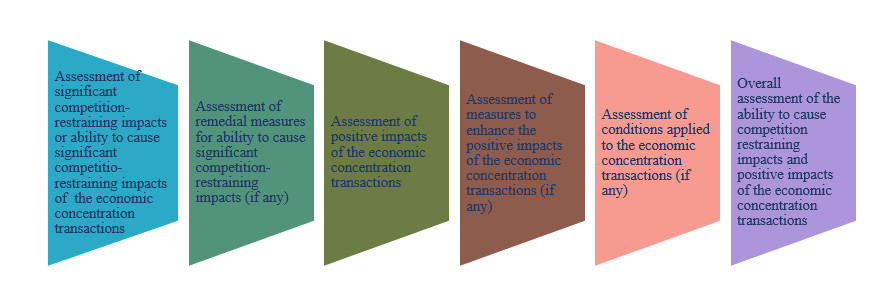
WHAT IS CONDITIONAL CLEARANCE?
A conditional clearance is an economic concentration transaction that is permitted to proceed but must meet one or more of the following conditions:
 WHEN IS AN ECONOMIC CONCENTRATION PROHIBITED?
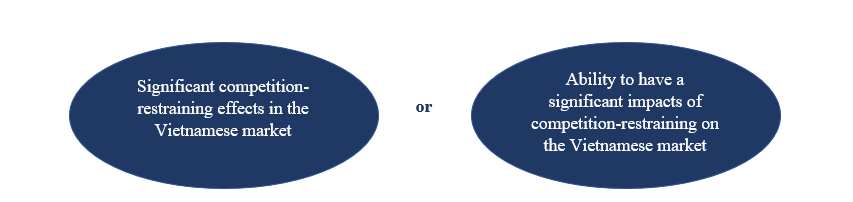
Note 2: During the process of official appraisal of an economic concentration, the NCC may request the parties to submit additional documentation but not more than twice, and the deadline for submitting additional documentation shall not be included in the deadline of appraisal of the economic concentration. If the requested parties fail to provide additional documentation or provide insufficient documentation, the NCC shall consider the application and decide on the basis of the available information and documents.
Note 3: The law does not provide a specific threshold for the official appraisal criteria, but depends on the assessment of the competent authority based on the actual market situation
DOSSIER FOR NOTIFICATION OF ECONOMIC CONCENTRATION
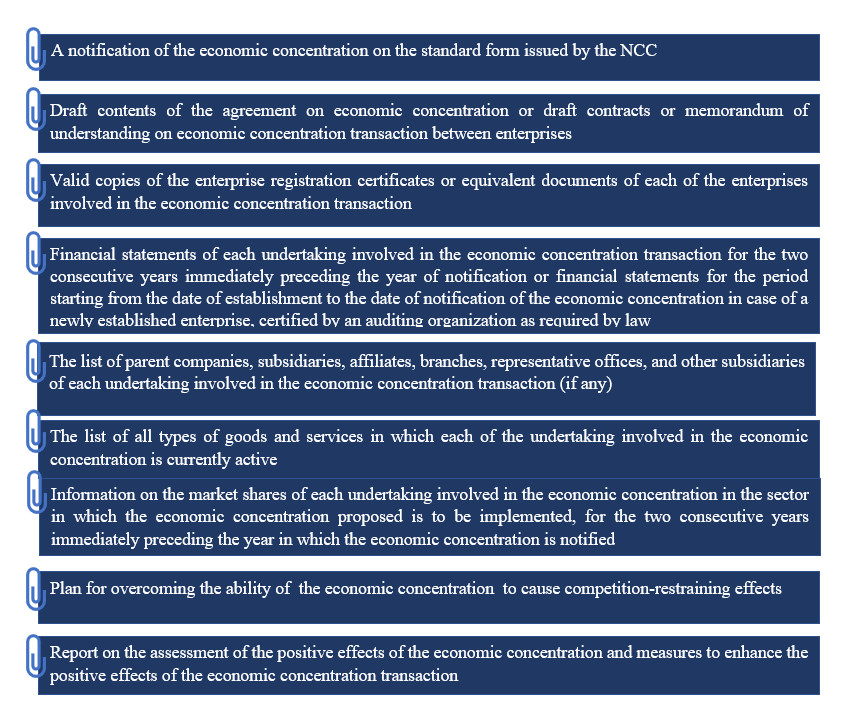
Notes 4: For foreign documents, the party who involved in the transaction must legalize overseas them and translate them into Vietnamese before submitting them.
HOW TO SUBMIT THE DOSSIER?
Submit in person or by post service.
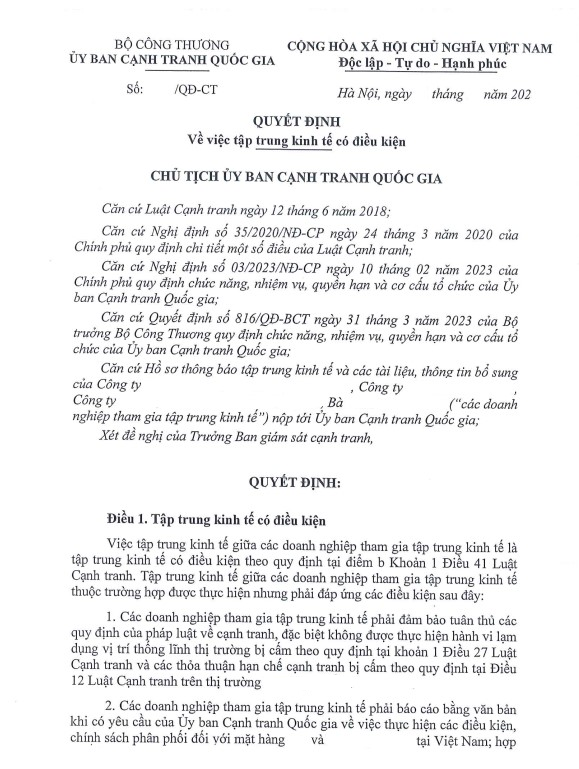
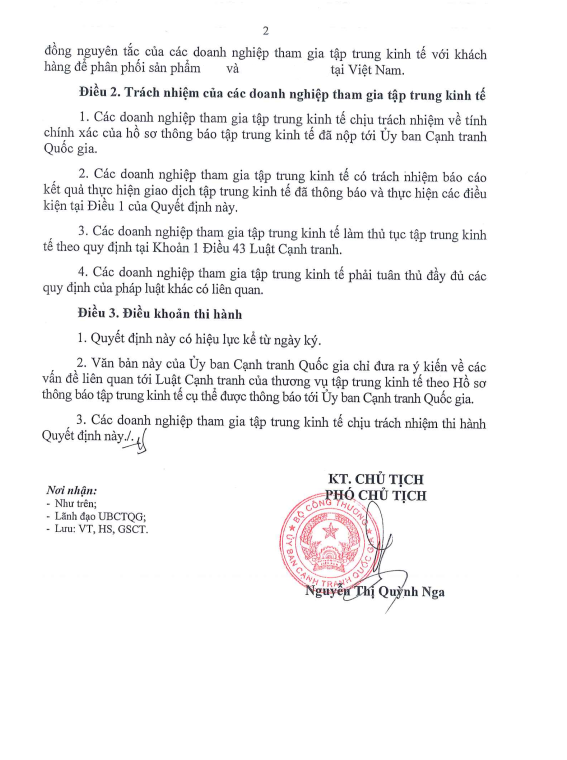
RESULT OF PROCEDURE IMPLEMENTATION
Image of an Official Letter approving conditional economic concentration.
SANCTION FOR FAILURE TO NOTIFY AN ECONOMIC CONCENTRATION
A fine of between 01% and 05% of the total turnover in the relevant market in the financial year preceding the year in which the infringement was committed shall be imposed on each undertaking in the economic concentration without complying with the notification obligations.
In addition, after the notification of an economic concentration, a party to the economic concentration may still be subject to administrative sanction if it commits any of the following violations[2]:
|
Violation Act |
Fine level |
Basis for calculation of fine |
|
Implementation of an economic concentration without notification of the results of the preliminary appraisal of the NCC |
0,5% - 01% |
Total turnover in the relevant market in the financial year preceding the year of committing acts of violation of each enterprise participating the economic concentration |
|
Implementation of economic concentration without NCC decisions in case the economic concentration is subject to official appraisal |
0,5% - 01% |
|
|
Non-implement or insufficient fulfillment of the conditions in the decisions on conditional economic concentration |
||
|
Implementation of economic concentration if there is a decision of the NCC on the prohibited economic concentration* |
01% - 03% |
(*) In the event of the decision of the NCC on a prohibited economic concentration, the parties implementing the economic concentration may be subject to additional sanctions and remedies as prescribed by laws, depending on the form of the economic concentration[3]
[1] Clause 1 Article 29 of Law on Competition 2018.
[2] Article 14 of Decree 75/2019/ND-CP dated September 26, 2019 on sanctioning of administrative violations in the field of competition (“Decree 75/2019/ND-CP”).
[3] Clause 2 Article 10, Clause 2, Clause 3 Article 11, Clause 2 Article 12, Clause 2, Clause 3 Article 13 of the Decree 75/2019/ND-CP.


