


FOREWORD
An initial public offering of shares (IPO) marks an important strategic milestone for the owners, the executive management and all shareholders of an enterprise. The transformation from a private company or a non-public joint stock company into a public company not only brings in new capital but also requires a comprehensive overhaul of governance structure, information transparency and compliance with capital market standards. In Vietnam, this process is currently taking place against the backdrop of a legal framework undergoing significant adjustments during 2025–2026. These changes include the requirement to audit the report on contributed charter capital, the mechanism for conducting an IPO concurrently with listing, the restructuring of the equity trading market, and proposed amendments to the Securities Law currently under consideration by the National Assembly. These new regulations impose higher requirements for thorough and specialized preparation on the part of enterprises.
This Handbook has been prepared to provide a comprehensive and systematic overview of the key decisions, legal procedures and matters requiring careful consideration that an enterprise must master before, during and after conducting an IPO in Vietnam. The content is organized following the logical sequence of an actual IPO project, beginning with a self-assessment of readiness and identification of eligibility conditions, followed by comprehensive preparation in the areas of finance, corporate governance and legal matters, the process of working with state regulatory authorities and the stock exchange, and finally the ongoing obligations of a public company after its official listing.
The entire content is built upon the practical experience of HM&P Law Firm in advising on M&A/FDI transactions, compliance and licensing, data protection, banking and capital markets, as well as dispute resolution. At the same time, the Handbook draws upon the structured and in-depth approach of international IPO guidance materials, in order to provide enterprises with recommendations that are practical and appropriate to the Vietnamese legal environment.
Should your company require in-depth advice tailored to a specific case, please contact our team of experts for timely and effective support.
Date of issue:
This Handbook reflects Vietnamese laws and regulations in effect as of September 2026, including Law on Securities No. 54/2019/QH14 (as amended by Law No. 56/2024/QH15), Decree 155/2020/ND-CP (as amended by Decree 245/2025/ND-CP) and other relevant guiding documents.
Contact:
For any comments, requests for updates or requests for in-depth advice, please contact HM&P using the information below
HM&P Law Firm
Address: 10th Floor, ITAXA House, 126 Nguyen Thi Minh Khai, Xuan Hoa Ward, HCMC
Phone: +84 28 73080839
Email: counsel@hmplaw.vn
Website: hmplaw.vn
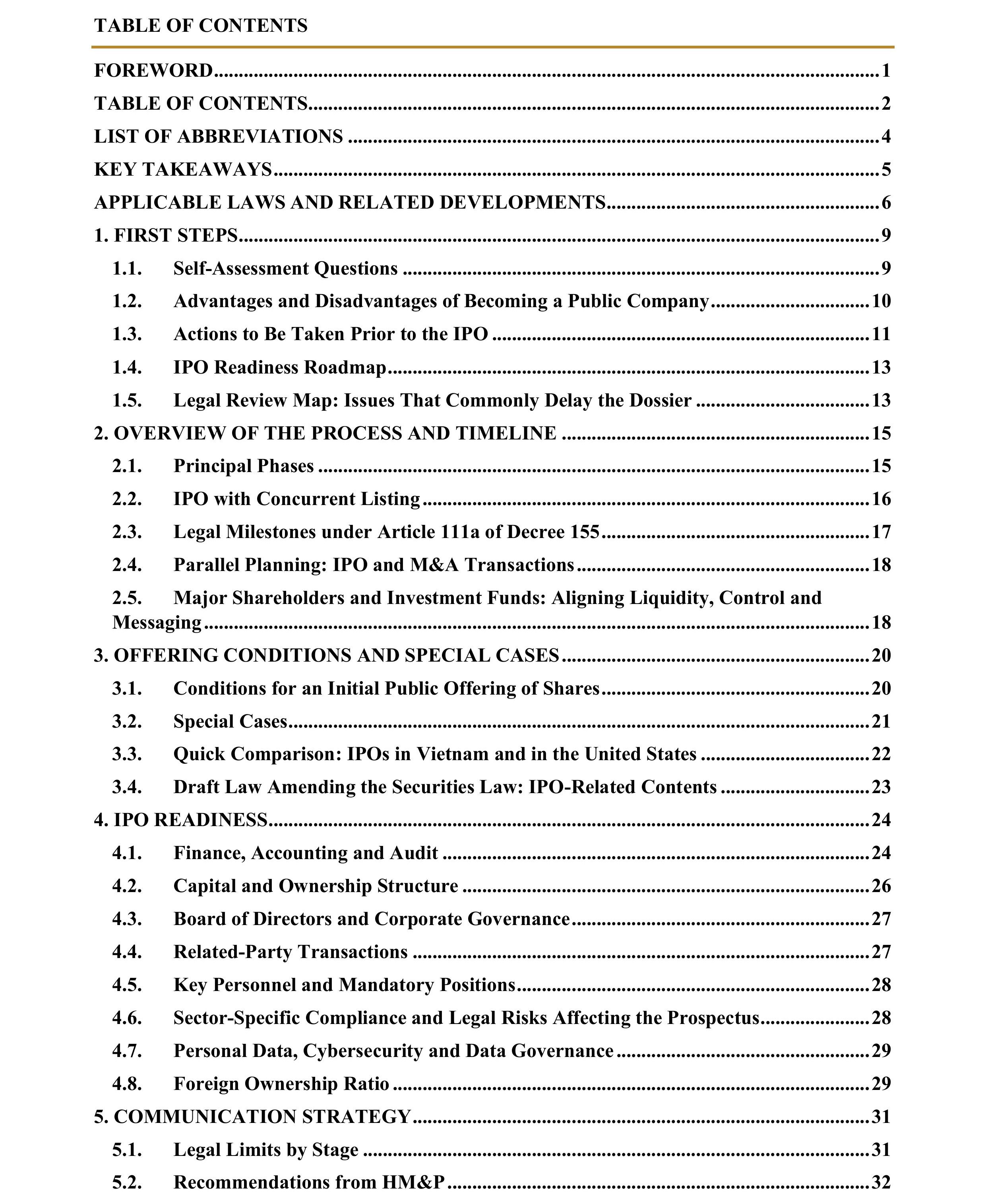
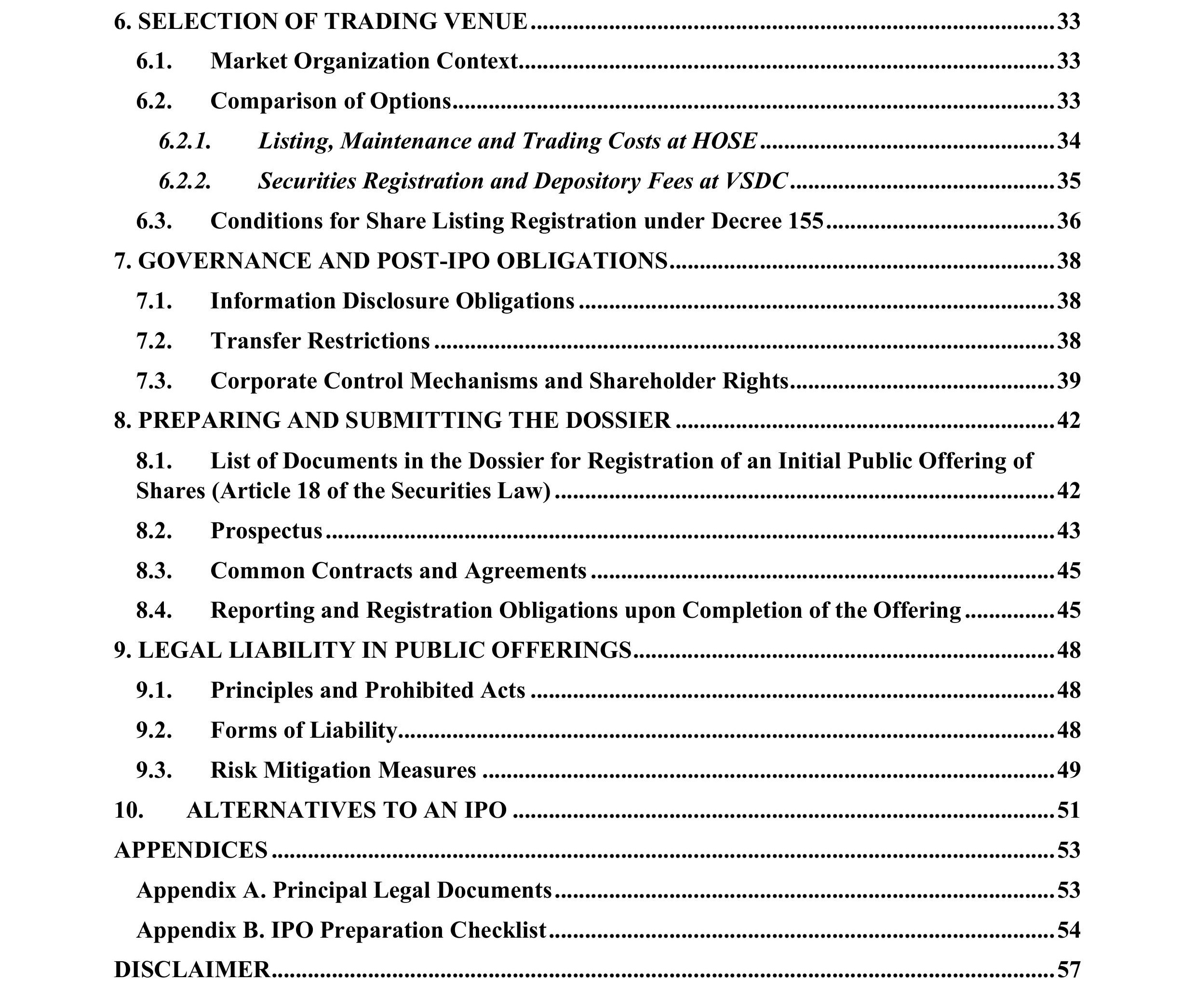
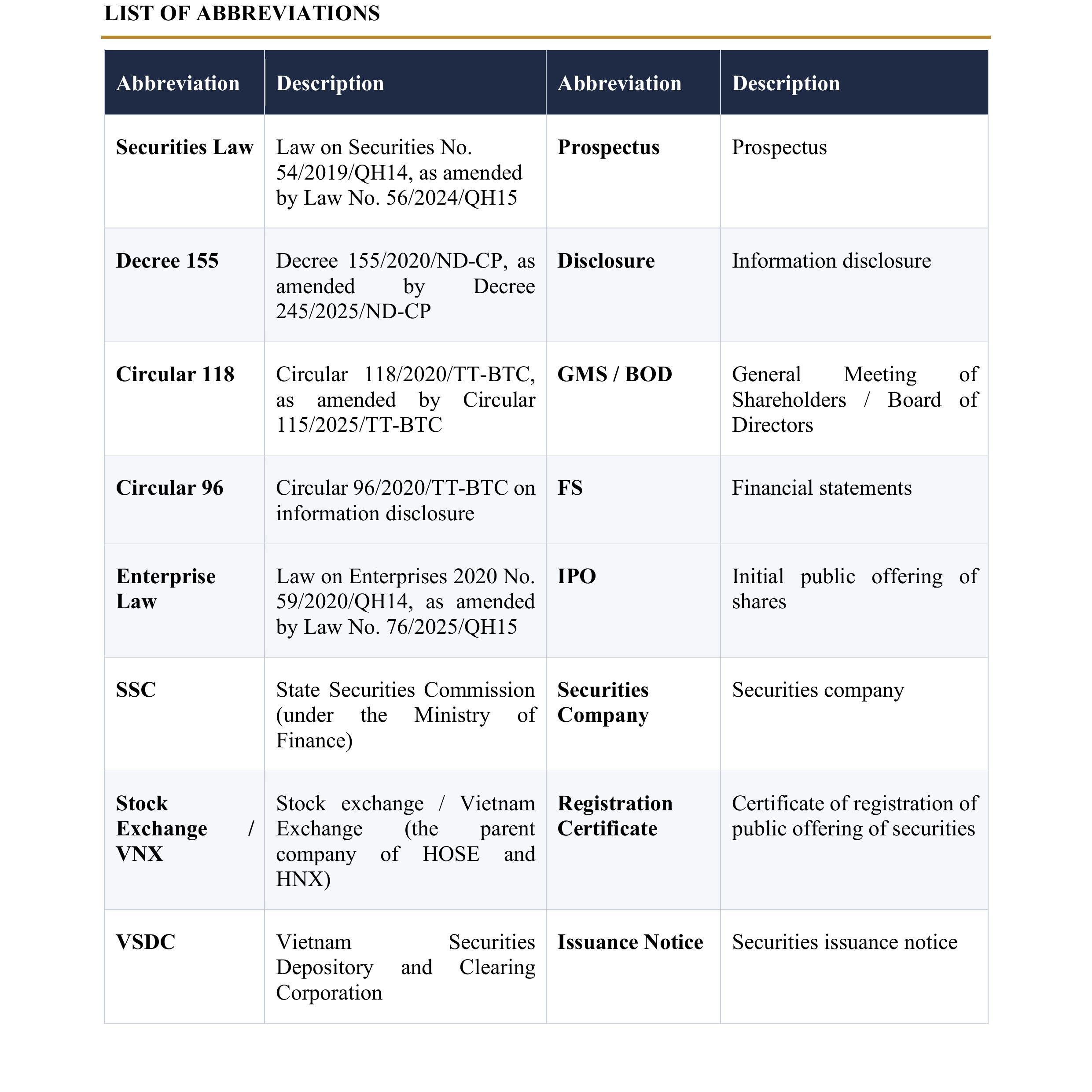
KEY TAKEAWAYS
- An IPO is a licensed procedure, not merely a sale of shares. The SSC issues the Certificate of Registration of Public Offering within 30 days from the date of receipt of a complete and valid dossier (Article 25 of the Securities Law); the offering may commence only after the Issuance Notice has been published.
- Basic conditions to be verified from the outset: paid-up charter capital of at least VND 30 billion; profit in the two consecutive years preceding the registration year and no accumulated losses; at least 15% of voting shares (10% if charter capital is VND 1,000 billion or more) sold to at least 100 investors who are not major shareholders; and major shareholders' undertaking to jointly hold at least 20% of charter capital for 01 year (Article 15 of the Securities Law).
- The audited report on paid-up charter capital is a new component of the dossier under Law No. 56/2024/QH15 (effective from 01/01/2025). Under Circular 19/2025/TT-BTC, the minimum reporting period is 10 years up to the time of IPO registration; if the enterprise has been operating for less than 10 years, the report covers its entire period of operation. Accordingly, enterprises with a complex history of capital contributions or capital increases should review supporting documents early.
- The IPO dossier and the listing dossier may be submitted concurrently (Article 111a of Decree 155, effective 11/09/2025); after the Stock Exchange approves the listing, the shares must be put into trading within a maximum of 30 days (previously 90 days).
- Newly listed shares are accepted at HOSE. From 01/07/2025, HNX no longer accepts dossiers for registration of new share listings; the consolidation of the equity market into HOSE is to be completed no later than 31/12/2026.
- Market sounding is strictly limited. While the SSC is reviewing the dossier, only the information in the Prospectus submitted to the SSC may be used for market sounding, and it must be used truthfully and accurately, clearly stating that information on the issuance date and the offer price of the securities is indicative (Article 24 of the Securities Law).
- There are multiple layers of transfer restrictions: major shareholders (20% for 01 year), key executives upon listing, ESOP shares (minimum 01 year) and strategic investors in private placements.
- Becoming a public company gives rise to ongoing obligations: ad hoc disclosure within 24 hours, audited annual financial statements, rules on non-executive members of the BOD, related-party transactions and corporate governance.
- Legal risks for untruthful dossiers have increased: Decree 306/2025/ND-CP (effective 09/01/2026) raises administrative penalty levels; the disclosure of misleading information, insider trading and market manipulation may also be subject to criminal prosecution.
- The securities legal framework remains in the process of being updated and amended: the draft Law Amending the Securities Law is expected to be submitted to the National Assembly in October 2026, with a proposed effective date of 01/03/2027. IPO plans should remain flexible and be reviewed periodically.
APPLICABLE LAWS AND RELATED DEVELOPMENTS
|
Document / Event |
Effective Date |
IPO-Related Content |
Practical Impact |
|---|---|---|---|
|
Law No. 56/2024/QH15 amending the Securities Law |
01/01/2025 |
Adds Article 18.1(k): a report on contributed charter capital up to the time of registration of the IPO, independently audited; similarly for the dossier for registration as a public company. |
The authenticity of contributed capital must be demonstrated; supporting documents and the history of capital increases must be prepared from the early stage of the project. |
|
Decree 245/2025/ND-CP amending Decree 155/2020 |
11/09/2025 |
Adds Article 111a (concurrent registration of listing with an IPO); shortens the period for putting shares into trading to a maximum of 30 days; Adds Article 7.8 on the basis of consolidated financial statements; Article 6 on the responsibilities of advisory and audit organizations; Amends Article 109.1(c); provisions on the BOD, related-party transactions and foreign ownership. |
Significantly shortens the time from dossier submission to the first trading day; binds the responsibilities of the parties participating in the dossier. |
|
Circular 115/2025/TT-BTC amending Circular 118/2020 |
28/01/2026 |
Updates guidance on offerings, issuances, public tender offers, share buybacks and registration of public companies; includes the IPO Prospectus template (Appendix 01). |
Prepare the Prospectus using the new template; the Ministry of Finance has issued a consolidated document (05/VBHN-BTC of 2026). |
|
Decree 306/2025/ND-CP amending Decree 156/2020 |
09/01/2026 |
Strengthens penalties for violations in the securities sector; the maximum fine is from VND 1 billion to VND 1.5 billion for forging documents or certifying forged documents in a private placement dossier. |
Dossier compliance risk increases; an internal document verification process is required. |
|
Restructuring of the equity trading market (Circular 57/2021 and Circular 69/2023/TT-BTC) |
01/07/2025; to be completed no later than 31/12/2026 |
HNX ceases to accept dossiers for new share listings; HOSE becomes the single exchange for the market in shares, fund certificates and covered warrants. |
Dossiers for new share listings are submitted to HOSE. |
|
Law on Personal Data Protection 91/2025/QH15 and Decree 356/2025/ND-CP |
01/01/2026 |
Personal data processing impact assessment, cross-border data transfer, data protection personnel. |
A key review item in legal due diligence and in the Prospectus. |
|
FTSE Russell upgrades Vietnam to Secondary Emerging Market status |
21/09/2026 |
Vietnamese shares begin to be allocated into FTSE indices, starting in September 2026 with an initial weighting of 10%, then rising to 30%, 65% and reaching 100% in September 2027. |
Improves expectations of foreign capital inflows; raises institutional investors' requirements for governance and transparency. |
|
Draft Law amending and supplementing a number of articles of the Securities Law |
Expected to be passed in 2026 and to take effect from 01/03/2027 |
Proposes abolishing the condition that the required percentage of shares be “sold” in the IPO; retains the post-IPO ownership percentage requirement; simplifies the publication of the Issuance Notice. |
Monitor the outcome of discussions at the National Assembly (expected October 2026 session). |

1. FIRST STEPS
The timing of an initial public offering of shares (IPO) depends first and foremost on the enterprise's legal, financial and governance readiness, and only then on market conditions and the progress of the competent authority's review of the dossier. This chapter is intended to help the leadership and shareholders clearly identify the key question: whether the enterprise has fully satisfied the conditions to become a public company, and at the same time to identify the work to be completed during the preparation period of 12–18 months leading up to the anticipated IPO date.
1.1. Self-Assessment Questions
|
Question Group |
Matters to Be Addressed |
|---|---|
|
Is the enterprise suitable to become a public company and attract public investors? |
|
|
Are the financial and legal information and data truthful, complete and transparent? |
|
|
How should the structure of the initial public offering be designed for optimal results? |
|
|
Which trading venue is appropriate? |
|
1.2. Advantages and Disadvantages of Becoming a Public Company
Advantages
|
Capital-Raising Capacity |
Liquidity and “Share Currency” |
Reputation and Governance |
|---|---|---|
|
|
|
Disadvantages and Risks
|
Compliance and Disclosure |
Obligations to make periodic and ad hoc disclosures (within 24 hours for ad hoc events), audited annual financial statements, and corporate governance rules for public companies. Strategic information, material transactions and financial figures become public to competitors, customers and suppliers. |
|
Costs |
Costs of dossier advisory, underwriting/agency, audit and legal services, fees related to the Stock Exchange and VSDC, communication costs, as well as post-IPO maintenance costs (audit, IR[2], governance). |
|
Loss of Control and Dilution |
Existing shareholders are diluted; related-party transactions, large-value transactions and amendments to the Charter must go through stricter approval mechanisms; there is a risk of public tender offers. |
|
Legal Liability |
Administrative and criminal liability for untruthful information, documents or dossiers, insider trading and market manipulation; liability of managers and of advisory and audit organizations. |
|
Performance Pressure |
Listed shares may be subject to mandatory delisting if, over the three most recent consecutive years according to audited annual financial statements, the company's business results in accumulated losses exceeding actual contributed charter capital or negative owners' equity.[3] |
|
Diversion of Management Resources |
The IPO process requires considerable time and effort from the executive management and the finance–accounting function; a clear roadmap is needed so as not to affect business operations. |
1.3. Actions to Be Taken Prior to the IPO
|
Business and Structure |
Finance |
Governance |
Communications and Investors |
|---|---|---|---|
|
|
|
|
1.4. IPO Readiness Roadmap
|
12–18 months before dossier submission |
6 months before dossier submission |
From official kick-off to dossier submission |
|---|---|---|
|
|
|
1.5. Legal Review Map: Issues That Commonly Delay the Dossier
The map below helps prioritize the handling of issues that commonly give rise to queries from the SSC, the Stock Exchange, the audit firm or investors during the review process.
|
Structure and Ownership |
Commercial, Licenses and Assets |
Finance, Control and Disclosure |
|---|---|---|
|
|
|

2. OVERVIEW OF THE PROCESS AND TIMELINE
An IPO in Vietnam comprises multiple steps, each with its own statutory time limits, involving the SSC, the Stock Exchange and VSDC. Since September 2025, an enterprise may prepare and submit the listing registration dossier concurrently with the IPO dossier, thereby potentially shortening the period from completion of the offering to the first trading day.
2.1. Principal Phases
|
Phase |
Principal Content |
Legal Basis and Time Limit |
|---|---|---|
|
1. Preparation and internal decisions |
The GMS approves the issuance plan, the plan for use of proceeds and the undertaking to list/register for trading; the BOD approves the dossier; preparation of the Prospectus, audited financial statements and the Report on Contributed Charter Capital; opening of a blocked account; execution of advisory (and underwriting, if any) contracts. |
Articles 15 and 18 of the Securities Law; Article 11 of Decree 155. Actual preparation time is typically 12–18 months. |
|
2. Dossier submission and review |
Submit the dossier to the SSC through the One-Stop Division/National Public Service Portal. While the SSC is reviewing the dossier, only the information in the Prospectus as submitted may be used for market sounding, and it must be used truthfully and accurately. |
Articles 24 and 25 of the Securities Law; Article 6.2 of Decree 155. The SSC issues the Registration Certificate within 30 days from the date of receipt of a complete and valid dossier. |
|
3. Completion of Registration Certificate procedures |
Upon receiving the notice requesting completion, submit 06 copies of the official Prospectus to the SSC. |
Article 41.3 of Decree 155. Within 07 working days from the date of receipt of the SSC's notice. |
|
4. Pre-offering disclosure |
Publish the Issuance Notice in 01 electronic newspaper or print newspaper for 03 consecutive issues; post the information and the official Prospectus on the issuer's website and on the Stock Exchange. The offering may commence only after such publication. |
Articles 25.3 and 25.4 of the Securities Law; Article 41.5 of Decree 155. Within 07 working days from the effective date of the Registration Certificate. |
|
5. Distribution of shares |
Subscription registration, distribution to investors, collection of payment into the blocked account and completion of procedures for transferring shares to purchasers. |
Article 26 of the Securities Law. To be completed within 90 days from the effective date of the Registration Certificate; the SSC may consider an extension of up to 30 days. |
|
6. Reporting of results |
Publish and report the offering results to the SSC, enclosing the bank's confirmation of the amount received in the blocked account. |
Article 26.5 of the Securities Law. Within 10 days from the end of the offering. |
|
7. Securities registration and listing/registration for trading |
Complete securities registration at VSDC before trading; complete listing procedures at the Stock Exchange or registration for trading on UPCoM. Where listing is conducted concurrently with the offering registration, the provisions on the order and procedures for concurrent listing registration apply. |
Articles 111 and 149 of Decree 155; Articles 133–135 of Decree 155 for UPCoM trading registration. |
2.2. IPO with Concurrent Listing
Prior to 11/09/2025, the regulations did not permit an enterprise to register for listing concurrently with its IPO dossier. Decree 245/2025/ND-CP, effective from 11/09/2025, adds Article 111a, allowing joint stock companies to submit a listing registration dossier concurrently with the IPO dossier. Accordingly, the Stock Exchange reviews the listing registration dossier in parallel with the SSC's review of the IPO dossier.

2.3. Legal Milestones under Article 111a of Decree 155
|
Milestone |
Description |
Time Limit |
|---|---|---|
|
Submission of the listing dossier |
Concurrently with the IPO dossier: documents under Article 110.1(a), (đ) and (g); the listing Prospectus (Form 29A) and the GMS resolution on listing; financial statements for the two years preceding the registration year; and the report on contributed charter capital up to the time of registration under Article 18.1(k) of the Securities Law. |
Concurrently with the IPO dossier |
|
Stock Exchange notice of preliminary satisfaction of conditions |
The Stock Exchange notifies that the paid-up charter capital condition of at least VND 30 billion and the conditions in Article 109.1(c), (e) and (g) have been met. This notice must be sent concurrently to the SSC. |
Within 30 days from the date of receipt of a valid dossier |
|
Post-IPO supplementary requirements |
The Stock Exchange requests supplementary documents: a request for continued consideration (Form 28B), the updated Prospectus information sheet (Form 29B), the enterprise registration certificate updated for charter capital, and documents under Article 110.1(c) and (d) |
The Stock Exchange makes the request within 01 working day from the time the SSC notifies receipt of the report on the results of the initial public offering of shares; the enterprise has 15 days to submit the supplements. |
|
Decision approving listing |
The Stock Exchange issues a decision if the market capitalization condition under Article 109.1(a) and the conditions under Article 109.1(d) and (đ) (shareholder structure, holding undertakings) are met. |
Within 15 days from the date of receipt of valid documents |
|
Registration of the first trading day |
The enterprise registers the first trading day; the Stock Exchange announces the trading date after receiving the registration request and VSDC's written confirmation that the shares have been registered at VSDC. |
Within 05 working days from the date the Stock Exchange issues its decision; the trading date must be at least 06 working days after the Stock Exchange receives the written request and no later than 30 days from the date of the Stock Exchange's decision. |
|
Note: If a valid listing dossier is submitted within 60 days from the end of the annual accounting period, the indicators on ROE, profit and accumulated losses are determined on the audited annual financial statements (Article 109.1(c) of Decree 155). If the dossier is submitted after the end of the half-year financial reporting period, the listing applicant must supplement reviewed or audited half-year financial statements (Articles 11.4(b) and 107.1(d) of Decree 155). Accordingly, the dossier submission schedule should be worked back from the audit and review schedule. |
Please read more and download full content of publication (PDF File) here
[1] ESOP (Employee Stock Ownership Plan): shares under a program of stock options for employees of the company.
[2] IR (Investor Relations): the function of managing communications and relations with investors
[3] Article 120.1(e) of Decree 155
[4] Anchor investor: a term used in capital market practice for a large investor expected to participate in an offering with a significant volume, thereby helping to create a basis for attracting the interest of other investors.


