


The number of experts, managers and technical workers from multinational corporations to work at the group's subsidiaries in Vietnam under the mechanism of intra-corporate transferee (ICT) to transfer knowledge, management experience and technology is increasing.

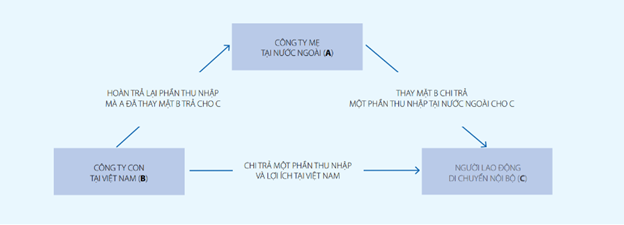
Multinational corporations often let overseas companies pay part of their income, living allowances or support to ensure the livelihood of experts in the host country.
Vietnam's regulations for employees who move intramural
The Government's Decree 219/2025/ND-CP (Decree 219) takes effect from August 7, 2025, inheriting and concretizing standards for ICT workers. A foreign worker is defined as an internal mobility when it fully meets the following criteria: being a manager, executive director, expert or technical worker of a foreign enterprise; have been recruited by that enterprise for at least 12 consecutive months before coming to Vietnam; and working at the commercial presence of such enterprise in Vietnam. Article 2 of Decree 152/2020/ND-CP (now Decree 219/2025/ND-CP), clearly separates two forms of foreign workers, including the implementation of labor contracts and internal movement of enterprises, and Official Letter 1099/CVL-QLLD[1] dated 17/10/2024 and Official Letter 10861/BNV-CVL dated 19/11/2025 of the Department of Employment[2] affirms that foreign workers working under internal mobility are "not allowed signing labor contracts and paying salaries" by the company in Vietnam.
Thus, according to the current regulations, once the ICT status is established, the expert who comes to the company in Vietnam to work is granted a "Certificate of exemption from the issuance of a work permit"; the company accepts the person to work but is not allowed to sign a labor contract – that is, it will not pay salary or support any expenses during the time the person works in Vietnam. From here, the conflicts between regulation and reality begin to emerge.
Conflict between regulation and reality
In fact, multinational corporations often let overseas companies pay part of their income, living allowances or support to ensure the livelihood of experts in the host country. But if this payment is made, the management agency can consider it as a sign of labor relations, thereby requiring the enterprise to apply for a work permit.
The aforementioned conflict not only exists within the scope of labor law but also spreads to the banking system, which plays a role in controlling cash flow and foreign exchange.
Currently, commercial banks often require labor contracts as a basic document to determine the legality of salary payments to foreign workers. However, for ICT workers, enterprises are not allowed to sign labor contracts. This makes businesses not have enough records to explain when transferring money through banks.
Meanwhile, the "Certificate of Exemption from Work Permit", the only legal document of ICT workers, does not record the salary, payment form or related financial terms. This leaves the bank lacking a basis to determine the nature of the transaction, which in turn can refuse or delay the processing of the transfer.
Businesses are therefore put in a situation where they do not have a perfect compliance plan: either they have to set up "formal employment contracts" to meet the bank's requirements, or they have to find alternative payment methods that have potential tax risks and foreign exchange controls.
The lack of synchronization between labor regulations and the operating practices of the banking system has turned this overlap into a "deadlock" in financial management and cash flow of enterprises.
Corporate income tax and expense reimbursement mechanism
The next problem arises in the field of taxation, especially corporate income tax (CIT) and foreign contractor tax (FCT).
Source: Eurocham 2026 White Paper
In the common model of multinational corporations, the overseas parent company often directly pays the salaries of ICT personnel to maintain the continuity of the remuneration regime in the country of origin. The company in Vietnam will then reimburse this cost to the parent company through an internal allocation mechanism.
However, when there is no direct labor relationship between the employee and the enterprise in Vietnam, the tax authority may not recognize this reimbursement as a deductible expense when calculating CIT. This raises the risk of expense exclusion and tax arrears.
Not stopping there, this cost reimbursement can also be reclassified in essence. If the tax authority considers that this is a payment for personnel services or management fees from the parent company, enterprises in Vietnam may be subject to foreign contractor tax (FCT), which is usually about 10% of the total payment value.
Thus, an initial expenditure of the nature of salary can be "distorted" into the cost of services, leading to a completely different tax obligation. This significantly increases personnel costs and creates significant legal risks for businesses.

Source: The Saigon Times
Proposal to remove obstacles
Overall, the above problems do not stem from a single regulation, but from the lack of synchronization between different legal systems.
Labor law establishes a clear separation mechanism between ICT and domestic labor relations. However, banking and tax law operates on the assumption that all salary payments are tied to a specific labor relationship, with a contract as a basis.
It is this "phase deviation" that makes a legal model according to international commitments difficult to operate in domestic practice. When each management agency applies its own logic, businesses are put in a situation where they have to "patchwork" to meet each individual requirement, instead of having a unified compliance mechanism.
To solve the current problems, it is necessary to have a synchronous and interdisciplinary approach, rather than dealing with each problem individually.
First, the labor management agency needs to officially distinguish between "wages in domestic labor relations" and "payments arising from internal transfers". Allowing businesses in Vietnam to pay for living expenses or financial support without being considered an establishment of labor relations will help solve the core bottleneck.
Secondly, the State Bank needs to issue guidelines to allow commercial banks to accept documents in lieu of labor contracts, such as the "Certificate of exemption from work permits" attached to the group's transfer decision, as a basis for processing money transfer transactions.
Third, the tax authority needs to develop a clear mechanism to recognize the "pay-for-refund" model as a reasonable cost, provided that the enterprise provides sufficient documents proving the nature of the salary. At the same time, it is necessary to have specific guidance to distinguish between salary expense reimbursement and service payment to avoid the application of housing tax inappropriate bidders.
Vietnam wishes to continue to strongly attract foreign investment inflows to become a developed country. Facilitating international personnel rotation is a key factor to improve competitiveness. Obstacles in paying salaries to ICT workers, if not removed in time, can become a bottleneck in the investment environment, affecting the decision to expand the operations of multinational corporations in Vietnam. Addressing this issue is not only a legal technical adjustment, but also a necessary step to ensure that Vietnam's international commitments are implemented effectively and consistently.
Lawyer Nguyen Van Phuc
HM&P Law Firm
Read more: Trả lương cho lao động ICT: khi quy định lệch pha với thực tiễn
[1] https://vinabookkeeping.com/wp-content/uploads/2025/08/17102024_CV1099_Guiding-the-issuance-of-work-permits-for-foreign-workers_Vietnamese.pdf, accessed on 08/04/2026.
[2] https://thuvienphapluat.vn/cong-van/Lao-dong-Tien-luong/Cong-van-10861-BNV-CVL-2025-thanh-toan-tien-luong-nguoi-lao-dong-nuoc-ngoai-682981.aspx, accessed on 08/04/2026.


