


FOREWORD
The Party and the State of Vietnam have identified the private economy as an important driving force of the economy[1], a series of special mechanisms and policies have been issued to remove difficulties and create favorable conditions for small and medium-sized enterprises to develop. One of the policies that the business community is particularly interested in is the regulation on corporate income tax exemption ("CIT") for the first 03 years from the time of issuance of the first Business Registration Certificate according to Resolution No. 198/2025/QH15 and specified in detail in Decree No. 20/2026/ND-CP.
This is a breakthrough policy, which has practical significance in reducing the financial burden on businesses in the early stage of operation - a time when businesses often face many risks and pressure on cash flow. However, since this is a new policy issued and implemented, the application process in practice has been raising many problems. Problems revolve around identifying the right beneficiaries of incentives, how to calculate the CIT exemption period in specific situations; procedures and documents need to be prepared to properly apply regulations, etc.
Stemming from the practice of consulting and accompanying businesses in the process of understanding and applying the law, HM&P realizes that many legal issues related to CIT exemption incentives for small and medium-sized enterprises need to be systematized and explained clearly, easy to access, associated with real situations that businesses often encounter.
The publication "Practical challenges in applying corporate income tax exemptions for small and medium-sized enterprises" was drafted and published by HM&P to provide businesses, business managers and interested individuals and organizations with a practical, easy-to-understand and easy-to-apply view. The content of the publication is presented in the form of questions and answers, closely following current legal regulations, especially Resolution no. 198/2025/QH15, Decree no. 20/2026/ND-CP and official letters answering the reality of the tax authorities for specific situations arising in the process of application.
Please note that this publication is not a substitute for legal advice which is applicable on a case-by-case basis. Instead, the publication is accomplished as an initial reference, assisting businesses identify critical legal issues, better understand their rights and obligations, and proactively review and prepare documents to properly apply and effectively take advantage of this preferential policy.
In the event that you have any questions regarding the content of the publication or have a need to use the legal services provided by HM&P, please contact us at the information below:
Our Managing Partner:
Lawyer Nguyen Van Phuc
Phone: 0932 768 630
Email: phuc.nguyen@hmplaw.vn
HM&P Law Firm
Address: 10th Floor, ITAXA House, 126 Nguyen Thi Minh Khai, Xuan Hoa Ward, HCMC
Phone: +84 28 73080839
Email: counsel@hmplaw.vn
Website: hmplaw.vn
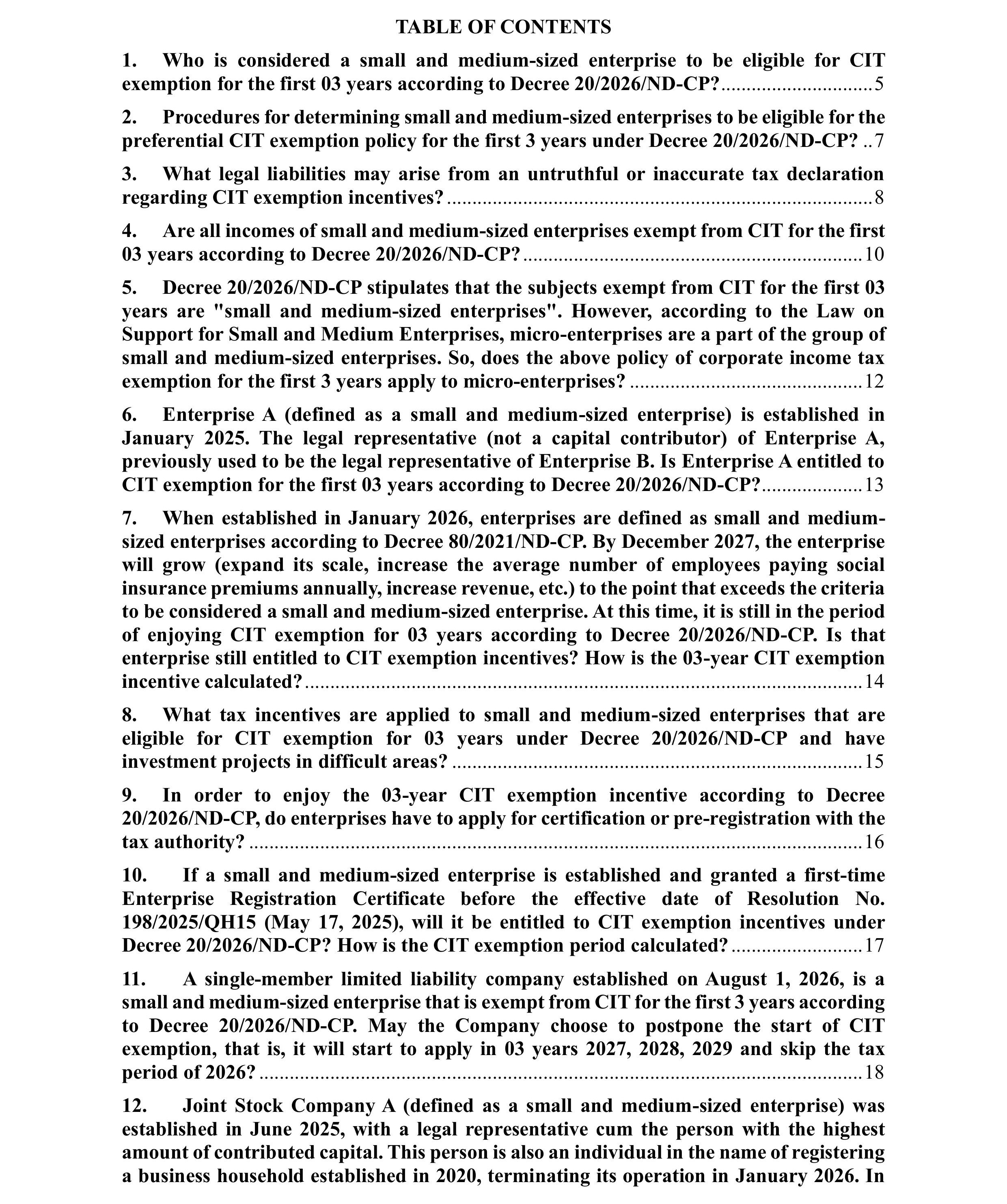
1. Who is considered a small and medium-sized enterprise to be eligible for CIT exemption for the first 03 years according to Decree 20/2026/ND-CP?
HM&P:
To be eligible for CIT exemption for the first 03 years according to Decree 20/2026/ND-CP, enterprises need to meet the following criteria: (i) register for business for the first time and (ii) belong to the case of small and medium-sized [2]enterprises.
Firstly, first-time business registration is understood as the issuance of a new enterprise in the market for the first time, which does not arise from (a1) merger, consolidation, division, separation, change of owner, type of enterprise or (b1) establishment of a new enterprise that the legal representative (except for the case where this person does not must be a capital contributor), a general partner or the largest capital contributor of a new enterprise that has been the legal representative, general partner or capital contributor in another enterprise that is operating or has been dissolved but has been dissolved for less than 12 months.
Secondly, to be considered a small and medium-sized enterprise, the enterprise must meet the criteria of (a2) the average number of employees participating in social insurance per year and (b2) the total revenue of the year or the total capital of the year[3].
Criteria for determining micro-enterprises, small enterprises and medium-sized enterprises
|
STT |
Enterprise size |
Field |
Average annual number of employees participating in social insurance |
Total Revenue of the Year or Total Capital of the Year |
|---|---|---|---|---|
|
1
|
Microenterprises |
Agriculture, forestry, fisheries |
No more than 10 people
|
Total revenue of the year: not exceeding VND 3 billion; or Total capital of the year: not more than 3 billion VND |
|
2 |
Industry & Construction |
No more than 10 people |
Total revenue of the year: not exceeding VND 3 billion; or Total capital of the year: not more than VND 3 billion |
|
|
3 |
Trade & Services |
No more than 10 people |
Total revenue of the year: not more than 10 billion VND; or Total capital of the year: not more than VND 3 billion |
|
|
4 |
Small Business
|
Agriculture, forestry, fisheries |
No more than 100 people |
Total revenue of the year: not more than 50 billion VND; or Total capital of the year: not more than 20 billion VND |
|
5 |
Industry & Construction |
No more than 100 people |
Total revenue of the year: not more than 50 billion VND; or Total capital of the year: not more than 20 billion VND |
|
|
6 |
Trade & Services |
No more than 50 people |
Total revenue of the year: not more than 100 billion VND; or Total capital of the year: not more than 50 billion VND |
|
|
7 |
Medium-sized enterprises
|
Agriculture, forestry, fisheries |
No more than 200 people |
Total revenue of the year: not more than 200 billion VND; or Total capital of the year: not more than 100 billion VND |
|
8 |
Industry & Construction |
No more than 200 people |
Total revenue of the year: not more than 200 billion VND; or Total capital of the year: not more than 100 billion VND |
|
|
9 |
Trade & Services |
No more than 100 people |
Total revenue of the year: not more than 300 billion VND; or Total capital of the year: not more than 100 billion VND |
The specific thresholds of each criterion differ depending on the different fields of operation of the enterprise, therefore enterprises need to accurately determine their field of operation based on the main business lines that the enterprise has registered with the business registration agency under the Vietnam Standard Industrial Classification[4].
2. Procedures for determining small and medium-sized enterprises to be eligible for the preferential CIT exemption policy for the first 3 years under Decree 20/2026/ND-CP?
HM&P:
Enterprises self-determine their own scale and self-declare are micro-enterprises, small enterprises or medium-sized enterprises according to the statutory Forms in the Appendix issued together with Decree 80/2021/ND-CP, and at the same time take responsibility before law for the declaration contents.
The identification of small and medium-sized enterprises is based on the criteria specified in the Law on Support for Small and Medium Enterprises and Decree 80/2021/ND-CP. In case the enterprise detects that the declaration is inaccurate, it must proactively adjust and re-declare prior to receiving support under the assistance policies.
Competent agencies and organizations do not issue a separate document to recognize small and medium-sized enterprises. When an enterprise applies for a support policy, the supporting agency or organization will verify and cross-check the business information on the National Business Registration Portal to determine whether the enterprise is eligible for support or not.
In practice, although businesses are allowed to determine their own size, dishonest declaration or false declaration to enjoy incentives can lead to legal consequences. In case incorrect declaration is identified, enterprises are responsible for adjusting and re-declaring before receiving support policies. If it is detected that the enterprise deliberately declares dishonestly to receive support, the enterprise must refund all the funds or benefits it has received and bear legal responsibility for intentionally misdeclaring its scale of the enterprise[5]. Particularly for the application of CIT exemption incentives, the untruthful declaration of their scale by enterprises, leading to the wrong declaration of tax bases, is also at risk of being sanctioned for administrative violations in the field of taxation.
Thus, in order to apply the CIT exemption policy for the first 03 years according to Decree 20/2026/ND-CP, enterprises do not have to carry out procedures for obtaining certification of small and medium-sized enterprises, but must self-determine and self-declare the right size of the enterprise according to Decree 80/2021/ND-CP[6] and fully meet the conditions for enjoying incentives under Decree 20/2026/ND-CP.
 3. What legal liabilities may arise from an untruthful or inaccurate tax declaration regarding CIT exemption incentives?
HM&P:
Acts of violation: The untruthful or incorrect declaration of the enterprise in the tax declaration regarding eligibility for CIT exemption incentives is deemed an act of misdetermining the case of tax exemption, leading to an increase in the exempted tax amount (provided that these economic operations have been recorded, fully reflected on the accounting book system).[7]
Sanctions and remedial measures: For the above violations, the primary sanction applicable to enterprises is a fine equal to 20% of the exempted tax amount[8]. Specifically, enterprises will be fined 20% on the declared tax amount in case of tax exemption[9]. In addition, enterprises must also pay the full amount of exempted tax and pay late payment interest; or submit supplementary documents in tax dossiers and provide information[10].
Exceptions:
- The enterprise may not be sanctioned for administrative violations, that is, not fined 20% of the exempted tax amount, in case the enterprise detects by itself, has made additional declaration of tax declaration dossiers and voluntarily paid the payable tax amount prior to the date the tax authority announces a tax audit decision, or prior to another competent authority announcing an inspection or audit decision at the taxpayer's premisesor or before the tax authority detects that the tax examination has not been passed at the taxpayer's head office or before other competent agencies detect it[11].
Although not sanctioned by 20% of the exempted tax amount, enterprises are still obliged to pay late payment interest[12], because in essence, late payment interest is considered as tax debts that enterprises have not yet paid into the state budget upon the expiration of the prescribed payment deadline[13].
- Expiration of the 5-year statute of limitations for administrative sanctions: Under Clause 7, Article 44 of the Law on Tax Administration 2025, incorrect declarations resulting in an increase in the exempted tax amount are subject to a 5-year statute of limitations for administrative sanctions, calculated from the date the violation was committed.[14]
Accordingly, the date of committing the violation is determined as follows: the date of committing the act of making false declaration leading to an increase in the exempted tax amount is the day following the last day of the deadline for submitting tax declaration dossiers of the tax period in which the taxpayer underdeclares tax or the day following the date on which the competent authority issues the decision on tax exemption[15].
However, even after the statute of limitations for sanctioning administrative violations has expired, enterprises must still fully pay the arrears tax (the underpaid tax amount, the evaded tax amount, the tax amount exempted, reduced, refunded higher than prescribed, late tax payment interest) into the state budget within the past 10 years .from the date of detection of the violation[16].

In addition, depending on the nature of each case and specific behavior, the enterprise may also be deemed to have committed tax evasion. Specifically, one of the acts of tax evasion is the act of using documents or materials that do not properly reflect the nature of the transaction or the actual transaction value to incorrectly determine the payable tax amount and the exempted tax amount[17]. For example, a small and medium-sized enterprise, which meets the conditions under Clause 3, Article 7 of Decree 20/2026/ND-CP, has a capital transfer transaction of the enterprise (at another enterprise) to another entity during the period of enjoying CIT exemption for 03 years. According to regulations, income from capital transfer is not exempt from CIT[18]. However, although the nature of the transaction is capital transfer, the enterprise and the transferee sign "shell contracts", that is, contracts under other names, such as investment trust contracts, cooperation contracts, long-term asset lease contracts (one-time payment with a value equivalent to the transfer price), etc loan contracts (with abnormal interest rates, or integrating debt clearing clauses but actually aiming to transfer ownership of contributed capital), ... Afterwards, the enterprise accounts the income from the "shell" transaction belonging to the income exempt from CIT, declares and finalizes tax at the end of the year. In case the tax authority examines and inspects, the above act is very likely to be considered as an act of tax evasion and will be sanctioned in accordance with the law.
4. Are all incomes of small and medium-sized enterprises exempt from CIT for the first 03 years according to Decree 20/2026/ND-CP?
HM&P:
For small and medium-sized enterprises, not all types of income are exempt from CIT for the first 03 years according to Decree 20/2026/ND-CP. Below are the types of income[19] that will not be eligible for the above CIT exemption incentives:
|
STT |
Income Type |
The nature of income |
|---|---|---|
|
1 |
|
Mainly incomes arising from investment transactions or asset transfers, not from regular production and business activities of enterprises. These incomes are usually one-time in nature, depending on the value of assets or investments that have been accumulated, rather than reflecting the efficiency of the business that the State is encouraging development. Particularly, income from investment in social housing construction is still calculated to enjoy CIT exemption incentives, because this is a business activity that contributes to improving the socio-economic life of the country. |
|
2 |
|
It is the industries that exploit natural resources - finite resources owned by the whole people. This activity often brings high profits thanks to the exploitation of national resources, so the State applies its own tax management mechanism and discourages it with ordinary corporate income tax incentives. |
|
3 |
|
Belonging to the group of the State that does not encourage consumption or needs strict management because it may affect public health, social order or consumption regulation policies. Therefore, continuing to give corporate income tax incentives for these activities will not be in line with the tax policy orientation. Particularly for projects in the production and assembly of automobiles, aircraft, helicopters, gliders, yachts and petrochemical refineries, the law still allows the application of incentives because these are industries with high added value, requiring large investment capital and are prioritized for development by the State. |
|
4 |
Special cases as prescribed by the Government |
To create a legal basis for the Government to supplement or adjust cases of incentives in the future when necessary, ensuring that tax policies can adapt to state management requirements and socio-economic development. |
The nature of the above incomes is not the object that the tax incentive policy is aimed at. Since the CIT exemption and reduction policy, in general, is designed to encourage enterprises to invest in production and business activities, innovate and create jobs, and improve the socio-economic life of the country. In particular, small and medium-sized enterprises engaged in such encouraged business activities are granted even more favorable conditions by the State compared to large-scale enterprises.
Therefore, for incomes that are not encouraged, or specific business activities that require strict management by the State due to their profound impact on social life, enterprises must still determine, account and pay CIT in accordance with current laws.
5. Decree 20/2026/ND-CP stipulates that the subjects exempt from CIT for the first 03 years are "small and medium-sized enterprises". However, according to the Law on Support for Small and Medium Enterprises, micro-enterprises are a part of the group of small and medium-sized enterprises. So, does the above policy of corporate income tax exemption for the first 3 years apply to micro-enterprises?
HM&P:
Yes. The CIT exemption policy for the first 03 years applies to micro-enterprises if they meet the conditions prescribed by law.
According to regulations, small and medium-sized enterprises include micro-enterprises, small enterprises and medium-sized enterprises[21].
Therefore, if a micro-enterprise registers its business for the first time and does not fall into the exclusions as prescribed[22] , it is still eligible to enjoy CIT exemption incentives for the first 03 years.
This interpretation is also in line with the guidance of Bac Ninh Provincial Tax in Official Letter No. 1661/BNI-QLDN1, whereby micro-enterprises, small enterprises and medium-sized enterprises (defined under the Law on Support for Small and Medium-sized Enterprises and guiding documents) are all subject to the CIT exemption policy for 03 years from the date of issuance of the Enterprise Registration Certificate for the first time, if it does not fall into the excluded cases under Decree 20/2026/ND-CP.
 6. Enterprise A (defined as a small and medium-sized enterprise) is established in January 2025. The legal representative (not a capital contributor) of Enterprise A, previously used to be the legal representative of Enterprise B. Is Enterprise A entitled to CIT exemption for the first 03 years according to Decree 20/2026/ND-CP?
HM&P:
Yes. In this case, Enterprise A is still entitled to CIT exemption incentives for the first 03 years, if it meets other conditions of Decree 20/2026/ND-CP.
Under Decree No. 20/2026/ND-CP, newly established enterprises are ineligible for incentives if their legal representative (except where the legal representative is not a capital-contributing member), general partner, or major capital contributor previously served in any of these roles in an operating company or in a company dissolved within 12 months prior to the establishment of the new enterprise[23].

In this situation, the legal representative of Enterprise A is not a capital contributor. Therefore, this person falls under the exception specified according to the regulations. The fact that this person was previously the legal representative of Enterprise B does not give rise to an exclusion case for Enterprise A.
In practice, when considering the conditions for enjoying incentives, governmental agencies will assess the nature of the subject with the right to own or control the enterprise, instead of only based on the title of the legal representative. Therefore, if the legal representative is only the lease manager, does not contribute capital and Enterprise A does not fall into other excluded cases (such as establishment from a division, separation, merger, consolidation or transformation of the type of enterprise), it is eligible for CIT exemption policy for the first 03 years according to Decree 20/2026/ND-CP.
Please read more and download full content of publication (PDF File) here
[1] Resolution No. 68-NQ/TW dated May 4, 2025 of the Politburo on private economic development
[2] Clause 3, Article 7 of Decree 20/2026/ND-CP.
[3] Article 5 of Decree 80/2021/ND-CP.
[4] Article 6 of Decree 80/2021/ND-CP.
[5] Clause 3, Article 10 of Decree 80/2021/ND-CP.
[6] Article 10 of Decree 80/2021/ND-CP.
[7] Clause 2, Article 45 of the Law on Tax Administration 2025.
[8] Point b, Clause 1, Article 7 of Decree 125/2020/ND-CP.
[9] Point b, Clause 3, Article 44 of the Law on Tax Administration 2025.
[10] Points a, c, Clause 3, Article 7 of Decree 125/2020/ND-CP.
[11] Point a, Clause 2, Article 44 of the Law on Tax Administration 2025.
[12] Point e, Clause 1, Article 16 of the Law on Tax Administration 2025.
[13] Clause 4, Article 4 of the Law on Tax Administration 2025.
[14] Clause 7, Article 44 of the Law on Tax Administration 2025 and Point b, Clause 2, Article 8 of Decree 125/2020/ND-CP.
[15] Point b, Clause 2, Article 8 of Decree 125/2020/ND-CP.
[16] Point a, Clause 6, Article 8 of Decree 125/2020/ND-CP.
[17] Point dd, Clause 4, Article 45 of the Law on Tax Administration 2025.
[18] Point b3, Clause 3, Article 7 of Decree 20/2026/ND-CP.
[19] Point b, Clause 3, Article 7 of Decree 20/2026/ND-CP, referring to Clause 3, Article 18 of the Law on Corporate Income Tax 2025.
[20] Point s, Clause 2, Article 12 of the Law on Corporate Income Tax 2025.
[21] Clause 1, Article 4 of the Law on Support for Small and Medium Enterprises 2017.
[22] Point b, Clause 3, Article 7 of Decree 20/2026/ND-CP.
[23] Clause 3, Article 7 of Decree 20/2026/ND-CP.


