


The article is made in collaboration between VCCI-HCM and HM&P Law Firm. In this article, our Managing Partner Nguyen Van Phuc and Cao Nguyen Bao Lien (HM&P) would like to highlight some key points that companies should be aware of from the moment Resolution 107 takes effect on January 1, 2024. Besides, this article was published in the Legal Electronic Magazine on February 5, 2024.
On November 29, 2023, the National Assembly promulgated Resolution No. 107/2023/QH15 ("Resolution 107") on the application of additional corporate income tax in accordance with the regulations of global tax base erosion prevention. This is the result of Vietnam's long-term research and discussion on the applicability of global minimum tax policies. Finally, Vietnam has also decided to apply this policy, and at the same time, internalize this policy with specific provisions in the Resolution 107. In this article, we will provide some notable points that enterprises need to pay attention to from the moment the Resolution 107 comes into effect on January 1, 2024.
Subjects affected by Resolution 107
Faced with the risk of losing a large amount of tax if the global minimum tax policy is not adopted, Vietnam has issued Resolution 107, which applies to taxpayers who are member companies of multinational enterprises whose turnover in the consolidated financial statements of the ultimate parent company[1] for at least two of the four consecutive years before the fiscal year, reaches a minimum of EUR 750 million.
The key point of this resolution is that if the effective tax rate (calculated on the basis of all group companies in a country) is less than 15%, Vietnam will apply a minimum tax rate of 15%. This poses a significant challenge for subsidiaries of multinational companies operating in Vietnam, especially for large companies. This means that all MNEs will have to adapt to the new tax policy and prepare the necessary measures to avoid violating the law.
However, Resolution 107 also removes some of the following items from its scope:
- Government’s organization;
- International organization;
- Non-profit organization;
- Pension fund;
- Investment fund that is the ultimate parent company;
- Real estate investment fund that is the ultimate parent company.
- Organization that owns 85% of the total value of assets directly or indirectly through organizations specified in cases (i) to (vi) above.

Some notable points for enterprises
First, the cases in which companies are required to pay Qualified Domestic Minimum Top-Up Tax (QDMTT)
This is one of the main issues addressed by Resolution 107 and also one of the measures mentioned in the Global Anti-Base Erosion Rules.
Specifically, in accordance with Clause 1 Article 4 of Resolution 107, the subjects of these regulations are constituent enterprises or a group of constituent enterprises of multinational enterprises engaged in production and business activities in Vietnam, whose revenue in the consolidated financial statements of the ultimate parent company for at least two out of four consecutive years immediately preceding the fiscal year reaches a minimum of 750 million USD. In other words, these regulations apply to foreign-invested enterprises in Vietnam owned by multinational corporations that enjoy a corporate income tax rate of less than 15%. It can be said that these are the reasons why the application of global minimum tax in Vietnam has been considered for such a long time. It is easy to see that foreign-invested enterprises in Vietnam currently enjoy many tax incentives, including preferential corporate income tax rates. Therefore, once these provisions are applied, the existing tax rate incentives will no longer be valid. Enterprises will be required to pay the Qualified Domestic Minimum Top-Up Tax, which may discourage foreign investors from investing in the Vietnamese market.
Second, the Income Inclusion Rule (IIR)
Besides the Qualified Domestic Minimum Top-Up Tax, the Income Inclusion Rule is the other policy mentioned in Resolution 107.
According to Clause 1 Article 5 of Resolution 107, the ultimate parent company, partial parent company, intermediate parent company that is a constituent entity of the multinational corporation that has income in the consolidated financial statements of the ultimate parent company for at least two years in the four consecutive years preceding the fiscal year, reaching a minimum of 750 million euros. Consequently, if they directly or indirectly own the constituent entity that enjoys tax rates below 15% at any time during the fiscal year, they must declare and pay tax under the Income Inclusion Rules equal to the amount distributed from the Qualified Domestic Minimum Top-Up Tax of the constituent entities that enjoy low tax rates abroad during the fiscal year.
For better illustration, we describe how QDMTT and IIR work in the following diagrams:
 According to the above chart and if based on Resolution 107 on Vietnam's application of QDMTT, Vietnam will be given priority to collect the first tax, which is equal to a tax difference of 15% multiplied by pre-tax profits.
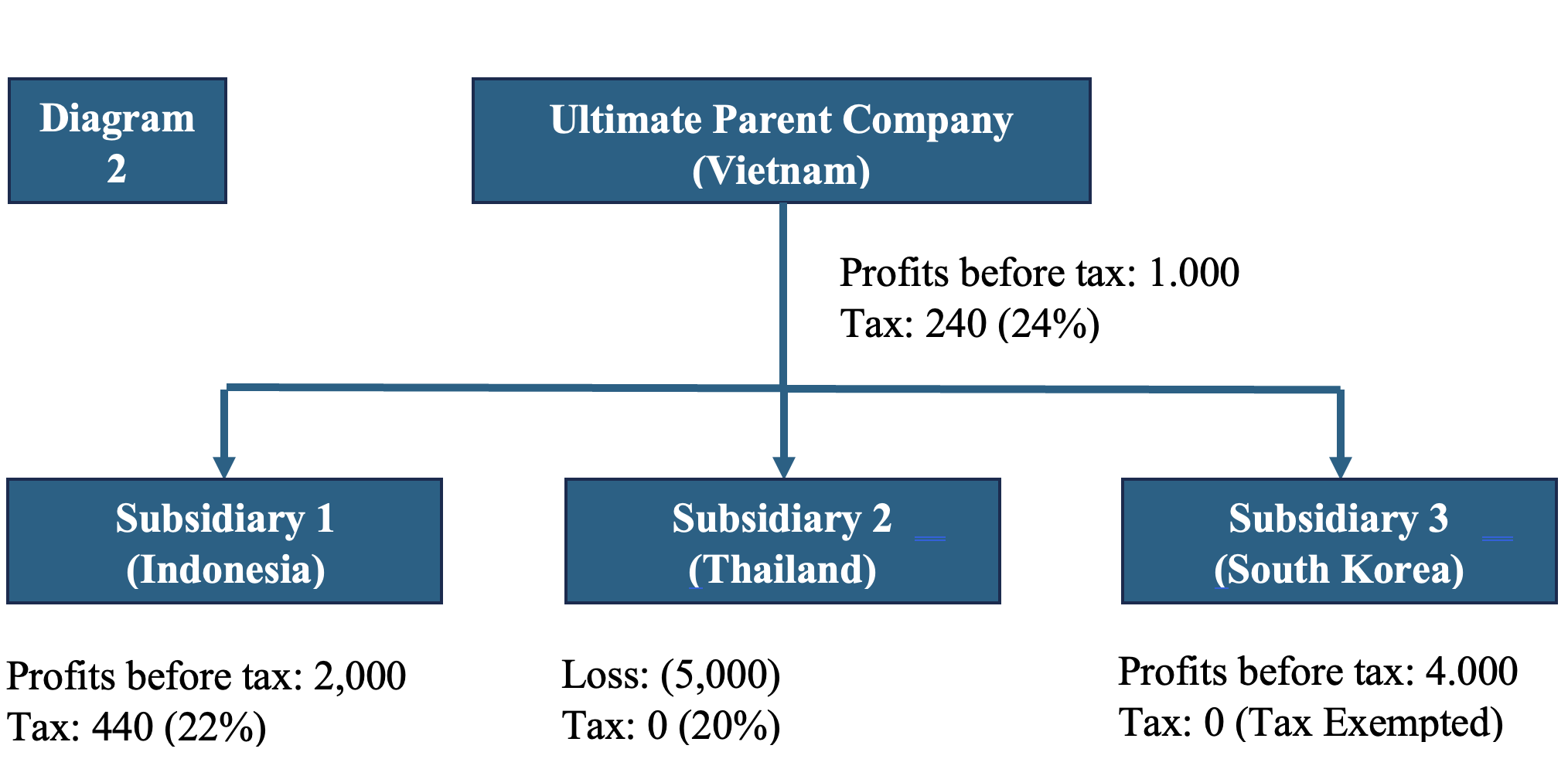
According to this chart, and based on Resolution 107 on Vietnam's application of the IIR, and assuming that Korea does not apply the QDMTT, Korea will lose the right to collect the tax. At that time, Vietnam will collect the tax that should have been collected in Korea under the IIR provisions.

Third, on the declaration and payment of tax under the Resolution 107
According to Clause 1 and Clause 2 of Article 6 of the Resolution 107, enterprises must pay attention to the time limit to comply with the deadline for filing declarations and paying additional taxes as follows:
- For QDMTT: no later than 12 months after the end of the fiscal year; and
- For IIR: no later than 18 months in the first year and no later than 15 months after the end of the fiscal years in the years after the first year.
The next thing that should be noted is the determination of the constituent entity responsible for filing and paying taxes. If the company has more than one constituent unit in Vietnam, the company must notify the appointment of the unit responsible for paying tax under the Global Minimum Tax Rules within 30 days of the end of the fiscal year. If there is no notification, the tax authority will intervene and appoint a constituent entity in Vietnam to file the return and pay the tax.
Fourth, liability relief for enterprises during the transition period
Apart from the above provisions, Decree 107 also provides for liability relief during the transition period of 03 years from January 01, 2024. The liability relief provisions specifically provide that during the transition period, the amount of additional tax under QDMTT and IIR in a country for the tax year will be deemed to be zero if either of the following criteria is met:
- In a fiscal year, a multinational corporation with a qualifying international income statement has total sales of less than EUR 10 million and a pre-tax profit of less than EUR 1 million or suffers a loss in that country.
- The multinational corporation may may benefit from the effective tax rate of that country in the fiscal year. The minimum conversion rate is 15% for 2023 and 2024; 16% for 2025 and 17% for 2026.
- The MNE's pre-tax profit (or loss) in such country is equal to or less than the substance and labor exclusion amount calculated under the global minimum tax rules of the constituent entities in such country according to the Interstate Profit Report.
In terms of administrative fines during the transitional period, Resolution 107 stipulates that violations regarding the declaration and submission of information returns in accordance with the global minimum tax regulations and supplementary corporate income tax returns together with explanations explaining discrepancies due to differences in financial accounting standards.
The above are the notable points of the global minimum tax policy adopted by Vietnam. To date, these regulations have come into effect, which makes research and compliance with these regulations mandatory for enterprises subject to Resolution 107.
Read more at:
VCCI: Nghị quyết 107/2023/QH15 về Thuế tối thiểu toàn cầu: Những lưu ý dành cho doanh nghiệp
Legal Electronic Magazine: Nghị quyết 107/2023/QH15 về thuế tối thiểu toàn cầu: Những lưu ý dành cho doanh nghiệp
[1] Pursuant to Clause 4 Article 3 of the Resolution 107, the ultimate parent company is a company belonging to a multinational corporation that has the power to control, to directly or indirectly own other companies, or organizations of the multinational corporation without being controlled or owned by any other companies, organizations and the financial statement of the ultimate parent company is not merged into a financial statement of any companies or organizations in the globe.


