


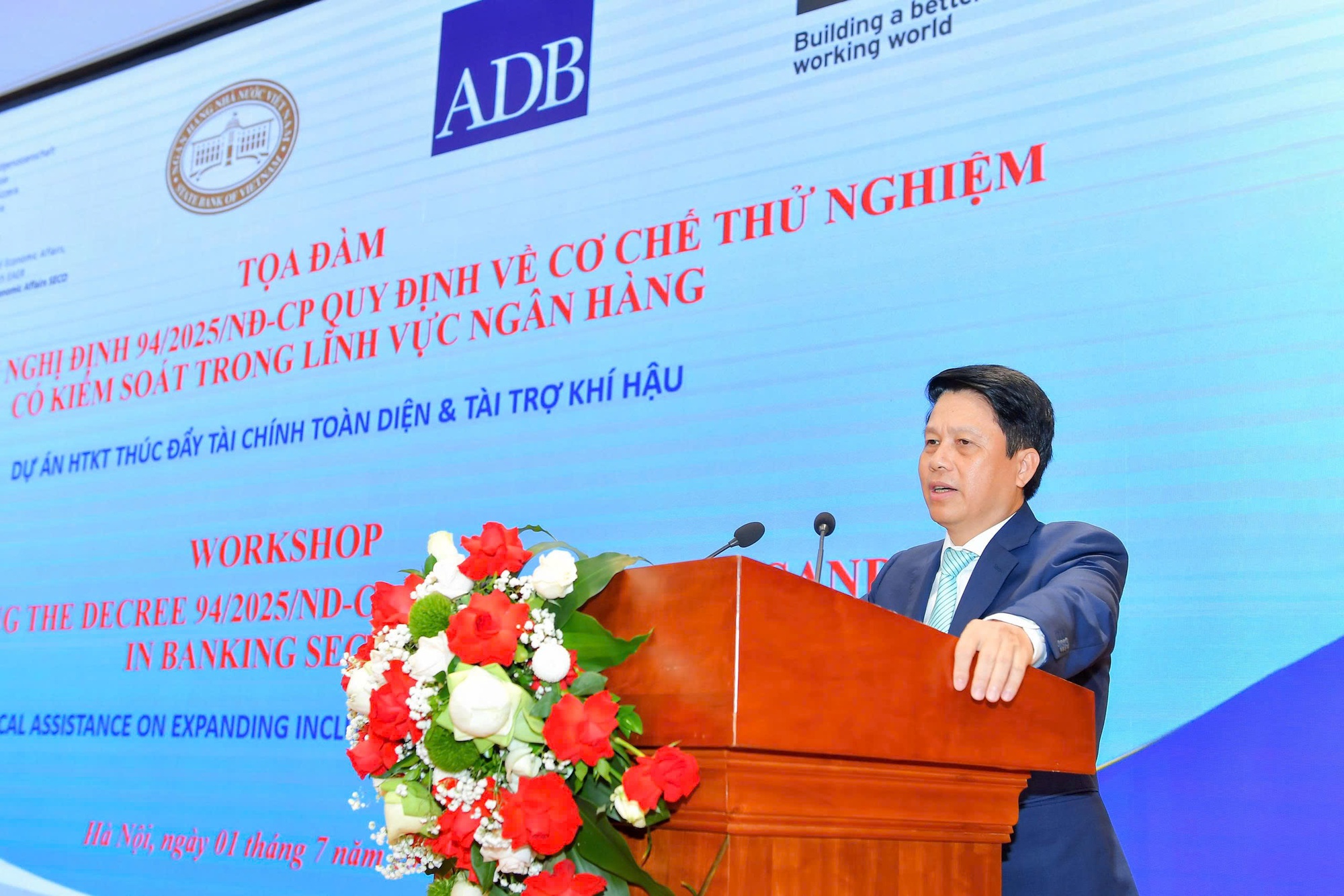
Just over a year after Decree 94/2025/ND-CP on the sandbox testing mechanism in the banking sector was issued, the State Bank of Vietnam (SBV) has proposed to amend a series of regulations related to participation conditions, dossier composition and procedure processing process for fintech enterprises[1].

Source: Government News
At first glance, this seems to be just a technical adjustment to cut administrative procedures. However, if placed in the broader context of institutional reform policies, private economic development, promotion of innovation and national digital transformation, these amendments show a remarkable shift in state management thinking towards new business models.
The most important message of the draft does not lie in the fact that businesses must submit fewer paperwork or meet fewer conditions. What is more noteworthy is that the regulator is gradually shifting from a management model based on records, procedures and input conditions to a management model based on data, monitoring and controlling risks in the process of operation.
In other words, instead of trying to predict and eliminate all risks before allowing businesses to experiment, the State is accepting that innovation takes place within a controlled scope, while at the same time using a supervisory mechanism to manage the risks that arise. This is also the core philosophy that has made the success of sandbox models in the UK, Singapore and many major financial centers around the world.
Why did Decree 94 have to be amended after just over a year?
Decree 94/2025/ND-CP was issued with the goal of creating a legal framework for testing fintech solutions in the banking sector. This is an important step because for many years, one of the biggest barriers to Vietnam's fintech ecosystem has been the gap between the speed of technological innovation and the speed of legal perfection.
However, even in the process of preparing for implementation, many new policies have been issued. Resolution 57-NQ/TW on breakthroughs in the development of science, technology, innovation and national digital transformation requires making institutions a competitive advantage. Resolution 66-NQ/TW on renewing the construction and implementation of the law emphasizes the requirement to build an open legal environment with low compliance costs. Resolution 68-NQ/TW on private economic development aims to sharply reduce business conditions and administrative procedures.
In that context, some provisions of Decree 94 quickly showed signs that they were not really in line with the spirit of the new reform. If the testing mechanism is designed to encourage innovation but the participation procedure itself is too complex, then the sandbox risks becoming a new "sublicense" rather than a tool to promote innovation.
It can be said that the amendment of Decree 94 this time does not come from the requirement to overcome major inadequacies in practice but mainly reflects a change in management thinking. The SBV is actively adjusting the legal framework to better suit the goals of fintech development and digital transformation of the economy.
Opening doors for tech workers
One of the most notable amendments relates to the eligibility for the legal representative or General Director of a fintech business to apply for the sandbox.
According to current regulations, managers must also have a university degree in certain majors and have at least two years of management and executive experience in the field of finance or banking.
The draft amendment changed this approach. Instead of requiring two conditions at the same time, businesses only need to meet one of two criteria. At the same time, the scope of training disciplines and experience fields has also been expanded to accounting, auditing, information technology and payment intermediaries.
This is a change that means more than an administrative condition.
In the global fintech ecosystem, many businesses are founded by software engineers, data experts or people with experience in developing digital products, not traditional bank managers. If we only see fintech as an extension of the banking sector, the staffing conditions will inadvertently eliminate many creative ideas from the first round.
The shift from the condition of "and" to "or" reflects an important realization: the capacity to innovate is not always demonstrated by a degree or years of experience in the financial industry.
This also shows that the SBV is looking at fintech as an intersection between technology and finance rather than just a branch of banking activities.
Record reduction: from pre-inspection to post-inspection thinking
Another noteworthy point is the SBV's proposal to remove many components of the dossier that businesses currently have to submit.
The draft abolishes the requirement to submit a resolution of the Board of Members, the Board of Directors or the General Meeting of Shareholders approving the fintech scheme for trial registration. At the same time, records related to positions such as Deputy General Director or other key personnel are also removed.
From the perspective of corporate governance, these are not meaningless documents. However, the question is whether the regulator really needs these documents to assess the testing capabilities of businesses?
If the goal is to assess the feasibility of the fintech solution and the ability of the business to manage risk, requesting a large amount of internal records may not provide value commensurate with the compliance costs that the business has to spend.
The reduction of records shows that the SBV is gradually shifting from the mindset of "enterprises must prove everything before being able to participate" to the mindset of "enterprises are allowed to participate but must be responsible for what they commit".
This is a shift from pre-inspection to post-inspection – a trend that is being applied more and more widely in the management of technology-based business models.
Manage with data instead of paper management
Perhaps the most notable change in the draft is not the reduction of records, but the change in the way the dossier is processed.
Accordingly, the SBV will actively exploit data from the national database on business registration and investment and the database on diplomas and certificates to replace many types of papers that businesses are having to submit.
This change reflects an important shift in governance.
For many years, administrative procedure reform in Vietnam has mainly focused on reducing the number of papers or simplifying forms. However, reducing paperwork is only a short-term solution. In the long run, the goal should be to completely eliminate the need to submit paperwork when state agencies already have data.
In other words, the real reform is not about requiring businesses to submit three types of papers instead of five. The real reform is that the state agency does not require businesses to submit any kind of papers that the State already has in its data system.
This is also the direction that many countries are pursuing in the process of building a digital government.
Source: Government News
Lessons from Singapore and the UK
When it comes to fintech sandboxes, Singapore and the United Kingdom are often cited as the two most successful models.
In the UK, the Financial Conduct Authority (FCA) has implemented the sandbox since 2016 with the core philosophy of reducing the time and cost of bringing new products to market. The FCA does not require businesses to demonstrate the perfection of their business model before testing. It is important for businesses to clearly define the risks, scope of testing and customer protection measures.
Singapore has opted for a similar approach. The Monetary Authority of Singapore (MAS) has repeatedly stressed that the goal of the sandbox is not to create an additional layer of licensing but to create an environment for innovation to take place safely.
What successful models have in common is that the regulator does not seek to control the business with more records, but with more data. They focus on monitoring the testing process rather than over-testing before the test begins.
From that perspective, the SBV's amendments are showing that Vietnam is gradually getting closer to international practices.
But is it enough?
Despite many positive signals, the draft amendment still leaves some questions worth pondering.
Firstly, the conditions for participation are relaxed, but how will the monitoring mechanism during the trial be strengthened?
In a risk-based management model, the reduction of pre-inspection is only reasonable when accompanied by an effective post-inspection system. If the monitoring capacity does not keep up with the pace of technological innovation, the risk can shift from the licensing stage to the operational phase.
Secondly, the application appraisal time is still relatively long[2] compared to the development speed of technology startups. In the fintech world, six months can be a complete product development cycle. If the processing time is too long, the business may lose the market opportunity even if it is finally approved to participate in the trial.
Third, the new sandbox now focuses on certain areas of banking activities. In the future, as financial technology develops more strongly, the need to expand the scope of testing to new models such as digital assets, artificial intelligence in finance or decentralized financial platforms may continue to be posed.
In other words, the amendment to Decree 94 may be just the beginning of a longer reform process.
Institutions must go faster than technology
The history of the development of fintech in the world shows that technology is always ahead of the law. The problem is not whether the regulator can forecast every new business model. That's almost impossible.
It is more important to develop a legal framework that is flexible enough to receive and evaluate new initiatives as they emerge.
The Sandbox is the tool that was born to solve that problem.
Overall, the draft amendment to Decree 94 shows that the SBV is choosing a more open approach to innovation. Expanding personnel conditions, cutting records, taking advantage of national data, and reducing procedural barriers not only help businesses access the testing mechanism more conveniently, but also reflect a new management philosophy.
It is a risk-based management philosophy instead of paper-based management; managing with data instead of managing with records; and most importantly, creating space for innovation to thrive while ensuring the safety of the financial system.
If this spirit continues to be maintained in the next legal updates, the fintech sandbox can not only be a place to test new technologies but also become a place to test Vietnam's new management thinking in the digital economy.
Lawyer Nguyen Van Phuc
HM&P Law Firm
Read more: Sanbox Fintech: Ngân hàng Nhà nước sẽ quản lý bằng dữ liệu thay vì quản lý bằng giấy t
[1] https://moj.gov.vn/portal/tin-tuc/chi-tiet/ho-so-tham-inh-du-thao-nghi-inh-sua-oi-bo-sung-mot-so-ieu-cua-nghi-inh-so-942025n-cp-ve-co-che-thu-nghiem-co-kiem-soat-trong-linh-vuc-ngan-hang-tgiic32856.html, accessed on 2026/06/20.
[2] Decree 94 requires the SBV to respond to the enterprise's testing mechanism dossier within 90 working days. The draft amendment is expected to reduce this time to 80 days.


