


The article is made in collaboration between VCCI-HCM and HM&P Law Firm. Through this article, our Managing Partner Nguyen Van Phuc and Lawyer Nguyen Nhat Duong would like to highlight some key points of the Regional Planning of the Southeast of 2021-2023, with a vision until 2050. Below is the English version of this article:
On December 15, 2023, the Evaluation Council for the Southeast Regional Plan 2021-2030 with a Vision to 2050 ("Regional Plan"), chaired by Deputy Prime Minister Tran Hong Ha, held a meeting to evaluate the Regional Plan. In this meeting, the Council has agreed that the Regional Planning will be adopted after being amended and supplemented based on the appropriate proposals for the development of the area.
The regional plan is expected to bring a breakthrough to the development of the Southeast in particular and the country in general.
1. Background suitability
The Regional Plan was developed by the Ministry of Planning and Investment in 2021, at the same time when Resolution No. 98/2023/QH15 ("Resolution 98") on piloting several specific mechanisms and policies for the development of Ho Chi Minh City was being developed. Later, on August 1, 2023, Resolution 98 officially came into force, laying the foundation for Ho Chi Minh City to implement the pilot policies designed for the city, as well as the momentum for the overall development of the entire Southeast region. At this time, when the regional plan is about to be promulgated, the contents of Resolution 98 will also become an important part of the Southeast Regional Plan, in which Ho Chi Minh City still plays a leading role.
2. Some key points of the Regional Planning
The Regional Planning of the Southeast of 2021-2023, with a vision until 2050 will comprise the following key points:
The view on the development is to be purposeful and concentrated, prioritizing efficiency in the period up to 2030; development with high growth targets, based on 3 main pillars: people - nature - cultural and historical traditions; taking people as the center, nature as the foundation, cultural and historical traditions as the driving force for development.
a. The region is expected to become the center, the leader, the role model in terms of socio-economic development, and the largest socio-economic center of the country.
b. The economic structure shall focus on industry, service, and tourism; green and high-tech agriculture; modern rural development, and civilized farmers.
c. The development structure includes 03 sub-regions; 06 economic corridors and industrial - urban - service belts; 02 green-ecological corridors linked to river basins; the national dynamic zone with Ho Chi Minh City as the growth pole; Redistribution of industrial-urban space linked to the transformation of industrial parks according to modern, ecological and circular models.
d. Improve high-tech industries, and high-quality services, giving the priority to the development of the semiconductor industry, chip manufacturing, and financial services with the hope of making Ho Chi Minh City into the global financial center
e. Develop and complete the transportation infrastructure such as highways, high-speed railways, urban regional railways, Long Thanh International Airport, and Cai Mep – Thi Vai international transshipment ports; to facilitate the investment in the intra-regional, trans-regional transportation infrastructure and connectivity with the region. In addition, to develop the international financial center in Ho Chi Minh City.
3. Some notable particulars
The Regional Planning has set many special targets for the development of the Southeast from 2021 to 2030, such as economic and infrastructure targets as follows: (i) the average GRDP growth rate in the period 2021 - 2030 will reach about 8-8.5%; and the per capita GRDP at current prices will be about 380 million VND, equivalent to 14,500 USD; (ii) the proportion of service sector accounts for 41.7% of GRDP, the industry and construction sector accounts for 45.3% (processing and manufacturing industry alone accounts for 33%), the agriculture, forestry and fishery sector accounts for 2. 3%, product tax minus subsidies accounts for 10.7%; (iii) digital economy accounts for about 30-35% of GDP; (iv) urbanization rate reaches about 70-75%; (v) completion of Ring Road 3, Ring Road 4 of Ho Chi Minh City, expansion of Tan Son Nhat International Airport, completion of Long Thanh International Airport Phase 1.
In addition, the Southeast region aims to become a modern developed region with income at the level of developed countries; to have strong economic potential and modern economic structure; to become the center of science, technology and innovation, high-tech industries, logistics and the top international financial center of the region and the world; and to have modern and synchronized infrastructure. At the same time, Ho Chi Minh City should be the nucleus, the growth pole of the region; a place where talents, experts, scientists, especially high-quality human resources and young intellectuals will be attracted to live and work; where international financial institutions, large economic corporations of the world will be located.
It can be seen that the goals set for the Southeast in the Regional Plan are very ambitious. Considering these goals in terms of the overall development direction of the Southeast region and the pilot policies applied to Ho Chi Minh City in Resolution 98, the development direction for the whole region is currently quite consistent.
In order to achieve the above-mentioned goals, the Regional Plan also targets several important and noteworthy development solutions.

3.1. To develop by sub-region
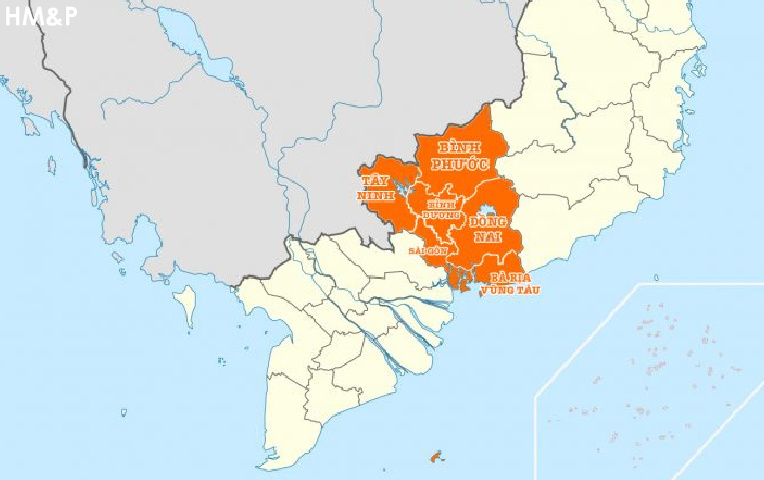
With the above GRDP structure, the regional planning aims to develop the Southeast by sub-region. Specifically, the regional planning divides the Southeast into 03 sub-regions, which are the central sub-region, the coastal sub-region and the northern sub-region.
Accordingly, the central sub-region includes Ho Chi Minh City, the south of Binh Duong and the southwest of Dong Nai. This will be the heart of the region's development, with high-tech industries, specialized industries, and high-quality services. We believe this is the appropriate solution to serve as the nucleus for the development of the whole region. With the existing resources, the central sub-region can generate products and processes with high added value in the value chains of the region and possibly the world. Moreover, with the limited land resources inside and outside the industrial parks, export processing zones and high-tech parks, the development of the central sub-region under the above plan is reasonable.
Meanwhile, the logistics industry and other sectors such as tourism, seaports, petrochemicals, etc. will be developed in the coastal sub-region including Can Gio District and Ba Ria - Vung Tau. With the strength of geography and marine resources, the division of the coastal region from the central sub-region will enhance the potential of this region more specifically.
The last sub-region is the northern sub-region, which includes Tay Ninh, Binh Phuoc and the north of Dong Nai and Binh Duong provinces. With abundant land and labor resources, this sub-region is arranged to maintain the development of border gate economy, logistics, and the expansion of industrial development space of the whole region. At the same time, this sub-region will ensure the development of a green and sustainable economy as it plays a crucial role in protecting the landscape, water sources, forest ecosystems and biodiversity.
3.2. Giving priority to the development of the Southern Key Economic Zone
The Southern Key Economic Zone, comprises Ho Chi Minh City, Binh Duong, Dong Nai, and Ba Ria–Vung Tau, and is also considered as the National Key Economic Zone. Therefore, investors when investing in the Southern Key Economic Zone must also pay attention to the following points:
i. To focus on the development of science, technology and innovation ecosystem, leading the growth model, building digital economy and social. Develop innovation centers and creative incubators in Ho Chi Minh City, Binh Duong and Dong Nai. Attract research and development (R&D) facilities of large enterprises from other countries.
ii. Promote the development of financial services, banking, science and technology, and logistics. To promote the development of Ho Chi Minh City as an international financial center. Attract investment in high-tech industries; production of electrical and electronic products, processing and manufacturing industries. Develop information technology industrial parks, software parks, artificial intelligence; and marine economy such as logistics services, oil and gas extraction and processing, marine tourism.
iii. Prioritize investment in a freight railway connecting with Cai Mep - Thi Vai International Gateway Seaport, making it the most important international transshipment port; construction of Ho Chi Minh Ring Road No. 3 and No. 4 and other land highways; construction of Long Thanh International Airport and Airport urban development.
iv. Improve regional infrastructure connectivity and motivate for linkage and spillover to promote cooperation and development with other regions such as the Mekong Delta, the Central Highlands, and the South Central.
3.3. Investment promotion solutions

With the above specific development and goals, the Southeast needs a special plan to attract investment capital for the whole region. The Regional Planning also set out some solutions to attract investment, as follows:
i. Prioritize State resources for investment and development of economic infrastructure and technical infrastructure, especially transportation and social infrastructure and interregional transportation infrastructure. Use the state budget to support public-private partnership projects as seed capital and invest in projects that are hardly financed by private capital. Efficiently combine the central and local capital, with appropriate mechanisms and policies to attract private capital and other lawful capital sources to invest in the construction of transportation infrastructure Utilize the land fund formed from investment in the construction of transportation infrastructure for reinvestment.
ii. Promote the decentralization of socio-economic management through the capacity of localities in the region. Develop a pilot mechanism to attract resources from the localities in the region for regional cooperation programs and projects.
iii. Improve the efficiency of investment promotion activities, and formulate joint investment promotion programs of the region. Selectively attract investment by focusing on advanced technology projects, high value-added projects, less labor and resource intensive projects, and environmentally friendly projects.
iv. Intensify administrative reform to improve the business environment and create outstanding competitive advantages for businesses and citizens. Prepare the necessary conditions to attract investment, such as clean land funds, strengthening the training of high-level human resources, policies and measures to develop supporting industries, etc.
v. Complete the legal system, mechanisms, and policies to ensure a modern and synchronized financial services sector to attract capital for the development of regional socio-economic.
Through the regional planning, it can be seen that the state recognizes the Southeast region with an extremely important position and role in the overall development of the country. On the basis of this planning, the municipalities should take immediate measures for their local development and gradually realize the goals set out in the Regional Planning.
Read the article on VCCI website at: Quy hoạch vùng Đông Nam Bộ – Trọng điểm phát triển quốc gia


