


Disclosure of information is an essential obligation that public companies must fulfill, especially when they hold the General Meeting of Shareholders. According to the provisions of the law, this disclosure is required before and after the meetings, depending on the various contents disclosed. However, in practice, some companies that are not authorized to hold such meetings continue to disclose information, including the minutes of the general meeting of shareholders, after the scheduled time of the meeting. This raises the question of whether these companies have grounds for taking minutes and disclosing information in this case. In this article, the author will analyze the appropriateness of taking minutes and disclosing information when the general meeting of shareholders is not eligible to be held from the perspective of large listed companies in Vietnam.
1. Conditions for the preparation of the General Meeting of Shareholders
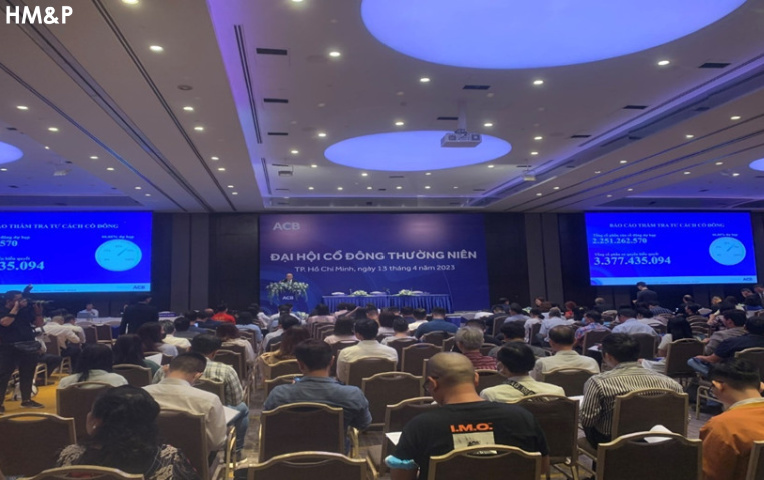
The Law on Enterprises 2020 does not contain any specific provisions mentioning the conditions for making minutes of the general meeting of shareholders. However, according to Clause 1, Article 150 of the Law on Enterprises 2020, the meeting of the general meeting of shareholders shall be documented in minutes, which may be audio recordings or other electronic forms. At the same time, the content of the minutes must include a number of information prescribed by law, such as the progress of the meeting and the status of voting. Thus, it is clear that the minutes contain information that exists or arises only if the general meeting of shareholders is held and may be held. Logically, the minutes of the meeting are documents that record objective facts concerning the meeting. Therefore, a prerequisite for the preparation of minutes is that the general meeting of shareholders is authorized to be held. In practice, there are still companies that prepare meeting minutes even if the general meeting of shareholders is not entitled to be held, such as in the recent case of Hoa Binh Construction Group Joint Stock Company (“HBC”)[1]. The minutes of this meeting stated that HBC examined the status of shareholders and the conditions for holding the meeting before determining that the meeting was ineligible to be held. The minutes prepared by HBC cannot be considered as the minutes of the general meeting of shareholders pursuant to Clause 1 Article 150 of the above-mentioned Law on Enterprises 2020 because this meeting was ineligible to be held.
Therefore, it can be seen that the minutes prepared to record the results of the examination of the status of the shareholders, the conditions for holding the meeting, and the conclusion that the general shareholders' meeting is not authorized to be held are merely a way to record objective facts. It confirms that HBC has held the meeting as previously announced, but that the meeting is not entitled to be held. However, it does not serve as the meeting minutes of the General Meeting of Shareholders in accordance with the Law on Enterprises.
2. What information about the general meeting of shareholders is required to be disclosed by a large public company?
Regarding the information disclosure of the general meeting of shareholders when the meeting is not eligible to be held, in addition to HBC, C.E.O. Group Joint Stock Company ("CEO") also sent a document to the State Securities Commission and Hanoi Stock Exchange on June 30, 2023, notifying them that the first meeting of the company was not eligible to be held and announcing that it would convene the second meeting[2].
According to Clause 1 Article 3 of Circular 96/2020/TT-BTC on guidelines on information disclosure on the securities market, a large public company is a public company with equity of VND 120 billion or more as shown in the latest audited annual financial statements. The 2022 audited consolidated financial statements of HBC and CEO show that each company has equity of VND 2,741,332,700,000[3] and VND 2,573,399,850,000[4], respectively. Therefore, both HBC and CEO are considered to be large public companies. However, in principle, the obligation to disclose information related to the general meeting of shareholders of a large public company is no different from that of a typical public company.

For the obligation to disclose information of the general meeting of shareholders, a public company shall disclose information of the general meeting of shareholders on its website and the website of the State Securities Commission and the stock exchange (if it is a listed or registered organization) at least 21 days before the opening date of the general meeting of shareholders, unless a longer period is stipulated in the company’s charter. A public company shall disclose information on the meeting of the general meeting of shareholders, including: the notice of the general meeting of shareholders, the agenda of the meeting, the voting slip, the meeting documents and the draft resolution on each item on the agenda[5]. Next, the public company must disclose information within 24 hours from the time on which decisions of the General Meeting of Shareholders are ratified, whether it is an annual or extraordinary meeting. Documents to be disclosured include: the resolution of the General Meeting of Shareholders, meeting minutes and documents attached to meeting minutes and resolution[6]. It should be noted that before disclosing information that is documents of the meeting of the General Meeting of Shareholders, the public company shall disclose information about the anticipated record date for the exercise of rights for existing shareholders for attending the meeting of General Meeting of Shareholders at least 20 days prior to the anticipated record date[7].
Thus, it can be seen that regarding the meeting of the General Meeting of Shareholders, large-scale public companies in particular and public companies in general must disclose information at least 03 times, including 01 time after ratifying the decision of the General Meeting of Shareholders.
3. Does the public company have to disclose information when the meeting of the General Meeting of Shareholders is not eligible to be conducted?
The meeting of the General Meeting of Shareholders that is not eligible to be conducted cannot certainly give rise to decisions of the General Meeting of Shareholders. The recording of the meeting that is not eligible to be conducted and the notice of the proposed convening of the second meeting cannot be considered a decision of the General Meeting of Shareholders. This is simply the procedure prescribed by the Law on Enterprises when the first meeting is not eligible to be conducted. It is assumed that the company does not make the minutes that record the fact that the meeting of the General Meeting of Shareholders is not eligible to be conducted, this meeting can still be held a second or third time in compliance with law. Therefore, the fact that a public company makes the minutes that record the fact that the meeting of the General Meeting of Shareholders is not eligible to be conducted, and notifies or reports to the State Securities Commission and the Stock Exchange has little significance. Since these companies still have to fulfill their obligation to disclose information about the meeting of General Meeting shareholders at least 21 days before the opening date of the meeting of the General Meeting of Shareholders for the second or even third meetings. On the other hand, as was mentioned in the preceding section, the law has set forth the circumstances in which information must be disclosed and the specific information that must be disclosed about the meeting of the General Meeting of Shareholders. Accordingly, it is not reasonable for public companies to disclose information about a meeting that is ineligible to be conducted, or even the meeting minutes of the General Meeting of Shareholders when such a meeting is ineligible to be conducted. Furthermore, there is no legal basis for such disclosure.
In conclusion, it can be understood that the purpose of making meeting minutes and disclosing information even when the meeting of the General Meeting of Shareholders is not eligible to be conducted is to record the incident and promptly report to shareholders and State agencies. However, this work also needs to be done reasonably, on the basis of compliance with the provisions of the law, because after all, these companies are large companies/corporations, it is necessary to ensure the legal grounds for any of their actions.
__________________
The article were written by Lawyer Nguyen Van Phuc an Lawyer Nguyen Nhat Duong and was published on The Court Magazine dated 05 August 2024.
Read more at: https://tapchitoaan.vn/ban-hanh-bien-ban-hop-dai-hoi-dong-co-dong-khi-cuoc-hop-bat-thanh-lieu-da-hop-phap11606.html
[1] https://cafef1.mediacdn.vn/download/280823/hbc-bien-ban-hop-h-c-bat-thuong-nam-2023-khong-thanh-cong-0.pdf, accessed on September 13, 2023.
[2]http://ceogroup.com.vn/public/media/files/cv_tri%E1%BB%87u_t%E1%BA%ADp_h%E1%BB%8Dp_l%E1%BA%A7n_2_-_signed.pdf, accessed on September 13, 2023.
[3] https://hbcg.vn/storage/pdf/report/20230630041625.pdf, accessed on September 13, 2023.
[4] http://ceogroup.com.vn/public/media/files/bchop_nhat_c.e.o_2022.pdf, accessed on September 13, 2023.
[5] Point a Clause 3 Article 10, Point a Clause 3 Article 11 of the Circular No. 96/2020/TT-BTC.
[6] Point a Clause 3 Article 10, Point a Clause 3 Article 11 of the Circular No. 96/2020/TT-BTC.
[7] Point b Clause 4 Article 11 of the Circular No. 96/2020/TT-BTC.


