


1. What is a public offering of shares?
Public offering of shares is a form of securities offering to the public, which is specified by the Law on Securities 2019 in Clause 19 Article 4, specifically, a company may offer to sell shares through one of the following methods:

2. In which cases is a company allowed to conduct an initial public offering of shares?
An initial public offering (IPO) includes involves either or a combination of the following:

3. What is a public company?

4. Can a limited liability company allowed to carry out an initial public offering of shares?
According to the regulations, a share means a type of securities that certify the legal rights and interests of an owner of a part of the charter capital in the issuing organization[1]. Therefore, a limited liability company may conduct an initial public offering of its shares, but it must change its form from a limited liability company to a joint stock company.
A limited liability company conducts initial public offering to convert the limited liability company into a joint stock company by means of initial public offering of shares to become a public company by changing the ownership structure without increasing the charter capital of the issuing organization or combining additional forms of initial public offering of shares to raise more capital for the issuing organization.
Example: Company A is a single-member limited liability company whose owner is Mr. X and whose charter capital is VND 30 billion. Company A can conduct an IPO to convert the limited liability company into a joint stock company in the following method:

5. What are the requirements for a joint-stock company wishing to conduct an IPO?
A joint-stock company wishing to carry out an IPO of shares must meet the conditions set forth in Clause 1 Article 15 of the Law on Securities 2019, specifically including:

Note 1: If the method of initial public offering of shares, in case a joint stock company uses the form of initial public offering of shares to become a public company by changing in the ownership structure but does not increase the charter capital of the issuing organization, the joint stock company is not required to have a plan for using the capital obtained from the share offering being approved by the GMS.
6. What are the requirements for a limited liability company wishing to make an initial public offering of shares have to fulfill?
A limited liability company wishing to make an initial public offering of shares must meet the conditions set forth in Article 15 of Decree 155/2020/ND-CP [2] and Clause 1 Article 15 of the Law on Securities 2019, specifically including:
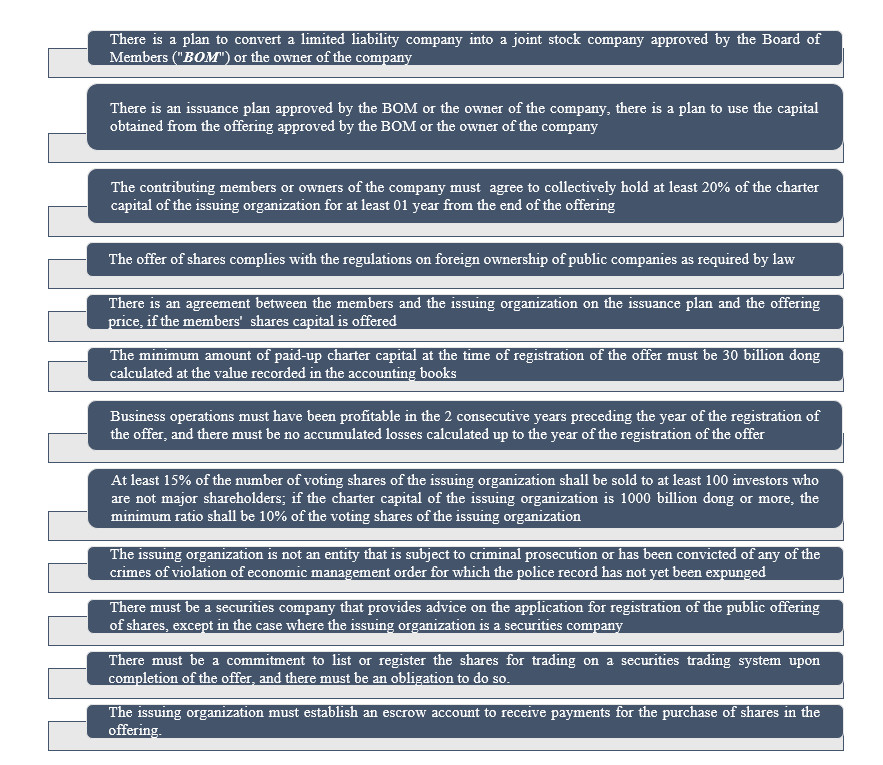
Note 2: Similar to Note 1, if a limited liability company uses the form of an initial public offering of shares to become a public company by changing the ownership structure but without increasing the charter capital of the issuing organization, the limited liability company is not required to have a plan for the use of the capital obtained from the offering being approved by the BOM or the company owner.
7. Why does a limited liability company wishing to make an initial public offering of shares have to obtain a commitment from capital contributors or company owners to jointly hold at least 20% of the issuing organization's charter capital for at least 01 year from the end of the public offering?
This regulation is similar to the regulation that requires major shareholders before the time of initial public offering of shares to commit jointly to hold at least 20% of the charter capital for at least 01 year from the end of the public offering, in the case of a joint stock company carrying out the initial public offering of shares.
The purpose of these provisions is to ensure, to a certain extent, that the company maintains stability in its ownership structure and business operations after the IPO and to avoid dilution of the company's shares.
8. Can a company that is already a public company conduct an IPO?
According to the regulations, a public company is not necessarily a joint stock company that has successfully conducted an IPO by registering with the SSC, but it can be a joint stock company whose already contributed charter capital is at least VND 30 billion and at least 10% of the voting shares are held by at least 100 investors who are not major shareholders. Thus, in the second case, a public company can completely conduct an IPO to raise more capital, or shareholders of a public company may offer to change the shareholder structure without increasing the charter capital.
9. Why should companies ensure that at least 15% of voting shares are sold to at least 100 investors who are not major shareholders; if the company's registered capital is over VND1,000 billion, the minimum ratio is 10% of the company's voting?
The purpose of this regulation is to prevent the abuse of power by major shareholders in the management of the company after the IPO, and at the same time to ensure the true nature of a public company that satisfies the number of small investors.
10. General procedure for the IPO
|
Step |
Scope of Work |
|
1 |
Companies and shareholders registering for an offer shall send the registration documents for the initial public offering of shares to the SSC |
|
2 |
Companies and shareholders registering for an initial public offering amend and supplement the application for registration of the initial public offering (if any) |
|
3 |
Companies and shareholders registering for the offering shall send to the SSC 06 Official Prospectus to complete the procedures for the issuance of the Certificate of Registration of the Public Offering ("Certificate") within 07 working days from the date of receipt of a notice from the SSC of the request to complete the procedure for the issuance of a Certificate. |
|
4 |
The SSC shall grant or deny granting the certificate (in writing and clearly state the reason) within 30 days from the date of receipt of a complete and valid application for registration of the IPO |
|
5 |
Within 07 working days from the effective date of the certificate, the company, the shareholders registering the offer must publish the notice of issuance on 01 electronic or printed newspaper in 03 consecutive issues and publish the information on the website of the Company, the shareholders registering the Offer being an organization (if any), the Stock Exchange ("SE"). The Official Prospectus shall be simultaneously published on the websites of the company, the Shareholder Registering for the Offer (if any) and the SE |
|
6 |
Companies and shareholders registering for an offer to distribute shares |
|
7 |
Enterprises or guarantors, shareholders registering the offering must send a report on the results of the offering together with the confirmation of the bank or foreign bank branch where the escrow account is opened on the proceeds of the offering to the SSC within 10 days from the end of the offering and publish information on the websites of the enterprise, the shareholder registering the offering is an organization (if any), the SE on the results of the offering |
|
8 |
Within 03 working days from the date of receipt of a complete and valid report on the results of the public offering, the SSC is shall:
|
|
9 |
Companies and shareholders registering for the Offer are required to unfreeze the proceeds of the Offer upon receipt of a notice of receipt of the report on the results of the Offer from the SSC |
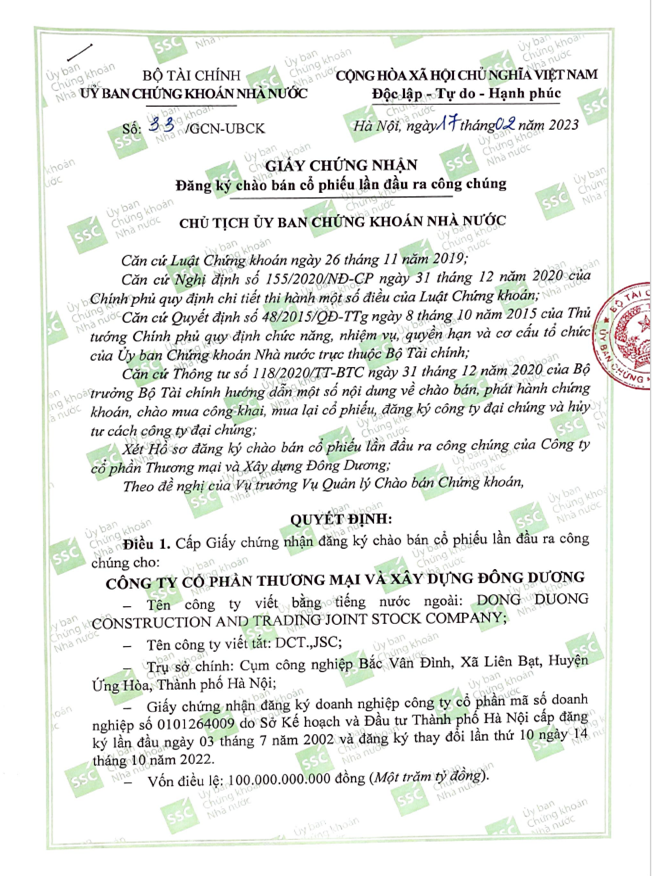
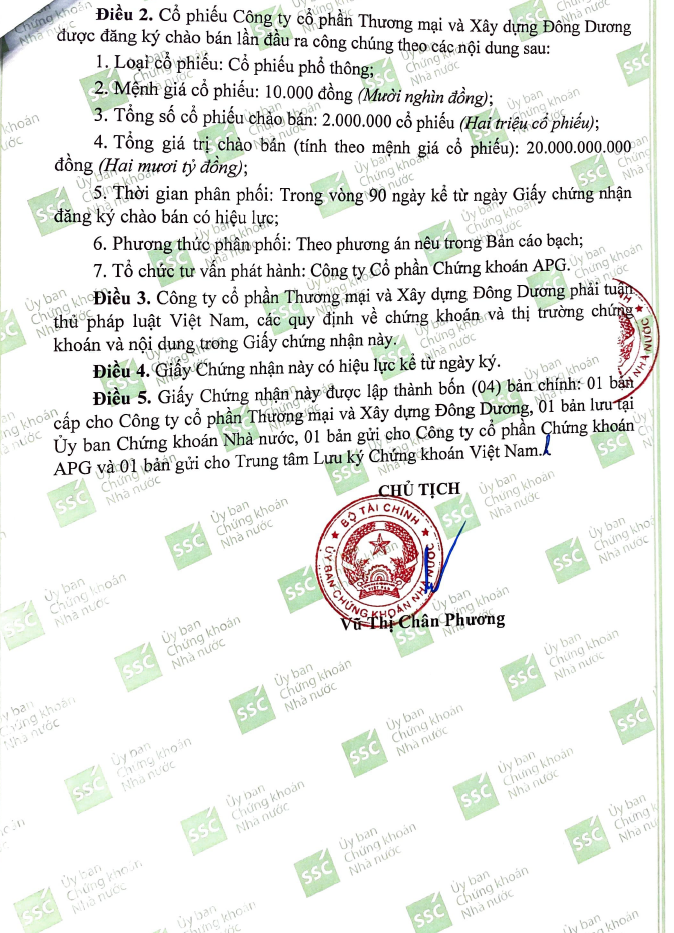
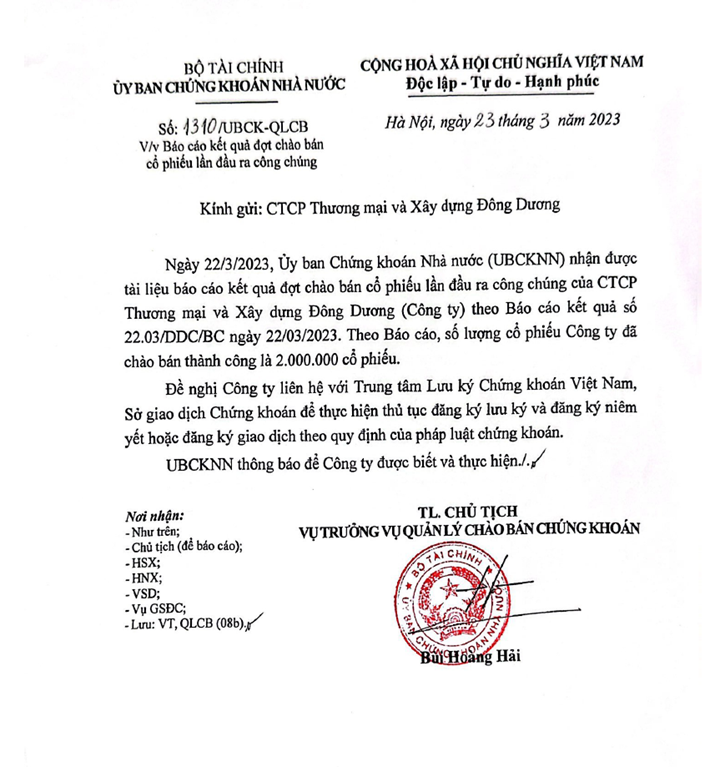
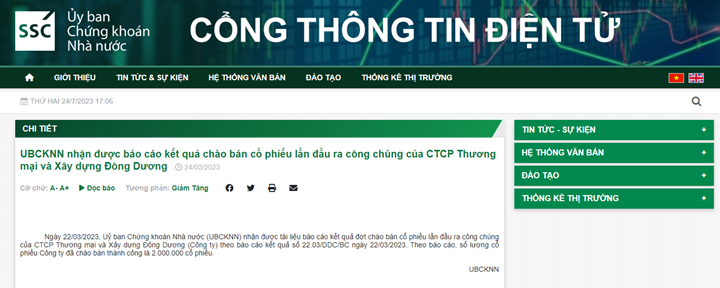
Some illustrative pictures and documents on the initial public offering procedure. (These documents are publicly posted on the website of the company that has conducted the initial public offering (public company) and the State Securities Commission.)
- Certificate of registration of an IPO
- Announcement on the Notice of the company's IPO on the e - newspaper

- Official letter approving the results of an IPO
-
Contents published by the SSC on the website of the SSC upon receipt of the report on the results of the IPO
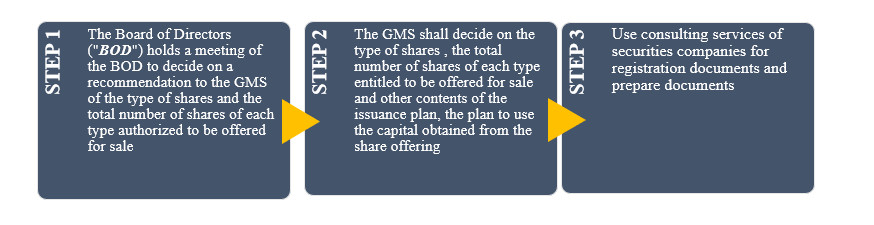
11. Necessary procedures before sending registration documents of initial public offering of shares to the SSC for joint stock companies
12. Necessary procedures before sending registration documents of initial public offering of shares to the SSC for limited liability companies
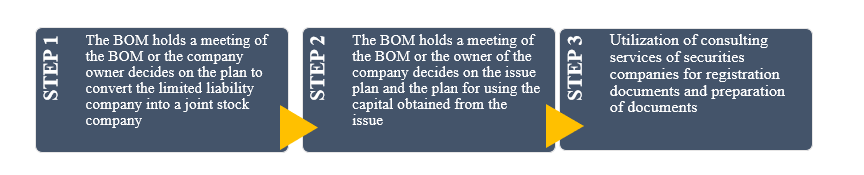
Note 3: The plan of conversion of a limited liability company into a joint stock company must specify the method of conversion of the type of enterprise, i.e., conversion for the purpose of raising additional capital or not for the purpose of raising additional capital or a combined method of raising additional capital and selling capital contributions of members and owners of the enterprise. At the same time, it must clearly state the expected charter capital structure of the company after the conversion, which includes: the number of shares of members/owners of the company, the number of shares offered to the public (including: the number of shares offered for sale to raise more capital for the issuing organization, the number of shares sold by members/owners of the company, the number of shares offered to other entities (if any).
13. When does the limited liability company apply for conversion?
According to the provisions of Clause 3 Article 202 of the Law on Enterprise 2020, the conversion shall be registered with the business registration authority within 10 days date of completion of the conversion. According to the regulations, there are still some cases in which the initial public offering of shares may be suspended or canceled, for example the case of failure to meet the minimum requirement of 15% of voting shares to be sold to at least 100 investors who are not major shareholders. Therefore, in such cases, the conversion of company form will not be completed.
Therefore, the registration of conversion from a limited liability company to a joint stock company will be carried out within 10 days from the date of the notification of the receipt of the SSC's report on the results of the offer.
14. What documents must a limited liability company prepare in order to meet the conditions of the obligation to list or register for trading of shares in the securities trading system after the end of the offer?
The provisions of Clause 6 Article 15, Clause 7 Article 16, Clause 8 Article 11 of the Decree 155/2020/ND-CP, Point h Clause 1 Article 15 of the Law on Securities 2019 refer to the statement that the offering documents of a limited liability company will be similar to those of a joint stock company in the sense that they must have a written commitment to list or register for trading of shares on the stock trading system after the end of the offering. However, unlike a joint stock company, where this commitment is made by the BOD, for a limited liability company, this commitment is made by the BOM or the owner of the company.
15. Does an IPO consider as a listed company?
IPO and listing registration are two completely different procedures, IPO is only the first step to create conditions for a company to become a public company, from which the company will must register for trading or register for listing on the stock exchange, depending on the company's conditions. However, after the IPO and becoming a public company, the company noted that it must carry out the procedures for securities registration with the Vietnam Securities Depository and Clearing Corporation (Vietnam Securities Depository (VSD)) in accordance with the laws.


