


In the modern economy, restructuring, or in other words, reorganizing businesses through division or separation, has become a crucial strategy for businesses to adjust their scale and optimize operations. However, many businesses still misunderstand these two procedures, leading to decisions that do not align with their business strategies. This article will focus on analyzing and highlighting the differences between business division and separation, thereby helping businesses to accurately understand the nature of these activities and make more informed decisions.
The fundamental difference and legal consequences
A major reason for the confusion between corporate division and separation is the misunderstanding of the basic differences and legal outcomes of each process.
According to Clause 1 Article 198 of the Law on Enterprise 2020, business division is a form of restructuring in which a limited liability company or joint-stock company is divided into new companies. Upon the completion of this process, the previous company terminates its existence and the new companies will inherit all financial obligations, including debts to creditors, labor contracts, and other financial obligations. In this case, the divided company no longer exists, and the new companies shall be jointly and severally liable for all obligations of the divided company.
Meanwhile, business separation, as stipulated in Clause 1 Article 199 of the Law on Enterprise 2020, is transferring a portion of the assets of an existing company to establish one or more new companies while the previous company continues to exist. This is a significant difference between division and separation: business division results in the termination of the former company, while business separation allows both the old and new companies to coexist.
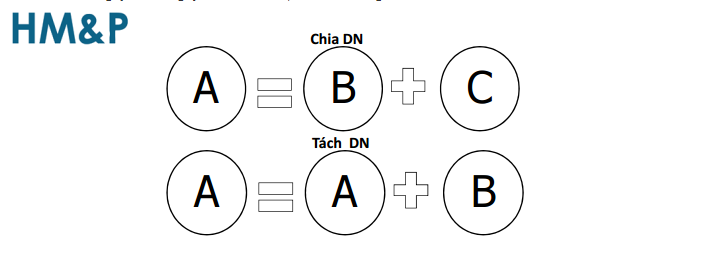
To illustrate, a company division can be applied when shareholders of a joint-stock company wish to completely separate the company’s operations to establish independent companies, thereby terminating the existence of the original company. Each new company would be solely responsible for its own financial and legal obligations. Conversely, if the joint-stock company only wants to separate a business unit, such as the Product Development department, to serve the research and production of a new product line without affecting its current operations then a business separation would be a suitable option.
Essentially, for multi-member limited liability companies and joint-stock companies, company division can be carried out by dividing the company’s assets, including the charter capital and assets of one or more members or shareholders, into new companies. Members or shareholders of the divided company will transfer to the new companies as agreed upon in the decision or resolution on the company division. After the company division, members of the divided company will have rights and obligations corresponding to the proportion of capital and assets allocated to the two or more new companies. Similarly, business separation is carried out in a similar manner. However, for single-member limited liability companies, the nature of company division and separation is based on the division and separation of assets to establish new companies, rather than on the division and separation based on company members, as this type of company has only one member who is also the sole owner. The division of charter capital and company assets will lead to changes in the capital and other assets of each new company as decided by the owner after completing the procedures. Therefore, enterprises need to understand that company division and separation are not merely legal procedures but also have a profound impact on the capital structure and assets of the new companies.
It is also important to note that while both business divisions and separations result in new companies assuming the financial obligations of the original company. The implications differ significantly in that in a division, the previous company terminates its existence, necessitating negotiations with creditors, customers, and employees to settle outstanding obligations. In contrast, in a separation, the original company continues to exist and shares joint responsibility with the new company, unless otherwise agreed.
Note on implementation methods and suitable choices for business purposes
Both division and separation are means of corporate restructuring, however they go with different purposes.
Business division is often carried out when shareholders or investors want to create new, completely independent legal entities to separate interests, assets, and liabilities between parties. Division can help resolve internal conflicts and simultaneously expand business operations in different directions. For example, a large manufacturing company that owns multiple brands may choose to divide the company when it wants to separate the distinct operating segments for these brands to focus on performance and optimize the business efficiency of each company, as well as terminate the existence of the original brand management unit. Conversely, separation is often applied when a company wants to separate a specific division to focus on developing a new business area without affecting the company's operations. A typical example is Vingroup, which applied the separation method to its subsidiary, Vinpearl Joint Stock Company, and established a new company called Ngoc Viet Company[1] to align with the company’s operating principles and the group's orientation. The separation allows the newly separated companies to develop independently.

Articles 198 and 199 of the Law on Enterpise 2020 detail the procedures for business division and separation. For business division, shareholders or members of the divided company must approve the resolution on company division as well as internal decisions for the new company, followed by the registration of the establishment of these companies. Meanwhile, business separation requires an agreement between the relevant parties on the allocation of assets, rights, and obligations between the divided company and the new company in the resolutions and decisions of the divided company. Additionally, businesses should note that one of the major challenges of conducting a business division or separation is the financial risk associated with financial obligations and taxes. Business division can lead to increased administrative and tax costs as the new companies must comply with current tax and legal regulations. In particular, when dividing a company without fully settling debts or related financial obligations, the new companies may face the risk of lawsuits and associated dispute resolution costs. For business separation, although the original company still exists, the joint and several liabilities for financial obligations between the original company and the new company can create significant financial pressures, especially if the new company operates inefficiently or faces financial difficulties.
When considering the regulations on business division, a significant issue arises regarding the disruption of the division process due to the requirement for agreements between the new companies and the creditors of the divided company regarding the inheritance of payment obligations. From the creditors’ perspective, the termination of the original company through division can easily lead to concerns about the new companies evading payment obligations, despite being publicly recorded in the division resolution. However, from the company’s perspective, if there is no consensus among the parties, delays in the division process are inevitable. Moreover, due to concerns about using company division to evade debt repayment obligations, creditors have the right to request the court to initiate bankruptcy proceedings against the divided company before it completes the division procedure. Therefore, it is essential to note that the arrangement for fulfilling the obligations to the creditors of the original company and the creditors’ consent are crucial conditions in the business division process. Only when the new companies and the creditors reach a clear agreement can the division process proceed as prescribed by law.
Business division and separation are two significant corporate restructuring methods but they have distinct differences. Misunderstanding these two can lead to severe legal and financial consequences for businesses. Therefore, enterprises need to thoroughly understand the legal nature of each method, clearly define their objectives, and select the appropriate one. To mitigate risks, consulting with experts is crucial to ensure the long-term interests of the business.


