


Recruiting foreign workers is an essential need for many Vietnamese businesses today, especially in fields related to technology, engineering, and management. This is due to the foundation of knowledge, specialized skills, international experience, language skills, and international networks in specific sectors where foreign workers have advantages over local Vietnamese workers. The presence of high-quality foreign personnel helps enterprises to improve competitiveness, expand business relationships, and deeply integrate into the international market. However, the recruitment and use of foreign labor also comes with certain considerations that companies need to be aware of. In this article, HM&P will discuss some key points that companies should pay special attention to when recruiting and employing foreign workers.

1. Cases in which businesses can employ foreign worker
Vietnam currently has a large labor force, so that ensuring employment opportunities for the working-age population is a task assigned to government authorities. Therefore, under the regulations of the Labor Code, enterprises are only allowed to recruit and employ foreign workers in Vietnam in specific cases, including the following job positions[1]:
- Manager;
- Executive
- Specialist; and
- Technical workers
Specifically, these positions must be ones that cannot be filled by local Vietnamese workers based on the production and business needs of the company.
According to the regulations, prior to recruiting and employing foreign workers in Vietnam in the above-mentioned positions, companies must explain the need for foreign workers and obtain written approval from the relevant state authorities. The Labor Code does not specify quantitative criteria for the appropriate recruitment and use of foreign labor. Therefore, when explaining the need for foreign workers, companies must provide as much detail as possible about the position to be filled, the shortage of Vietnamese workers, and the suitability of foreign workers.
2. Conditions for foreign workers to work in Vietnam
Basically, the conditions for foreign workers to work in Vietnam differ in certain aspects compared to domestic workers. These conditions include:
- Foreign workers must be at least 18 years old and have full civil capacity. When recruiting and employing Vietnamese workers, enterprises can still recruit and employ workers under the age of 18, or even under the age of 15, as long as they comply with the law. However, when recruiting and employing foreign workers, enterprises may only recruit and employ individuals who are 18 years of age or older and have full civil capacity.
- Foreign workers must have professional qualifications, technical skills, expertise, work experience, and meet the health requirements set by the Minister of Health. For the specific positions for which companies recruit foreign workers, the law stipulates that foreign workers must meet the relevant qualification, experience and health requirements. Companies can prove that they meet these requirements by submitting documents such as diplomas, workers' certificates, confirmation of work experience from previous employers, and health examination certificates as required by the Ministry of Health when applying for a work permit.
- They must not be serving a sentence, have a criminal record that has not been expunged, or be subject to criminal liability under the laws of foreign countries or Vietnamese law.
- They must have a work permit issued by the competent state authority in Vietnam, except for some cases that are not subject to work permit requirements.
3. Cases not requiring a Work Permit
According to the current regulations, foreign workers are exempt from the work permit requirement in the following cases:
-
Being the head of a representative office, project, or having primary responsibility for the activities of international organizations or non-governmental organizations in Vietnam.
-
Entering Vietnam for a period of less than 3 months to sell services.
-
Entering Vietnam for a period of less than 3 months to solve complex technical and technological incidents, situations affecting or threatening to affect production and business, which cannot be handled by Vietnamese and foreign experts currently in Vietnam.
-
Being a foreign lawyer who has been granted a license to practic in accordance with the Law on Lawyerso of Vietnam.
-
In cases specified in international treaties to which the Socialist Republic of Vietnam is a party.
-
Foreigners married to Vietnamese citizens and residing in the territory of Vietnam.
-
Being the owner or contributing member of a limited liability company with a contributed capital value of VND 3 billion or more.
-
Being the chairman of the board of directors or a member of the board of directors of a joint-stock company with a registered capital value of VND 3 billion or more.
-
Transfer within an enterprise falling within the scope of 11 service sectors in Vietnam's commitments on services to the World Trade Organization, including business, information, construction, distribution, education, environment, finance, health, tourism, culture and entertainment, and transportation.
-
To enter Vietnam to provide professional and technical consulting services or to perform other tasks for research, construction, appraisal, monitoring, evaluation, management and implementation of programs and projects using official development assistance (ODA) in accordance with regulations or agreements in international treaties on ODA signed between competent authorities of Vietnam and foreign countries.
-
To be granted permission by the Ministry of Foreign Affairs to conduct information and press activities in Vietnam in accordance with the law.
-
Sent to Vietnam by competent foreign authorities or organizations to teach or conduct research in international schools managed by foreign diplomatic missions or the United Nations; institutions, organizations established under agreements signed or participated in by Vietnam.
-
Volunteers as defined in Clause 2, Article 3 of Decree No. 152/2020/ND-CP.
-
Entering Vietnam to work in managerial, executive, expert, or technical worker positions for a period of less than 30 days and not more than 3 times in 1 year.
-
Entering Vietnam to implement international agreements signed by central and provincial authorities according to legal regulations.
-
Students studying in foreign schools or educational institutions with an internship agreement with organizations, institutions, and enterprises in Vietnam; trainees on Vietnamese ships.
-
Relatives of members of foreign representative authorities in Vietnam as stipulated in Point l, Clause 1, Article 2 of Decree No. 152/2020/ND-CP.
-
Holders of diplomatic passports working for state agencies, political organizations, political-social organizations.
-
Being responsible for the establishment of a commercial presence.
-
Confirmed by the Ministry of Education and Training to enter Vietnam to teach or conduct research.
Companies should note that despite the exemption from work permit issuance in the above cases, they are still required to complete various procedures with the competent authorities. Specifically:
For cases (2), (4), (6), (7), (8), (14), and (17), companies are not required to complete procedures to confirm that the worker is not subject to work permit issuance. However, companies must complete reporting procedures to the Ministry of Labor, Invalids and Social Affairs or the Department of Labor, Invalids and Social Affairs where the foreign worker intends to work. This report must include the foreign worker's name, age, nationality, passport number, name of the foreign employer, start and end dates of work, and must be submitted at least 3 days before the foreign worker begins work in Vietnam.
For other cases, enterprises must conduct procedures to confirm that the worker is not subject to work permit issuance. The detailed procedure can be found in Article 7 of Decree No. 152/2020/ND-CP.

4. Considerations on formation and implementation of employment contracts
4.1 When to enter into and implement an employment contract
According to the provisions of Clause 3 Article 11 of Decree No. 152/2020/ND-CP, after foreign workers are granted work permits, the enterprise and the foreign worker must enter into a written labor contract in accordance with the labor laws of Vietnam before the scheduled date of commencement of work for the enterprise. Based on this regulation, it can be understood that the enterprise and the worker can only sign an employment contract after the worker has obtained a work permit, as this is a prerequisite for foreign workers to work in Vietnam.
4.2 Term of the Labor Contract
Companies should note that the term of the employment contract cannot exceed the validity period of the work permit. Therefore, if a company intends to continue employing a foreign worker, it must extend the work permit before signing a new employment contract. In addition, because the term of the contract depends on the validity period of the work permit, the Labor Code 2019 allows enterprises and foreign workers to sign multiple labor contracts with defined terms[2].
4.3 Currency for salary and wage payments
Unlike Vietnamese workers, foreign workers working in Vietnam, regardless of their residency status, can negotiate with the enterprise to receive salary, bonuses, and allowances in foreign currency in the employment contract through bank transfers or in cash. This is in accordance with the provisions of Clause 2 of Article 95 of the 2019 Labor Law.
Paying salaries in foreign currency also affects the processes of social insurance and personal income tax for foreign workers. Specifically, when an enterprise contributes to social insurance for workers, the monthly social insurance premium in Vietnamese dong is calculated based on the wages in foreign currency converted into Vietnamese dong using the average interbank exchange rate announced by the State Bank of Vietnam on January 2 for the first half of the year and on July 1 for the second half of the year. If this date falls on a public holiday when the State Bank of Vietnam has not yet announced the rate, the rate of the next consecutive day will be used. Regarding personal income tax, income, taxable income subject to personal income tax is calculated in Vietnamese Dong. If the income, taxable income is received in foreign currency, it must be converted into Vietnamese dong using the actual buying exchange rate of the bank where the individual has a transaction account at the time the income is earned. If the individual does not have a transaction account in Vietnam, the foreign currency must be converted into Vietnamese dong using the buying exchange rate of the Vietnam Joint Stock Commercial Bank for Foreign Trade at the time the income is earned. For foreign currencies that do not have an exchange rate against the Vietnamese dong, the conversion should be made using a foreign currency that has an exchange rate against the Vietnamese dong[3].
4.4 Insurance regime for foreign workers
According to the current regulations, foreign employees who have a work permit, a professional practice certificate or a practice license issued by the competent authorities of Vietnam and who have an open-ended employment contract or a fixed-term employment contract of one year or more with employers in Vietnam are subject to compulsory social insurance, except for the following cases[4]:
- Transfer within the enterprise as provided for in Clause 1 of Article 3 of Decree No. 11/2016/ND-CP;
- Foreign workers who have reached the retirement age as prescribed in the Labor Code.
In addition, according to the provisions of Point 1.1 Clause 1 of Article 17 of Decree No. 595/QD-BHXH, foreign employees who work under an indefinite labor contract or a fixed-term labor contract of three months or more and those who hold managerial positions in enterprises are subject to compulsory health insurance. Thus, if foreign employees meet these criteria, they must also participate in health insurance.
In terms of contribution rates for social and medical insurance, enterprises and foreign workers follow similar rates as Vietnamese workers. The only difference is that foreign workers are not subject to unemployment insurance[5].
5. On the residence status of foreign workers
According to the current regulations, after obtaining a work permit, or in cases where a work permit is not required, foreign employees can proceed with the procedure to obtain a temporary residence card in Vietnam. Therefore, foreign workers in Vietnam can be residents or non-residents. Therefore, companies must also consider whether their workers fall under the category of residents or non-residents, as these two groups will be subject to different personal income tax bases. Specifically, for individuals who are residents, the personal income tax on income from wages and salaries is calculated using progressive tax rates applied to each tax bracket. On the other hand, for non-resident individuals, the personal income tax on income from wages and salaries is calculated on the basis of taxable income from wages and salaries (×) at a rate of 20%[6].
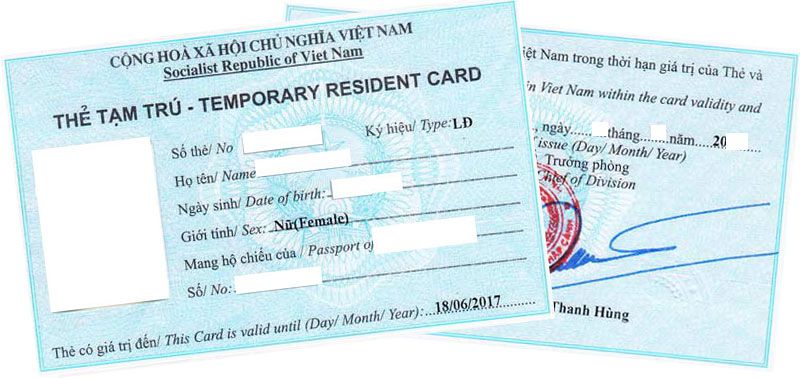
Picture: Temporary Resident Card
6. Reporting on the utilization of foreign employees
When employing foreign workers, companies must take note of and comply with the obligation to report the use of foreign workers to the competent Department of Labor, Invalids and Social Affairs in two instances, as follows:
Semi-annual report: Before July 5th of each year, covering the data of the first 6 months of the year. The reporting period runs from December 15 of the previous year to June 14 of the reporting year.
Annual Report: Before January 5 of the following year, covering data for the entire year. The reporting period runs from December 15 of the previous year to December 14 of the year under review.
The reporting template follows Form No. 07/PLI Appendix I, issued together with Decree No. 152/2020/ND-CP.
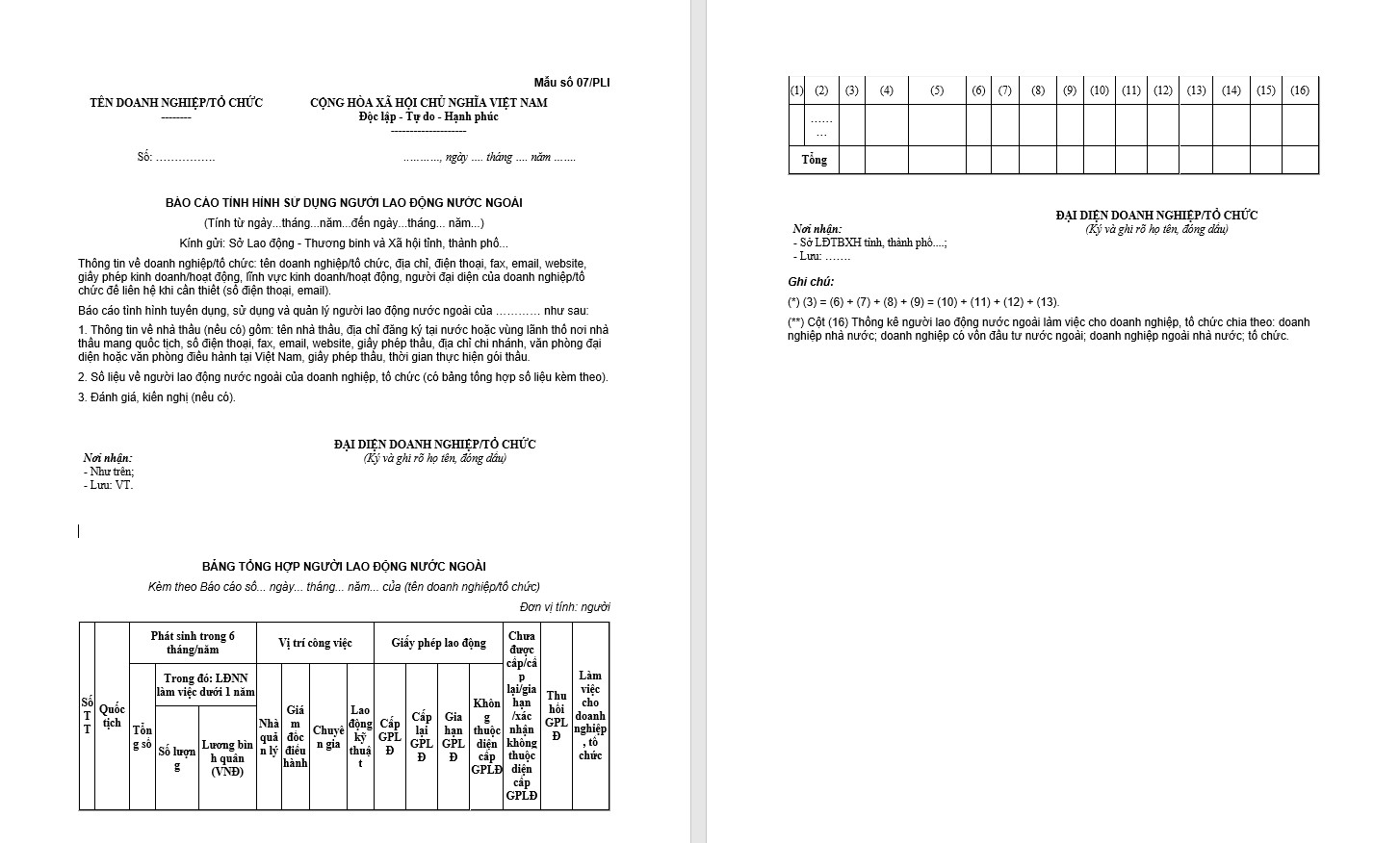
Picture: Template Reporting on the utilization of foreign employees


