


The Annual General Meeting of Shareholders (AGM) is held every year in accordance with the law to ensure the right to participate in governance and supervision of shareholders, especially minority shareholders. In addition to the annual meetings, the General Meeting of Shareholders may hold extraordinary meetings when needs arise during the operation of the enterprise. These meetings play a central role in the adoption of important decisions, directly impacting the company's development direction, organizational structure, and business activities. However, not all resolutions passed at the General Meeting of Shareholders are automatically legally effective. Some serious errors can lead to the risk of the resolution being requested to be canceled.
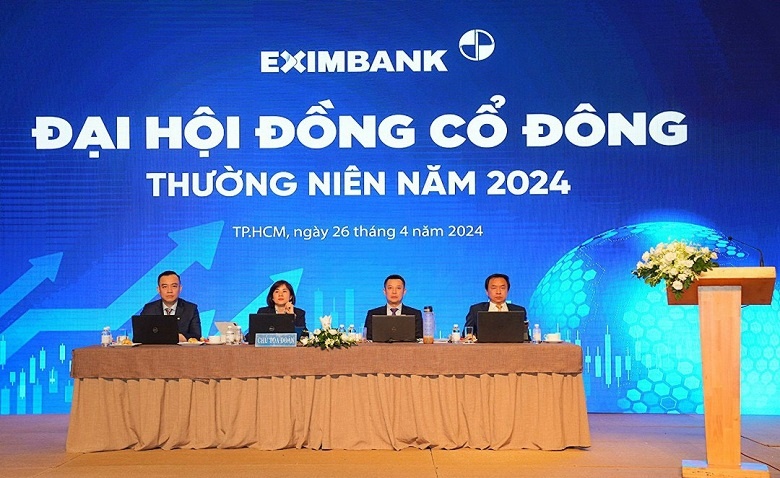
The Presidium of the 2024 Annual General Meeting of Shareholders of Eximbank. Source: Thời báo Ngân hàng
Failure to resolve shareholders' petitions on the content of the General Meeting of Shareholders
In fact, any violation related to the form or content may lead to the cancellation of the resolution of the General Meeting of Shareholders, unless the resolution is passed with 100% of the total voting shares.[1] Typically, in the Appellate Decision No. 57/2021/VKDTM-PT, the People's [2]Court of Hanoi City held that the request to cancel the Resolution of the General Meeting of Shareholders of the plaintiff (Mr. Nguyen Ngoc P - shareholder of MHD Company) was grounded when determining that the defendant (MHD Company) had violated the order when conducting the meeting and part of the content violated the law on real business. movable property.
Previously, Mr. Nguyen Ngoc P sent a petition to the Chairman of the Board of Directors on the content of the General Meeting of Shareholders 03 days before the date of the meeting. However, in the face of legitimate requests, the meeting was still continued and did not have any additional content as previously proposed. At the same time, only on 30/12/2019 (i.e. 3 days after the General Meeting of Shareholders took place) will the Company have a written reply to the petition. Meanwhile, in Clauses 3 and 4, Article 142 of the Law on Enterprises 2020, the convener of the General Meeting of Shareholders is required to approve or reject the proposal within at least 02 working days before the date of the meeting. Therefore, this is considered a violation of the corporate law, leading to the content of the previously passed Resolution not being objective, causing damage to the legitimate interests of shareholders.
Don't send meeting invitation notifications and meeting-related information
In addition, one of the basic mistakes is the failure to send an invitation letter to the General Meeting of Shareholders in time, affecting the right of shareholders to attend. According to the current law, the notice of invitation to the meeting must be sent at least 21 days before the time of the meeting.[3] This is the minimum statutory timeline to create conditions and opportunities for shareholders to study the meeting agenda and accompanying documents in advance. In fact, the charter of some companies may provide for an earlier time, whereby the convener is obliged to prepare and send a notice in accordance with the requirements set forth in the company's charter.
In the commercial business judgment No. 126/2022/KDTM-PT[4] on the request to cancel the resolution of the General Meeting of Shareholders between 2 shareholders (Ms. T and Ms. TH) and D6 Joint Stock Company, this error occurred. In this case, when considering the order and procedures for convening the meeting, the court of first instance judged that the "Bill of Lading with many posts" dated 28/10/2020 provided by the representative of D6 Joint Stock Company did not show the documents that the convener of the extraordinary general meeting of shareholders sent to Ms. T and Ms. TH." Similarly, the appellate court also took a concurring opinion on the previous decision. Therefore, the representatives of Ms. T and Ms. TH argued that Ms. T and Ms. TH did not receive the documents used for the meeting as grounded. In addition, the time when shareholders receive information about the General Meeting of Shareholders is later than the fixed time of the meeting.
It can be seen that, although D6 Joint Stock Company has appealed for reconsideration, the fundamental violation of the Enterprise Law is still the basis for the appellate court to uphold the decision to cancel the resolution in the first-instance judgment.
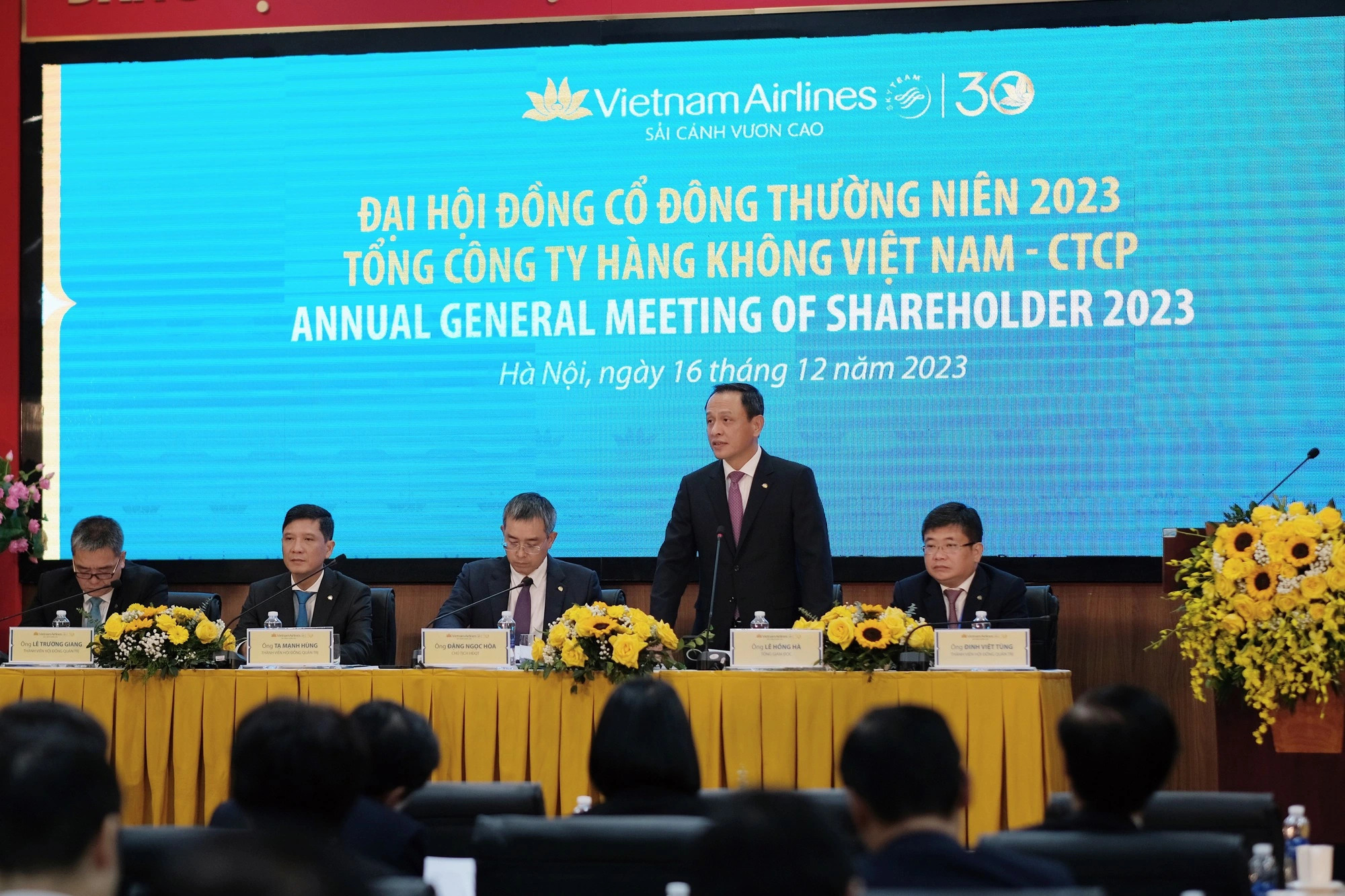
The Vietnam Airlines Board of Directors presided over the 2023 Annual General Meeting of Shareholders. Source: Thanh nien Newspaper
Violation of conditions for conducting the General Meeting of Shareholders
According to Article 145 of the Law on Enterprises 2020 (amended and supplemented in 2025), the conduct of the General Meeting of Shareholders must meet the number of shareholders attending the meeting representing more than 50% of the total votes. The Company reserves the right to request a higher specific rate on the basis of the issued Charter. At that time, in case this condition is not met, the company must conduct a notice of invitation to the second meeting. The continuation of the first meeting will not ensure the right to participate and vote. Thereby, the Resolution passed will not reflect the will of the company's existing shareholders and may be canceled according to the decision of the Court and Arbitration if there is a request from the company's own shareholders.[5] In particular, the law has introduced a protection mechanism for shareholders or groups of small shareholders. In particular, these subjects only need to own 5% or more of the total ordinary shares or other smaller proportions if the Charter stipulates that they will have the right to request cancellation when they consider that their rights are infringed.
Errors in determining the number of voting shares of shareholders
In order to meet the organization of the General Meeting of Shareholders in accordance with current laws, enterprises need to ensure the correct determination of the number of voting shares of shareholders before conducting the meeting. In addition, it also ensures fairness and objectivity for the interests of shareholders holding shares. However, the determination of voting shares in some complicated cases easily leads to inaccuracies.
Specifically, in the first-instance commercial business judgment No. 01/2024/QDST-KDTM[6], Mr. T is a shareholder of Son Dong Trading Joint Stock Company owning 31.7%, of which 20% of the charter capital is transferred to the State through auction. At the Extraordinary General Meeting of Shareholders, Mr. T authorized his wife, Ms. V, to participate. However, at the time of the meeting, the organizers said that she was only allowed to represent 20% of the State's charter capital instead of 31.7%. After that, the meeting was still held and the resolution was passed with many important contents. In the appellate decision, the Court ruled that 20% of the charter capital is still held by Mr. T because there is no judgment or decision of the state agency canceling the auction result until the date of the auction. At the same time, in the process of organizing the General Meeting of Shareholders, there were many violations of the provisions of the Law on Enterprises, especially violations of the conditions for conducting meetings when only shareholders representing 15.6% of the charter capital attended. Therefore, the resolution passed at the General Meeting of Shareholders was annulled according to the court's decision.
The practice of judgments and decisions shows that, unless the resolution of the General Meeting of Shareholders is approved with 100% of the total number of legal voting shares, the canceled common cases do not meet the requirements on conditions, order and procedures from the convening stage to the passage of the resolution. A small number of cases stemming from the content of the resolution still violate the provisions of the law. Therefore, in order for the resolution of the General Meeting of Shareholders to be approved and avoid the situation of being requested to be canceled, the following notes can be considered:
Firstly, it is necessary to fully prepare the meeting invitation letter and relevant documents attached, necessary notes and send it to shareholders before the meeting date according to the time limit prescribed by law or the company's charter.
Secondly, consider and resolve shareholders' petitions in a timely and complete manner through written replies.
Thirdly, clearly determine the percentage of the total number of votes to attend, check the eligibility conditions when organizing the General Meeting of Shareholders.
Fourthly, there is a specialized department in charge of reviewing the content of the resolution of the General Meeting of Shareholders, ensuring that the content of this document is not contrary to current legal regulations. In addition, the passage of the resolution of the General Meeting of Shareholders must meet all conditions on the form of opinion collection and voting rate. And at the same time, it must notify shareholders within 15 days from the date of passing the resolution or posting it on the company's website in accordance with the requirements of the law.
Nguyen Viet Hung
HM&P Law Firm
[1] Clause 2, Article 152 of the Law on Enterprises 2020 (amended and supplemented in 2025).
[2] Decision on settlement of commercial business No. 57/2021/VKDT-PT dated April 6, 2021 of the People's Court of Hanoi, see more at https://congbobanan.toaan.gov.vn/2ta689901t1cvn/chi-tiet-ban-an.
[3] Article 143 of the Law on Enterprises 2020 (amended and supplemented in 2025).
[4] Decision on settlement of commercial business No. 126/2022/KDTM-PT dated 22/03/2022 of the People's Court of Ho Chi Minh City, https://congbobanan.toaan.gov.vn/2ta1061819t1cvn/chi-tiet-ban-an.
[5] Article 151 of the Law on Enterprises 2020 (amended and supplemented in 2025).
[6] Decision on settlement of commercial business No. 126/2022/KDTM-PT dated August 15, 2024 of the People's Court of Son Dong district, https://congbobanan.toaan.gov.vn/0tat1cvn/ban-an-quyet-dinh


