


The 2005 Commercial Law was expected to be a "framework law" regulating commercial relations in the market economy, but the practice of more than two decades has shown that the role of the "central law" of this law has been significantly reduced. The reason does not lie in a specific provision, but the sum of many different factors such as the wide scope of regulation, the overlap between regulations, and the emergence of new specialized legal frameworks, has faded into obscuring a law that should have played the most important role in the nation's commerce.

A version of the Commercial Law that "promotes its role" does not have to be longer, but must be clearer.
Position of Commercial Law in the business legal system
The Commercial Law 2005, effective from January 1, 2006, stipulates "commercial activities" with a very broad definition: activities for the purpose of profit, including the purchase and sale of goods, provision of services, investment, trade promotion and other lucrative activities. The inclusion of investment activities in the definition of trade when the Law on Investment has established a central mechanism for the management of prohibited industries/conditions and investment procedures, this definition becomes an intersection point that is easy to interfere with related activities.
The Commercial Law also designs its own "interconnection mechanism" with other laws: specific commercial activities that have been prescribed by other laws shall apply such laws; commercial activities not specified in the Commercial Law and in other laws, the Civil Code shall apply. This mechanism helps to avoid the "adjustment gap", but at the same time creates a consequence: as the number of specialized laws increases, the "core" of the Commercial Law shrinks; and as the Civil Code reinforces the "common law" role of contracts, the Commercial Law is more susceptible to being pushed into a complementary role, lacking the necessity of a statute that regulates business activities.
When looking at the actual operation of enterprises, the Commercial Law is often not the first choice to "lay the foundation" for legal decision-making: registering business conditions to the Law on Investment, the Law on Enterprises; when signing and handling contracts based on the Civil Code; handle counterfeit goods and trade frauds, and re-examine sanctioning decrees and specialized documents. That fragmentation puts the Commercial Law at risk of becoming a "background law" in terms of symbolism but a "secondary law" in terms of operation.
The recent policy context also shows that the Commercial Law is facing two major pulls. Firstly, institutional reform aims to reduce overlap and improve the consistency and transparency of business law. Secondly, the organizational reform of Vietnam's administrative apparatus along with decentralization and decentralization give rise to the need to adjust authority and procedures in industrial and commercial fields such as fairs and trade exhibitions[1].
The role of Commercial Law in practice
The reasons can be attributed to four systemic "clusters of problems", which simultaneously reflect both the design of the law and the way the legal system has developed and differentiated after 2005.
First, there is the overlap in the regulations on commercial activities
The focal point for managing prohibited industries/business conditions is recorded in many different laws and decrees that weaken the centrality of the Commercial Law. The Commercial Law still maintains the mechanism of the list of goods/services banned from trading, restricted from business and conditional business. Meanwhile, the Law on Investment establishes a clear principle: if there are different provisions between the Law on Investment and other laws promulgated in advance on industries and trades banned from business investment or conditional, the Law on Investment shall apply; and require the names of industries in other laws to be consistent with the Law on Investment. In terms of legislative techniques, the parallel existence of two "catalogue languages" increases the cost of searches and legal risks, making it difficult for the Commercial Law to play the role of a "gateway" to the commercial regulatory system.
The second is the inherent inconsistency and overlap with the Civil Code
The Commercial Law establishes a separate sanctions system and stipulates that the ceiling of fines for violations does not exceed 8% of the value of the breached obligation, and at the same time stipulates the relationship between fines for violations and compensation for damages. Meanwhile, the Civil Code stipulates penalties for violations in the direction of respecting the agreement, "unless otherwise provided for by relevant laws", and the contract interpretation system is designed as a "general framework" that applies broadly. The phase difference in the penalty ceiling is a practical reason why many commercial contracts and related disputes "hesitate" to choose the governing law, especially when businesses prioritize reducing litigation risks.
The third is the "update delay" before the shift in market structure and management model
This "delay" is clearly and especially manifested in two points: state monopoly and decentralization and decentralization. The Commercial Law still recognizes the mechanism for the State to exercise a definite state monopoly on a number of goods, services or localities. Meanwhile, the policy of improving the market economy institution emphasizes fair competition, transparency, and the competition legal system has developed strongly after 2005. When the "management mindset" changes, some old regulations become anchor points that are no longer relevant, making the Commercial Law both difficult to apply in a positive sense and difficult to implement in a management sense.
In addition, when the authority and procedures are restructured by organizational documents, the Commercial Law, if not "synchronously adjusted", can easily become a source of regulations that no longer match the actual operating mechanism in the locality.
The fourth is the "adjustment drop point" of counterfeit goods and digital trade outside the Commercial Law
This is the point where this law loses its leading role. The Commercial Law refers to the sale of counterfeit goods in the group of violations of the commercial law, but the law itself does not define "counterfeit goods", while the law under the law defines it very specifically. Decree 98/2020/ND-CP defines "counterfeit goods" according to a detailed structure such as counterfeit in terms of use/utility value; falsification of quality/quantitative indicators; forging labels/packaging; fake label stamps, etc., and technical thresholds are directly used for sanctioning.
As a result, in enforcement, the agency inspecting and handling enterprises that violate the regulations on counterfeit goods often only applies the Decree more than to the law.
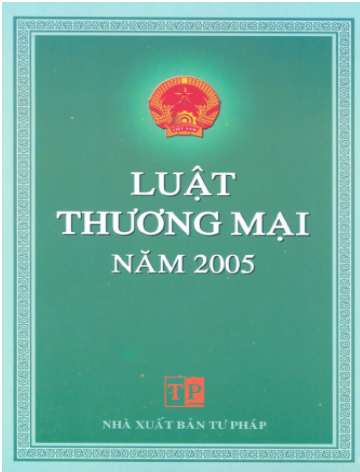
Source: Vietbooks
International lessons and suggestions for Vietnam
International experience shows that a "commercial law" that plays a good role often does not try to cover every issue with detailed lists and procedures; instead, it focuses on (i) foundational principles; (ii) core institutions and concepts; (iii) the mechanism of interconnection is consistent with the general law and specialized law.
Firstly, in digital commerce, UNCITRAL's international standard approach is to develop "technology-neutral principles" and "functional equivalence"[2] to ensure that electronic transactions have the same effect as traditional papers. With transfer documents and logistics, UNCITRAL has also developed a framework for "electronic transfer records" to address the problem of "possession/control" in the digital environment. This is an important suggestion for Vietnam: if the Commercial Law wants to be repositioned as a "framework law", it needs to contain the basic principles and concepts for digital trade, rather than letting the entire technological and commercial activities "fall under the law" or be governed by other specialized laws.
Second, in the U.S. common law tradition, the Uniform Commercial Code focuses on regulating core commercial transactions such as the purchase and sale of goods in a way that "synchronizes" the concept and scope in a unified framework, limiting the situation that a transaction has to look up many discrete categories. The lesson here is not in copying the model, but in the commercial law mindset that must help reduce legal costs, increase predictability, and avoid creating two parallel "categories".
Thirdly, in terms of legislative techniques, many successful legal systems maintain a clear assignment: the general law on contracts serves as the basis for all transactions; the commercial law only supplements the specific part of traders and market institutions, avoiding overlap on the same regulatory floor. This is the "difficult point" of the current Vietnamese Commercial Law when it wants to be a law framework, which both carries many detailed operational contents, and stands next to the Civil Code, which has been quite complete over many years of implementation.
Policy recommendations
A version of the Commercial Law that "promotes its role" does not have to be longer, but must be clearer. To reduce overlap, increase transparency and applicability, the Commercial Law needs to be adapted to a new, more modern and practical approach.
The "repositioning" of the Commercial Law as a framework law on market structure and commercial transactions, and at the same time "cutting" the parts that already have stable focal points. Regarding the list of prohibited industries/conditions, the logical option is to amend the Commercial Law according to the guidance of invoking and complying with the uniform mechanism in the Law on Investment, instead of maintaining the current status of two lists. This approach not only reduces the compliance costs of enterprises but also in the spirit of prioritizing the application of the Investment Law when there is a conflict.
In addition, the legislature also needs to clarify the relationship between the Commercial Law and the Civil Code according to a definitive policy choice. There are two directions: (1) keeping the provisions on sanctions and dispute resolution in the Commercial Law but reviewing to be consistent with the Civil Code on applicable terminology, structure and logic; or (2) narrow the contracts and sanctions of the Commercial Law to the level of principles, so that the Civil Code plays the role of "general contract", while the specifics of the industry/type of contract are assigned to specialized laws. Whichever direction you choose, it is necessary to solve the most obvious "noise point", which is the ceiling of 8% violation in the Commercial Law compared to the principle of agreement in the Civil Code; Because if not handled, the policy will continue to create "strategic choices" in the proceedings.
In addition, the Commercial Law also needs to "legalize" a number of foundational concepts that have a large market impact such as regulations on counterfeit goods. State agencies have also set out a plan to introduce the concept of counterfeit goods into the Commercial Law in the direction of listing or regulating the framework and assigning the Government to guide. In terms of legislation, the enumeration option can help increase clarity immediately, but it is necessary to design a "compatibility" clause to avoid conflicts with specialized laws such as the Law on Pharmacy, the Law on Intellectual Property, etc.
The 2005 Commercial Law is not "weak" because of the lack of provisions, but because the business legal system has developed in the direction of fragmentation: the focal point of business conditions focuses on the Investment Law; mature contract framework in the Civil Code; hot issues such as counterfeit goods and digital commerce operate mainly by specialized decrees and laws. If the amendment to the Commercial Law is considered as an opportunity to reposition, the focus should not be on "supplementing" but "clarifying its role" in the Vietnamese legal system, the elimination of overlapping areas with the Law on Investment; unifying the sanctioning logic with the Civil Code; legislation of the basic concept of such as counterfeit goods; and the inclusion of framework principles for digital trade based on international standards is very necessary and must be done immediately.
Lawyer Nguyen Van Phuc
HM&P Law Firm
[1] https://vibonline.com.vn/du_thao/du-thao-luat-sua-doi-cac-luat-thuong-mai-canh-tranh-quan-ly-ngoai-thuong-va-bao-ve-nguoi-tieu-dung, accessed on 2026/03/26.
[2] https://uncitral.un.org/en/texts/ecommerce/modellaw/electronic_commerce, last accessed on 26/03/2026


