


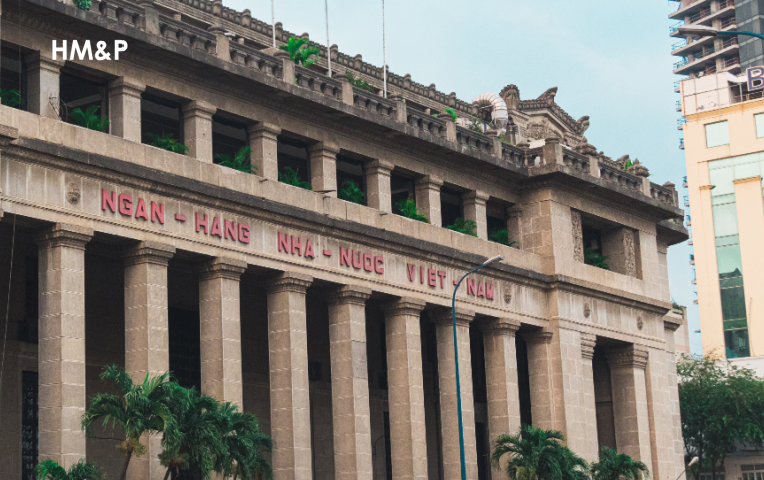
Recently, information about the "free takeover" of three banks, including Vietnam Construction Bank (CB Bank), Ocean Commercial Bank Limited (“OceanBank”), Global Petro Sole Member Limited Commercial Bank (GP Bank), and another specially controlled bank, Dong A Commercial Joint Stock Bank (DongA Bank), are in the process of being forced to transfer to four other commercial banks are of particular public interest. This process is a part of the scheme for restructuring the credit institutions in connection with the resolution of non-performing loans settlement in the period 2021 – 2025, which was approved by the Prime Minister on 8 June 2022 ("Scheme for Restructuring Credit Institutions").
In order to create a legal framework for the compulsory transfer, the State has issued a number of amended and adjusted legal documents for this process, most recently, the State Bank of Vietnam (“SBV”) has submitted to the State the promulgation of the Decree on amending and supplementing the Government's Decree No. 01/2014/ND-CP dated January 03, 2014, on foreign investors' purchase of shares of Vietnamese Credit Institutions ("Decree 01/2014/ND-CP"). It proposed to increase the total shareholding of foreign investors in the banks subject to compulsory transfer to more than 30% but not exceed 49%, of the charter capital of banks receiving the compulsory transfer (excluding commercial banks in which the State holds more than 50% of the charter capital).
So, what are the reasons leading to the SBV’s proposal to increase the "foreign room" of the bank receiving the compulsory transfer?
1. Supporting sources of funding for banks receiving the compulsory transfer
Although when participating in compulsory transfer plans for poorly performing commercial banks, transferee banks may enjoy certain benefits, such as the opportunity to expand the market network, the opportunity to reach new customers, or the opportunity for the State Bank to increase the credit room, which were desired by other banks. However, there are many challenges that these banks may face. After the transfer of poorly performing commercial banks, the transferee banks not only have to take on a huge amount of non-performing loans from poorly performing commercial banks, but also have to pay interest on deposits to customers who have deposited money. Lessons learned from the merger of Southern Commercial Joint Stock Bank (Southernbank) into Saigon Thuong Tin Commercial Joint Stock Bank ("Sacombank") were still new. At that time, a part of Sacombank's shareholders strongly opposed this merger option[1]. Up to now, this deal has slowed down Sacombank compared to the development momentum at that time[2].
Returning to the current situation, according to the information given by the representatives of Military Commercial Joint Stock Bank (MB) at the annual general meeting of shareholders of this bank in 2022, it may take about seven to eight years to fully settle all non-performing loans up to VND 20,000 billion of OceanBank[3]. This can be considered as a big challenge for this bank, which will affect the interest of shareholders. Therefore, increasing the total shareholding of foreign investors in banks receiving the compulsory transfer will help these access large sources of capital from foreign investors. According to the provisions of Point dd, Clause 1, Article 151e of the Law on Credit Institutions 2010, amended and supplemented in 2017, the transferee bank may sell and issue shares of the transferee bank to foreign investors in accordance with the approved compulsory transfer plan. However, at present, Decree 01/2014/ND-CP limits the total shareholding of foreign investors to no more than 30% of the charter capital of a Vietnamese commercial bank[4]. Therefore, the right to sell and issue shares to foreign investors is considered meaningless if the transferee bank has filled the "foreign room”. Thus, the SBV's proposal to increase the "foreign room" beyond 30% of the transferee bank’s charter capital helps to remove the bottleneck on the limit of foreign investors’ share ownership, thereby optimizing the rights of the transferee bank.
This regulation can help the transferee bank to access new capital, create resources to deal with the problems of the transferred bank as well as to take advantage of the management experience of international banks.
2. Use foreign investors’ resources for restructuring credit institutions
The SBV shall, in accordance with the policy on the restructuring of credit institutions, encourage and attract qualified domestic and foreign investors to participate in the restructuring of credit institutions[5]. In addition to the advantage of abundant capital resources as mentioned in Section 1, the resources of foreign investors, including human resources, management capacity, and technology can be used. According to the SBV, the draft amendment to Decree 01/2014/ND-CP increases the total of shareholding of foreign investors in the bank receiving the compulsory transfer to more than 30% but will not exceed 49% of the charter capital of the banks receiving the compulsory transfer, but does not adjust ownership limits for individual investors, foreign organizations, or foreign strategic investors. This means that a foreign strategic investor can only own up to 20% of the charter capital of the transferee bank, allowing new investors to join the transferee bank. As mentioned above, the arrival of new investors will bring other resources to the bank, accelerate the process of restructuring poorly performing commercial banks, and help the transferred bank to quickly return to its original growth rate.
3. Why raise only the total shareholding of foreign investors?
In addition to the desire to attract new investors, one of the reasons for the SBV to raise only the total shareholding of foreign investors without raising the shareholding limit for each individual investor, foreign organization, or foreign strategic investor may be concerns about capital withdrawal by foreign investors. For a relatively immature banking system that is vulnerable to economic factors such as Vietnam, the fact that foreign investors with a large number of shares withdraw capital from banks, especially listed banks, may complicate banks' operations and affect national fiscal and monetary policies. Although there are regulations in place to restrict the transfer of shares of foreign strategic investors and foreign institutional investors for a certain period of time[6], however, bank restructuring is a long process, during which the dispersion of the foreign ownership shares helps somewhat to limit the possibility of adverse effects of foreign investors on the banking system.
In conclusion, the SBV's proposal to increase the total shareholding of foreign investors to more than 30% of the charter capital of the transferee bank is a step in line with the policy set out in the Scheme for Restructuring Credit Institutions, which provides practical support to transferee banks.It also avoids putting transferee banks in a "don’t trouble trouble till trouble troubles you". Simultaneously, this proposal also ensures the least impact on the banking system, in order to maintain the soundness and sustainability of the Vietnamese banking system.
[1]https://vietnamnet.vn/co-dong-sacombank-phan-doi-gay-gat-viec-sap-nhap-167167.html, accessing on 08/6/2023.
[2]https://vietnamfinance.vn/sacombank-gong-minh-truoc-ap-luc-no-xau-20161104021437774.htm, accessing on 08/6/2023.
[3]https://laodong.vn/tien-te-dau-tu/tgd-mb-mat-khoang-8-nam-de-xu-ly-het-20000-ti-no-xau-tu-ngan-hang-yeu-kem-1037751.ldo, accessing on 08/6/2023.
[4]Clause 5 Article 7 of Decree 01/2014/ND-CP.
[5]Clause 3, Article 1.I Decision approving the Scheme for restructuring the credit institutions.
[6]Clause 5, Clause 6, Article 14 of Decree 01/2014/ND-CP.


